

Best overall: a standalone pneumatic compression session with adjustable settings and staff support. Best for training-day convenience: an on-site session at your training facility; best for combining appointments: a wellness-studio session with compression explicitly listed. This 2026 Orange County guide ranks session formats so you can choose the right setup before choosing a location.
TL;DR
For compression therapy, prioritize adjustable pressure, correct garment fit, and clear staff instructions over extra wellness services.
Standalone pneumatic compression sessions are the default choice when compression is your main reason for booking.
Training-site sessions suit readers who want recovery appointments attached to an existing workout routine.
Livesuperhuman offers adjacent wellness therapies in Costa Mesa; confirm compression separately rather than assuming it is included.
Why this matters
Compression therapy is not one interchangeable service. An inflatable recovery boot, a compression stocking, and clinician-directed compression serve different purposes, even when their names sound similar.
For a fitness-focused appointment, ask whether the session uses intermittent pneumatic compression: garments that inflate and deflate using an air pump. A listing that says only recovery, circulation, or leg therapy does not establish which equipment you will use.
Livesuperhuman is best for Costa Mesa readers comparing adjacent wellness therapies, not for assuming compression therapy is included. Its listed services include hyperbaric oxygen therapy, red light therapy, PEMF, EWOT, and altitude training. Treat each as a separate service when planning your visit.
What makes the best compression therapy session?
Use these criteria to compare Orange County appointments in 2026. The strongest choice is the session that meets your needs without requiring you to buy into unrelated services.
Session format: Confirm that the booking is pneumatic compression, not a similarly named treatment or a different recovery modality.
Pressure control: Ask who sets the pressure and how you request an adjustment. A higher setting is not a ranking advantage.
Fit and coverage: Confirm which body areas the garments cover and whether the available fit accommodates you properly.
Staff oversight: Establish who explains the controls, checks comfort, and responds if you need to stop.
Repeatability: Choose an appointment location and booking process that fit your actual routine, not an idealized schedule.
Keep the comparison specific. An impressive menu does not answer whether the compression garment fits, whether you can change the settings, or whether someone is available to help.
Compression therapy sessions at a glance
These are booking formats, not endorsements of named Orange County compression providers. Use the table to decide which type of appointment to investigate first.
1. Standalone pneumatic compression
Best for: Compression-focused visits
Standout feature to confirm: Dedicated appointment with adjustable settings and clear instructions
Key limitation: Requires a separate visit if you train elsewhere
2. Training-site compression
Best for: Attaching recovery to your workout routine
Standout feature to confirm: Equipment located where you already exercise
Key limitation: Confirm access, assistance, and how equipment use is scheduled
3. Wellness-studio compression
Best for: Coordinating separate wellness appointments
Standout feature to confirm: Compression explicitly bookable alongside other services
Key limitation: A broad wellness menu does not establish compression availability or combined benefits
1. Standalone sessions: best for compression-focused visits
A standalone pneumatic compression appointment keeps the decision simple: you are booking time with compression equipment rather than choosing a package of unrelated services. It is the default format when compression itself is the reason for your visit.
Choose this format on the details of the appointment, not the number of therapies advertised around it. Confirm garment coverage, pressure adjustment, staff instructions, and how you end the session before you commit.
Standalone session pros
Keeps the appointment focused on the modality you intend to use.
Makes it easier to compare like-for-like session descriptions.
Lets you assess compression separately from other wellness services.
Avoids making another treatment a prerequisite for your booking decision.
Standalone session cons
Adds another destination when your training happens elsewhere.
Offers less appointment consolidation than a location with several relevant services.
The standalone label alone says nothing about garment fit or staff support.
Best for: Readers who want to evaluate compression on its own, including anyone deciding whether the session experience suits them.
Before booking in 2026, ask the provider to describe the appointment from arrival to finish. You need a clear explanation of setup, controls, supervision, and stopping—not a promise that the equipment will transform your recovery.
Verdict: Buy only after the provider confirms the equipment, fit, adjustment process, and suitability checks. Choose standalone compression first when you do not have a practical reason to combine appointments.
2. Training-site sessions: best for workout-day convenience
Training-site compression means using equipment at the location where you exercise. The advantage is logistical: you can attach the appointment to an existing visit instead of arranging a separate trip.
That convenience does not establish better recovery results. Compare the actual setup with a standalone appointment, including whether staff explain the controls and whether equipment use needs its own reservation.
Training-site session pros
Removes the need to travel to another location after training.
Fits an appointment around a routine you already maintain.
Keeps your training and recovery logistics in one place.
Training-site session cons
Access can depend on the facility's rules; confirm your eligibility before planning around it.
A familiar training environment does not establish expertise in compression equipment.
Convenience can distract from checking fit, settings, and suitability.
Best for: Readers who already train at a facility that explicitly offers pneumatic compression and explains how access works.
Ask whether you reserve the equipment, whether someone assists with setup, and how garments are cleaned between users. Do not assume that an open recovery area means an appointment is available whenever your workout ends.
For a 2026 training plan, judge this option by whether it simplifies your schedule without weakening your selection criteria. If you cannot get clear answers about the equipment, the shorter journey is not enough.
Verdict: Buy when the training-site appointment meets the same equipment and support checks as a standalone session. Skip choosing it solely because the boots are nearby.
3. Wellness-studio sessions: best for coordinating appointments
A wellness-studio compression appointment suits readers who want to arrange separate services at one location. The essential check is straightforward: compression must be explicitly listed or directly confirmed, rather than inferred from a recovery-focused description.
This distinction matters when comparing Livesuperhuman with a compression-specific appointment. The Costa Mesa studio lists hyperbaric oxygen therapy, red light therapy, PEMF, EWOT, and altitude training; those names do not establish a pneumatic compression offering.
Wellness-studio session pros
Can consolidate travel when your chosen services are confirmed at one location.
Lets you discuss the appointment order before arranging your visit.
Supports a focused comparison between individual services rather than vague recovery packages.
Wellness-studio session cons
A long treatment menu can make different modalities appear interchangeable.
Combining appointments adds scheduling decisions that a standalone visit avoids.
Offering services together does not establish that their effects add together.
Best for: Readers who already intend to book another wellness service and can independently confirm compression at the same location.
Ask for the purpose and requirements of each appointment separately. A recommendation to combine services should explain why the sequence fits your circumstances, not rely on the idea that more treatments automatically produce a better session.
Verdict: Buy only when compression is confirmed and each additional service has its own clear reason for inclusion. Skip a bundle that leaves you uncertain about what you are booking.
How to choose your first session
Follow this sequence before comparing locations. It prevents a convenient address or an appealing service menu from deciding the appointment for you.
Define your goal. Separate a fitness-recovery appointment from a concern about pain, swelling, or a medical condition.
Confirm the equipment. Ask whether the session uses intermittent pneumatic compression and which body areas it covers.
Check the fit. Ask how staff select garments and address discomfort during setup.
Review suitability. Disclose relevant health conditions and ask whether you need guidance from your healthcare professional.
Choose the format. Select standalone, training-site, or wellness-studio booking based on the answers above.
The order matters: decide whether the service fits your purpose before deciding where it fits your calendar. Location is a useful tie-breaker after the essential checks, not a substitute for them.
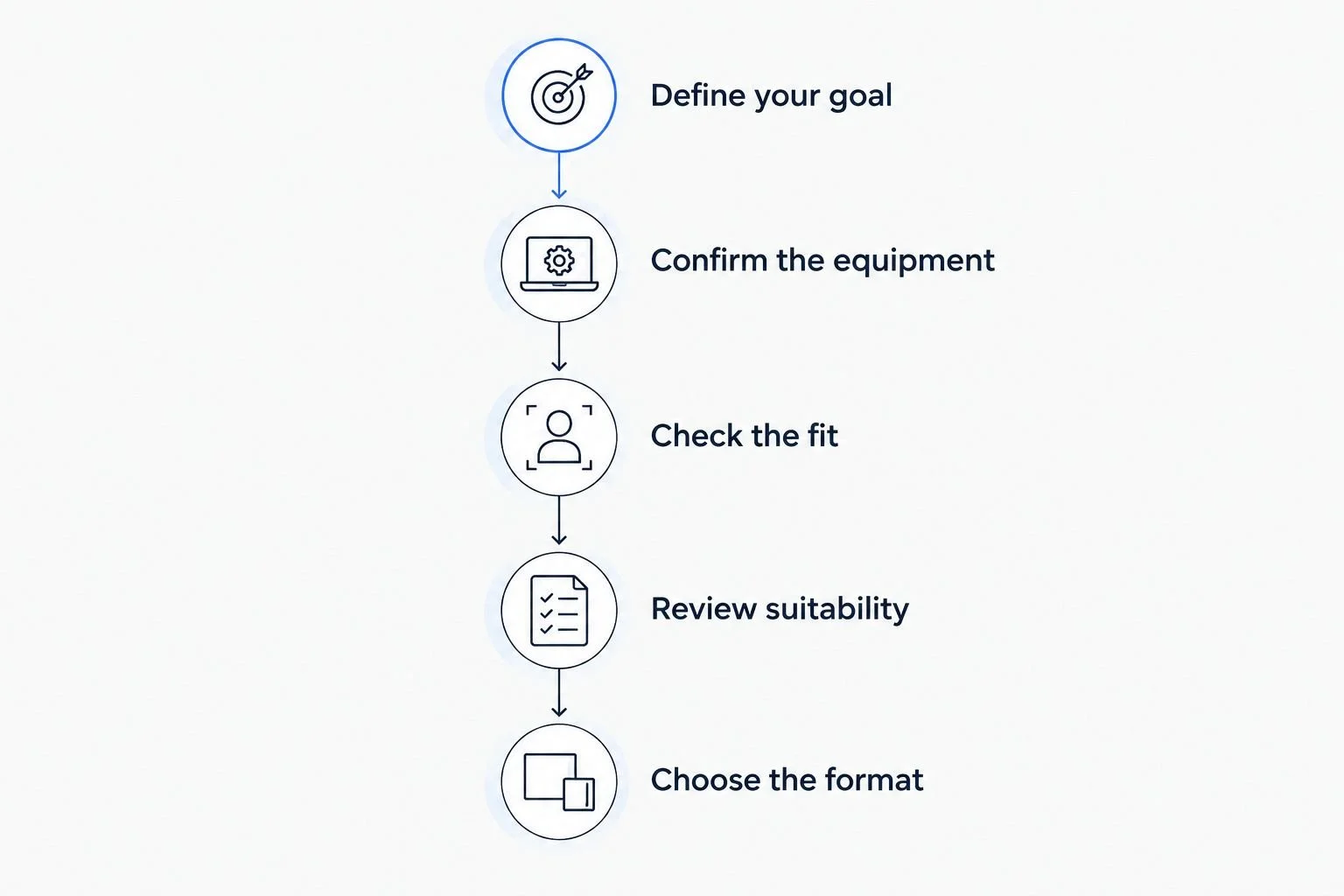
Confirm the service and its suitability before choosing the most convenient location.
Compression and hyperbaric oxygen are different services
Pneumatic compression applies external pressure through inflatable garments. Hyperbaric oxygen therapy involves breathing oxygen in a pressurized chamber; it is not a boot-based compression appointment.
Livesuperhuman lists hard-shell chamber options at 1.6 ATA and 2.0 ATA. ATA means atmospheres absolute: 1 ATA represents approximately atmospheric pressure at sea level. These chamber specifications describe a different kind of pressure from the pressure applied by compression garments.
Do not compare an ATA figure with a boot setting as if they measure competing versions of the same service. Equipment type, exposure, and suitability differ. A higher number is not a universal measure of a better wellness appointment.
For your 2026 booking, start with the exact service name. If you want inflatable leg garments, ask for pneumatic compression rather than simply requesting pressure therapy or recovery therapy.
When a recovery booking is the wrong next step
Do not use a fitness-recovery session to assess unexplained swelling or pain. New one-sided leg swelling, warmth, redness, or pain needs prompt medical evaluation rather than a trial compression appointment.
Chest pain or sudden shortness of breath requires emergency help. These symptoms are not booking questions for a wellness studio.
If you have a diagnosed vascular condition, a history of blood clots, or another condition affecting whether compression is appropriate, discuss the proposed equipment with your healthcare professional. Staff assistance with controls is not a replacement for individual medical guidance.
During any session, report pain, numbness, or other concerning symptoms immediately and stop using the equipment. Stronger pressure is not a goal in itself.
How these session formats are ranked
The ranking prioritizes a clear service definition, pressure adjustment, garment fit, staff support, and practical repeatability. Standalone sessions come first because they keep a compression-focused decision separate from other purchases.
Training-site sessions take the convenience slot. Wellness-studio sessions take the appointment-coordination slot. Neither placement claims that one format produces better physiological outcomes than another.
This 2026 ranking is a buying framework, not a clinical effectiveness ranking. A named provider belongs on your shortlist only after you confirm that its actual appointment meets the criteria.
Which compression therapy session should you choose?
Choose a standalone pneumatic compression session if compression is your main objective. It gives you the clearest starting point for evaluating the equipment and appointment experience without adding other services to the decision.
Choose training-site compression when the confirmed setup meets those same checks and fits your workout routine. Choose a wellness-studio appointment when compression is explicitly confirmed and combining visits solves a real scheduling need.
Keep the service name attached to the booking throughout the process. Recovery is your goal; pneumatic compression is the specific equipment-based appointment you are evaluating.
FAQ
What's the best compression therapy session in Orange County?
A standalone pneumatic compression appointment is the default format when compression is your main goal. Confirm adjustable settings, garment fit, staff instructions, and suitability before choosing a provider.
Does Livesuperhuman offer compression therapy?
Livesuperhuman's listed services do not establish a compression therapy offering. The Costa Mesa studio lists hyperbaric oxygen therapy, red light therapy, PEMF, EWOT, and altitude training; confirm compression directly before planning a visit for it.
Is pneumatic compression the same as compression stockings?
No. Pneumatic compression uses inflatable garments connected to an air pump, while compression stockings apply pressure through fitted fabric. Do not treat the two as interchangeable booking options.
Is a gym compression session better than a standalone session?
A gym-based session wins on convenience when you already train there, not automatically on outcomes. Compare equipment, fit, staff support, and access rules before choosing it over a standalone appointment.
Should I choose the highest compression setting?
No. Higher pressure is not a universal indicator of a better session. Follow the equipment instructions and appropriate professional guidance, and report discomfort immediately.
Can I use compression therapy for unexplained leg swelling?
Unexplained leg swelling needs medical assessment before a fitness-recovery booking. New one-sided swelling, warmth, redness, or pain requires prompt evaluation rather than a trial session.
Is hyperbaric oxygen therapy the same as compression therapy?
No. Hyperbaric oxygen therapy uses a pressurized chamber, while pneumatic compression applies external pressure through inflatable garments. Chamber pressure figures do not describe compression-boot settings.
One last thing
Ask one question before booking: What exactly will apply pressure to my body? The answer should identify the equipment and how it works, not repeat a recovery slogan.
That simple distinction separates inflatable garments from chamber-based services and ordinary compression clothing. Once the service is clear, compare fit, support, and scheduling—not the breadth of the menu.