

Best local altitude-training pick: Livesuperhuman in Costa Mesa. Best for protocol-specific IHHT: a provider that confirms hypoxic–hyperoxic cycles. Best for exercise-focused altitude work: a sports facility offering supervised hypoxic training. If you’re searching for “ihht therapy near me” in 2026, match the breathing protocol to your goal before choosing a nearby appointment.
TL;DR
Livesuperhuman offers altitude training in Costa Mesa; confirm the breathing protocol before booking it as IHHT.
IHHT alternates reduced-oxygen and oxygen-enriched breathing phases; altitude training does not automatically mean IHHT.
Choose protocol-specific providers for IHHT and exercise-focused facilities for training under reduced oxygen.
Ask about screening, monitoring, supervision, and stopping criteria before your first session.
Why this matters
IHHT, altitude training, and oxygen therapy describe different approaches. A provider can offer one without offering the others. The wrong label sends you to an appointment that does not match your search.
The best provider is the one that can explain the breathing protocol, screening process, and supervision—not the one with the longest wellness menu. Proximity matters after those questions have clear answers.
For a local starting point, Livesuperhuman offers bookable altitude training alongside hyperbaric oxygen therapy, red light therapy, PEMF, and EWOT. Treat those as distinct services, not interchangeable versions of IHHT.
What makes the best IHHT and altitude training provider?
Use these criteria to compare providers in 2026. A polished service name is not enough.
Protocol clarity: The provider explains whether you breathe reduced oxygen, enriched oxygen, or alternating combinations—and whether you exercise during the session.
Screening: Someone reviews your health history and suitability before you begin, rather than treating the booking form as clearance.
Monitoring: Staff explain what they monitor, who watches the readings, and what triggers a pause or stop.
Goal fit: The appointment matches your purpose: passive breathing intervals, exercise under reduced oxygen, or a broader wellness visit.
Practical fit: You understand the appointment structure, travel requirements, and how follow-up decisions are made before committing.
Ask each provider the same questions. That makes the answers comparable and prevents a familiar term such as altitude training from hiding a different service.
Best providers and provider types at a glance
This ranking separates one named Costa Mesa studio from two provider categories. The categories are search routes, not endorsements of unnamed businesses.
1
Provider or provider type: Livesuperhuman, Costa Mesa
Best for: Local altitude training within a broader wellness studio
Standout distinction: Bookable altitude training alongside other named wellness services
Key limitation: An altitude-training offering does not establish an IHHT protocol
2
Provider or provider type: A dedicated IHHT practice
Best for: Passive hypoxic–hyperoxic breathing intervals
Standout distinction: Explicit confirmation of reduced-oxygen and oxygen-enriched phases
Key limitation: The IHHT label alone does not establish screening or supervision quality
3
Provider or provider type: A sports-focused hypoxic training facility
Best for: Exercise performed under reduced oxygen
Standout distinction: Training format tied to an exercise task
Key limitation: Exercise-focused altitude work is not interchangeable with passive IHHT
The order reflects different appointment needs, not measured differences in outcomes. Choose the row that matches what you actually want to do.
1. Livesuperhuman: best for local altitude-training sessions
Livesuperhuman is a Costa Mesa wellness studio offering altitude training, EWOT, hyperbaric oxygen therapy, red light therapy, and PEMF. Its stated audience includes recovery- and performance-focused clients seeking bookable wellness sessions.
Livesuperhuman is the local pick for Costa Mesa readers seeking altitude training within a broader wellness studio. That recommendation applies to altitude training; it does not establish that the studio provides IHHT.
Where this option fits
Start here if your priority is a local altitude-training appointment and you want to explore other wellness services separately. Before booking, ask whether the altitude session involves passive breathing, exercise, or alternating oxygen concentrations.
Do not assume that having several oxygen-related services answers that question. EWOT, hyperbaric oxygen therapy, and altitude training describe different session formats.
Livesuperhuman pros:
A named Costa Mesa location gives local readers a concrete starting point.
Altitude training is explicitly included in the studio’s offering.
Other named wellness services support a broader appointment discussion without requiring you to confuse the modalities.
Livesuperhuman cons:
The stated altitude-training offering does not confirm hypoxic–hyperoxic intervals.
Readers specifically seeking IHHT need protocol confirmation before booking.
A Costa Mesa location is not the nearest choice for every reader searching locally.
Best for: Costa Mesa-area readers seeking altitude training and interested in a studio with several distinct wellness services.
Verdict: Buy only after the altitude-session format matches your goal; hold if IHHT confirmation is essential.
2. A dedicated IHHT practice: best for passive breathing intervals
A dedicated IHHT practice is the right provider category when your requirement is specifically intermittent hypoxic–hyperoxic training. IHHT alternates breathing phases with reduced oxygen and phases with oxygen above the normal ambient concentration.
The defining feature is the oxygen sequence—not a reclining chair, a mask, or a general promise about recovery. Ask the practice to describe both phases in plain language.
Where this option fits
Choose this search route when you want passive breathing intervals rather than a workout. Ask whether exercise forms any part of the proposed session instead of assuming that every practice uses the same format.
For a 2026 shortlist, require a clear explanation of how the protocol is selected and adjusted. A provider should distinguish its actual appointment from related terms used on its website.
Dedicated IHHT practice pros:
An explicitly described hypoxic–hyperoxic protocol matches the IHHT search directly.
A passive session format separates breathing intervals from exercise performance.
A protocol-specific conversation makes it easier to compare supervision and monitoring between practices.
Dedicated IHHT practice cons:
Using the IHHT name does not prove that screening or oversight meets your needs.
A passive breathing appointment does not replace sport-specific exercise training.
Finding the correct protocol can require looking beyond the closest general wellness studio.
Best for: Readers whose priority is a confirmed passive hypoxic–hyperoxic session rather than altitude training in general.
Verdict: Buy only after the practice confirms both oxygen phases, suitability screening, and active supervision.
3. A sports-focused hypoxic facility: best for exercise-based training
A sports-focused hypoxic training facility is the better category when you want to exercise under reduced-oxygen conditions. The relevant question is what training you perform and how the session fits your existing program.
This is a different decision from selecting passive IHHT. A facility offering reduced-oxygen cycling or treadmill work is not automatically offering hypoxic–hyperoxic breathing intervals.
Where this option fits
Choose this route when the exercise task matters as much as the breathing environment. Ask the facility to explain the workload, supervision, and criteria for changing or stopping the session.
Do not accept a generic performance claim as a substitute for a training plan. The provider should explain the purpose of the appointment without promising a specific result.
Sports-focused hypoxic facility pros:
Exercise is central to the session rather than an unrelated add-on.
A defined training task gives you something concrete to discuss with your coach.
The format can be evaluated against your existing exercise schedule.
Sports-focused hypoxic facility cons:
Exercise adds a workload that passive-session seekers are not looking for.
Reduced-oxygen exercise does not establish an IHHT service.
The session needs coordination with your wider training demands.
Best for: Exercisers seeking a supervised reduced-oxygen workout with a clearly explained training purpose.
Verdict: Buy for a defined exercise goal; skip when your requirement is passive IHHT.
IHHT versus altitude training: understand the difference
Normal dry air at sea level contains approximately 20.9% oxygen. Simulated-altitude systems can reduce the oxygen fraction you breathe without placing you in a pressurized chamber.
IHHT adds a different feature: alternating reduced-oxygen and oxygen-enriched breathing phases. Altitude training is a broader label and does not, by itself, confirm that alternation.
IHHT
Defining feature: Hypoxic–hyperoxic cycles
Useful distinction: Identifies the alternating breathing protocol
Limitation when choosing a provider: Does not establish the quality of supervision
Altitude training
Defining feature: Reduced oxygen
Useful distinction: Identifies a hypoxic training environment
Limitation when choosing a provider: Does not specify passive breathing, exercise, or hyperoxic phases
Hyperbaric oxygen therapy
Defining feature: Increased ambient pressure
Useful distinction: Separates chamber-based oxygen sessions from simulated altitude
Limitation when choosing a provider: Is not another name for IHHT
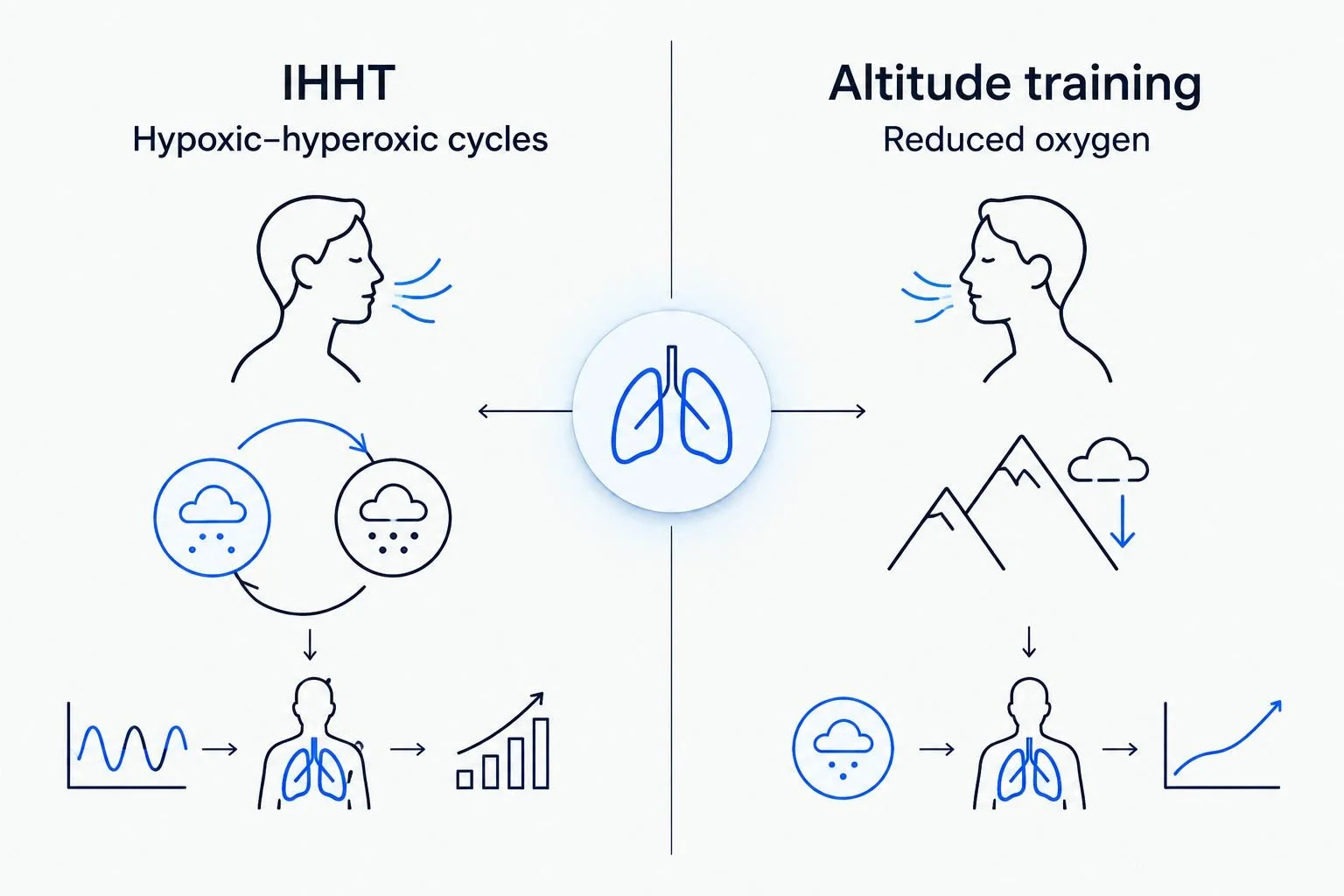
An altitude-training label does not confirm a hypoxic–hyperoxic protocol.
The brand’s stated hard-shell hyperbaric chamber options include 1.6 ATA and 2.0 ATA, where ATA means atmospheres absolute. Those figures describe chamber pressure; they do not identify an IHHT breathing sequence or establish a better option for your goal.
Keep pressure, oxygen concentration, and exercise workload separate when comparing services. They describe different parts of an appointment.
Questions to ask before your first appointment
Use this checklist when contacting a provider in 2026. Ask for explanations you can understand, not just equipment names.
Confirm the protocol
Ask: Does the session alternate reduced oxygen with oxygen-enriched air, or does it use a different sequence? Then ask whether you sit, recline, or exercise.
If your search is specifically for IHHT, the answer must describe both hypoxic and hyperoxic phases. A general answer about oxygen wellness leaves the main question unresolved.
Confirm the screening
Ask who reviews your health history and how suitability is decided. Disclose relevant conditions, medications, and previous difficulties with breathing equipment or exercise.
If you have a medical condition or uncertainty about suitability, seek advice from a qualified healthcare professional before booking. A wellness service description is not individual clearance.
Confirm the monitoring
Ask what staff monitor during the appointment and whether someone actively observes the session. Also ask what happens if you feel unwell or want to stop.
A useful answer explains actions, not just devices. Knowing that a monitor is present is different from knowing who responds to it.
Confirm the follow-up decision
Ask how the provider decides whether to repeat, adjust, or discontinue sessions. Keep your goal specific enough to discuss without relying on a broad promise of better health.
Avoid committing to a series before the first appointment’s format and suitability are clear. A package is not a substitute for a reason to continue.
How these options are ranked
The 2026 ranking prioritizes protocol clarity, screening, monitoring, goal fit, and practical access. The named local studio comes first for Costa Mesa altitude-training enquiries; the other entries address different service requirements.
This is a fit-based buying guide, not a clinical effectiveness ranking. No outcome comparison or claim that one provider produces better results underpins the order.
Which provider should you choose?
For Costa Mesa altitude training, start with the named local studio and confirm the appointment format. For IHHT specifically, choose a practice that explicitly describes hypoxic–hyperoxic intervals.
Choose a sports-focused facility only when exercise under reduced oxygen is your intended session. Do not let a shorter drive override a mismatch between the service and your goal.
Explore local altitude training
Review the Costa Mesa studio, then confirm which session format matches your goal.
FAQ
What should I look for when searching for ihht therapy near me?
Look for explicit confirmation of hypoxic–hyperoxic breathing intervals, suitability screening, and active supervision. A nearby altitude-training provider does not automatically offer IHHT.
Does Livesuperhuman offer IHHT in Costa Mesa?
Livesuperhuman lists altitude training among its Costa Mesa wellness services; that does not establish an IHHT protocol. Ask whether the session alternates reduced-oxygen and oxygen-enriched breathing phases before booking specifically for IHHT.
Is IHHT the same as altitude training?
No. IHHT specifies alternating hypoxic and hyperoxic breathing phases, while altitude training is a broader term for training involving reduced oxygen.
Is hyperbaric oxygen therapy the same as IHHT?
No. Hyperbaric oxygen therapy involves increased ambient pressure, while IHHT describes alternating oxygen concentrations during breathing phases. Do not use chamber pressure to identify an IHHT protocol.
Should I choose passive IHHT or exercise-based altitude training?
Choose according to the session you want: passive breathing intervals or exercise under reduced oxygen. Confirm the format and discuss suitability before booking either approach.
What should I ask about safety before an IHHT appointment?
Ask who reviews your health history, what staff monitor, and what triggers a pause or stop. Seek individual advice from a qualified healthcare professional if you have a medical condition or questions about suitability.
How do I compare local providers in 2026?
Ask every provider the same questions about protocol, screening, monitoring, supervision, and session format. Compare the answers before choosing on proximity alone.
One last thing
A mask tells you almost nothing about the protocol. Different breathing services can use similar-looking interfaces while changing oxygen concentration, exercise workload, or both.
Before your first appointment, ask the provider to describe the session without using the words altitude, recovery, or optimization. A clear explanation of what you breathe and what you do is more useful than the label.