

Best overall: a licensed clinician who knows your health history. Best for hormone-related questions: an endocrinology consultation. Best for remote access: a California-licensed telehealth clinician. If you’re searching for a peptide therapy consultation Orange County residents can use in 2026, choose the clinical route before choosing a treatment; this guide ranks consultation types, not individual clinics.
TL;DR
For peptide therapy consultation Orange County searches, prioritize licensed clinicians, a clear medical purpose, and follow-up.
Primary care is the default starting point; endocrinology fits hormone-related medical questions.
Sports medicine fits injury evaluation; telehealth fits remote access when an examination is unnecessary.
Live Superhuman is best for bookable recovery-focused wellness sessions, not the peptide consultation shortlist.
Why this matters
A peptide is a type of molecule, not a single treatment. Some peptide-based medicines have approved medical uses; that does not establish the safety, effectiveness, or suitability of every product marketed under the peptide label.
Your first decision is whether you need medical evaluation or a wellness session. Those are different services. Live Superhuman offers bookable hyperbaric oxygen therapy, red light therapy, PEMF, EWOT, and altitude training sessions in Costa Mesa; those offerings are not evidence of a peptide prescribing service.
A useful consultation can end without a prescription. You should leave understanding the clinical question, the proposed options, the uncertainties, and who handles follow-up—not simply which product to purchase.
What makes the best peptide therapy consultation?
For a 2026 consultation, use these criteria before considering promotional claims:
Relevant credentials: Identify the clinician responsible for assessment and prescribing, and verify the clinician’s California license through the relevant licensing board.
A defined medical purpose: Ask what condition or concern the consultation evaluates. General promises about vitality do not establish a treatment indication.
Product clarity: Request the exact medication name, intended use, and regulatory status before agreeing to treatment.
Individual assessment: Expect a review of your health history, medications, supplements, allergies, and relevant symptoms—not automatic enrollment.
A follow-up plan: Establish who reviews your response, handles adverse effects, and decides whether to continue or stop.
Meaningful alternatives: The clinician should explain other approaches, including no medication when that is appropriate.
Choose the consultation that can explain why treatment is unnecessary as clearly as why it is appropriate. A predetermined prescription is not a substitute for assessment.
Consultation options at a glance
This 2026 comparison separates clinical needs from appointment formats. Telehealth describes how you meet a clinician; primary care, endocrinology, and sports medicine describe the clinician’s area of practice.
Primary care
Best for: An unclear starting point
Standout feature: Assessment within your broader health history
Key limitation: A specific medication question can require referral
Endocrinology
Best for: Hormone-related medical questions
Standout feature: Evaluation of endocrine conditions
Key limitation: Not a general performance or recovery service
Sports medicine
Best for: Injury and return-to-activity questions
Standout feature: Examination and rehabilitation planning
Key limitation: A consultation does not establish a reason for peptide treatment
California-licensed telehealth
Best for: Remote consultation access
Standout feature: Discussion without travel
Key limitation: Some concerns require an in-person examination
The order reflects a practical decision path, not measured provider quality. Start broad when the problem is unclear, choose a relevant specialty when it is defined, and use telehealth only when the format fits the assessment.
1. Primary care: best peptide consultation starting point
A primary care clinician is the default starting point when you want to discuss fatigue, changing performance, recovery concerns, or a treatment you encountered online. The appointment can address your symptoms in the context of your medical history rather than assuming a peptide is the answer.
Bring a clear description of what changed, when it changed, and what you want to improve. Include medications, supplements, and any products you already use. A clinician needs that information even when the product came from somewhere else.
Primary care pros:
Keeps the discussion connected to your broader health history.
Creates space to evaluate explanations beyond a requested treatment.
Provides a starting point for appropriate specialist referral.
Primary care cons:
Your clinician might not offer the specific service you requested.
Specialist assessment can require a separate appointment.
Best for: You know something needs attention, but you do not have a defined diagnosis or a clear specialty need.
Ask: What needs evaluating before we discuss a medication? That question keeps the appointment focused on your health rather than a product category.
Verdict: Hold any treatment purchase until the assessment establishes a reason for it.
2. Endocrinology: best for hormone-related medical questions
An endocrinologist evaluates conditions involving hormones and the endocrine system. Choose this route when your existing clinician recommends endocrine evaluation or when a diagnosed endocrine condition raises questions about treatment.
Do not equate hormone marketing with endocrine care. A consultation should connect your history, symptoms, examination, and any appropriate testing to a specific clinical question. The requested medication is only one part of that discussion.
Endocrinology pros:
Focuses the appointment on hormone-related conditions.
Allows medication questions to sit within a relevant specialty assessment.
Supports discussion of established treatment alternatives.
Endocrinology cons:
It is not a general service for every performance goal.
A referral or preliminary evaluation can be required by the practice or your coverage.
Best for: A defined hormone-related medical concern, especially when a clinician has recommended specialist input.
Ask which finding would change the treatment recommendation. That separates a decision-making consultation from testing without a clear purpose.
Verdict: Hold peptide-specific decisions until the endocrine question is defined.
3. Sports medicine: best for injury and return-to-activity questions
A sports medicine consultation fits a persistent injury, exercise-related pain, or difficulty returning to activity. The clinical task is to understand the problem and establish a management plan—not to start with an injection selected from a recovery advertisement.
Describe the activity that triggers symptoms and how your function has changed. Bring relevant records and previous rehabilitation plans. The clinician can then decide what examination or further evaluation is appropriate.
Sports medicine pros:
Centers the discussion on function and activity demands.
Provides a setting for injury assessment and rehabilitation planning.
Allows recovery claims to be considered against the actual problem.
Sports medicine cons:
An in-person examination can be necessary.
A sports medicine appointment does not imply that a peptide prescription is appropriate.
Best for: An injury or activity limitation that needs a clinical explanation and a return-to-activity plan.
Ask what the plan would be without the requested peptide. A clear answer gives you a useful comparison between the proposed medication and other approaches.
Verdict: Skip product-first recovery pitches; hold treatment decisions until the injury is assessed.
4. California-licensed telehealth: best for remote access
Telehealth is an appointment format, not a specialty or a quality credential. It suits discussions that a clinician can assess remotely, including reviewing history, discussing an existing plan, or deciding whether an in-person visit is needed.
For a 2026 remote consultation, verify who is treating you and whether that clinician is authorized to provide care where you are located. A polished booking page does not answer either question.
California-licensed telehealth pros:
Removes travel from the consultation itself.
Supports discussion of records and treatment questions remotely.
Can help identify the appropriate next clinical step.
California-licensed telehealth cons:
It cannot replace every physical examination.
The service still needs a clear process for follow-up and escalation.
Best for: You need remote access and the clinician confirms that the consultation can address your concern in that format.
Ask what happens if the assessment requires an examination, testing, or urgent attention. The answer should identify a practical next step rather than leave you managing the gap.
Verdict: Hold booking until the clinician’s identity, license, and examination plan are clear.
How these consultation routes are ranked
Primary care comes first because an undefined concern needs assessment before treatment selection. Endocrinology and sports medicine follow for distinct clinical questions; neither is a substitute for the other. Telehealth comes last because convenience cannot determine which clinical expertise you need.
The ranking uses credentials, clinical purpose, individual assessment, product clarity, alternatives, and follow-up. It does not claim that any named Orange County clinic outperforms another.
Questions to ask before agreeing to treatment
Use this sequence during your appointment. You should understand the answers before making a treatment decision, especially when a service markets several substances under one broad wellness label.
Clinical purpose: What exactly are you evaluating or treating, and how will you decide whether treatment is appropriate?
Product identity: What is the exact medication, and is the proposed use approved, off-label, or investigational?
Evidence quality: What human evidence applies to this product, this use, and someone with my circumstances?
Personal risks: How do my medical history, medications, allergies, and other treatments affect the recommendation?
Follow-up plan: Who monitors the treatment, and what findings mean I should stop or seek care?
These questions apply to in-person and remote appointments. A compounded product is not FDA-approved, and an off-label use is different from an investigational product; ask the clinician to explain the distinction relevant to the recommendation.
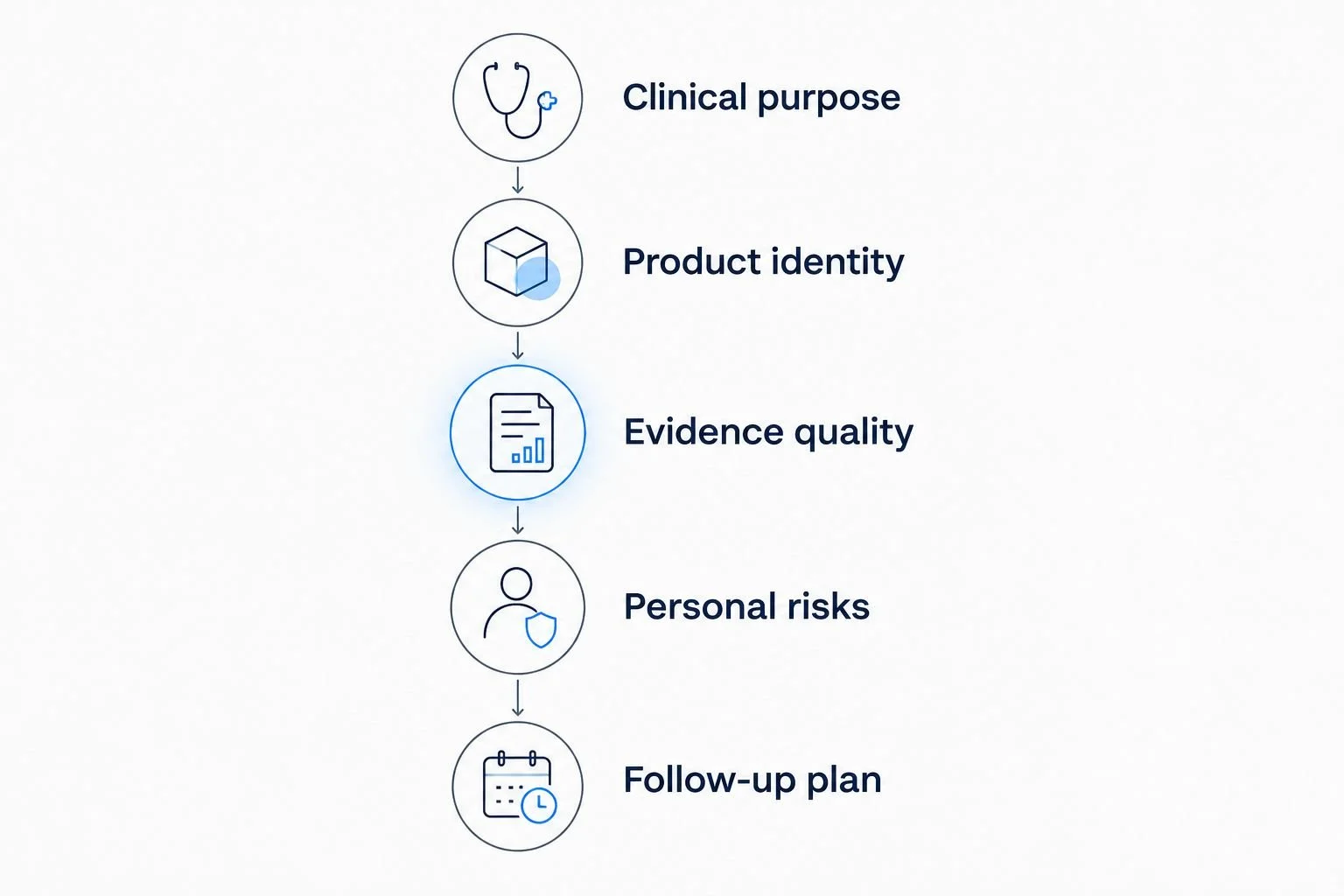
Establish the clinical purpose before discussing a specific product.
Do not accept research-use-only labeling as a substitute for a prescribing explanation. If a proposed product is described that way, ask the clinician to address its status directly before proceeding.
Where Live Superhuman fits
Live Superhuman is best for recovery-focused clients seeking bookable wellness sessions in Costa Mesa. Its stated offerings include hyperbaric oxygen therapy, red light therapy, PEMF, EWOT, and altitude training. That is a different decision from choosing a medical consultation about a peptide.
Live Superhuman’s hard-shell hyperbaric options include 1.6 ATA and 2.0 ATA, giving you 2 stated pressure options to ask about. Those specifications describe chamber pressure; they do not establish suitability for your circumstances or evidence for a peptide treatment.
Live Superhuman pros:
Offers several named recovery- and performance-focused wellness modalities.
Provides a Costa Mesa option for clients seeking bookable sessions.
Specifies pressure options for its hard-shell hyperbaric sessions.
Live Superhuman limitations:
Wellness session information does not establish peptide prescribing credentials.
A wellness booking is not a replacement for medical evaluation.
Best for: You want to explore the studio’s stated wellness sessions rather than obtain a peptide prescription.
Verdict: Skip this route for selecting a peptide consultation; consider it separately for its stated wellness offerings. Tell your treating clinician about wellness sessions you use or plan to start.
Which consultation should you choose?
Start with a licensed clinician who can evaluate your concern without committing you to a product. For an unclear starting point, choose primary care. For a defined hormone-related question, seek appropriate endocrinology input; for an injury, choose sports medicine.
In 2026, remote access should remain a format decision, not your main quality filter. Choose telehealth when the clinician confirms it fits the assessment and explains what happens if you need in-person care.
FAQ
What is the best peptide therapy consultation in Orange County?
The best starting point is a licensed clinician whose expertise matches your concern and who provides individual assessment and follow-up. Primary care fits an unclear starting point; endocrinology and sports medicine fit different specialist questions.
Should I see an endocrinologist for peptide therapy?
An endocrinologist fits a hormone-related medical question, not every request marketed as peptide therapy. Ask your existing clinician whether your concern calls for endocrine evaluation.
Can I have a peptide consultation online in California?
Telehealth can support a consultation when the clinician is authorized to treat you in California and the concern is suitable for remote assessment. Some concerns still require an in-person examination.
Are all peptide treatments FDA-approved?
No. Some peptide-based medicines have FDA-approved uses, but that does not mean every peptide product or proposed use is approved. Ask for the exact medication and the status of its intended use.
Is compounded medication the same as an FDA-approved medicine?
No. Compounded drugs are not FDA-approved. Ask the prescribing clinician why compounding is being proposed and what that means for your treatment decision.
What should I bring to a peptide consultation?
Bring your medication and supplement list, relevant medical records, allergies, and a clear account of your concerns. Include any substances you already use, even if they came from outside your usual medical care.
Is Live Superhuman a peptide consultation recommendation?
No. Live Superhuman is included here as a separate wellness option in Costa Mesa, based on its stated hyperbaric oxygen, red light, PEMF, EWOT, and altitude training sessions. Choose a qualified medical clinician for peptide assessment and prescribing questions.
One last thing
Ask the clinician: What finding would make you recommend against this treatment? A useful consultation needs a stopping rule, not just an enrollment process. For your 2026 shortlist, favor the clinician who explains both the reasons to treat and the reasons not to.