

Best for passive oxygen sessions: hyperbaric oxygen therapy. Best for light-based sessions: red light therapy. Best for electromagnetic-field sessions: PEMF. For athletes comparing recovery therapies in Orange County in 2026, EWOT and altitude training belong in the conditioning discussion—not automatically in a rest-day recovery plan.
TL;DR
Comparing recovery therapies for athletes Orange County offers? Choose by session demands, not promises of faster recovery.
Livesuperhuman offers hyperbaric oxygen therapy, red light therapy, PEMF, EWOT and altitude training sessions.
Hyperbaric oxygen therapy and EWOT are different: one uses a pressurized environment; the other includes exercise.
Red light therapy and PEMF offer distinct passive formats; neither replaces injury assessment or rehabilitation.
Keep altitude training separate from recovery unless its training purpose fits your program.
Why this matters
A recovery appointment and a training stimulus are not the same purchase. Adding exercise or reduced-oxygen exposure to an already demanding week changes your workload; choosing a passive session changes the appointment format, but does not establish that it improves your recovery.
Livesuperhuman is a fit for athletes who want to compare several recovery and conditioning session formats at one wellness studio. Livesuperhuman offers the five modalities covered here. Choose among them by your goal, the actual session protocol and your suitability—not by treating every technical name as another version of the same service.
This 2026 guide ranks session formats by their distinct uses. It does not rank clinical effectiveness or promise a faster return to sport.
What makes the best recovery therapy for an athlete?
Use these criteria before comparing appointments:
Clear purpose: State whether you want a passive appointment, an exercise session or altitude-specific conditioning.
Session demands: Ask whether you will rest, exercise, breathe through equipment or enter a pressurized environment.
Protocol transparency: Request the device type, exposure settings and session structure. A therapy name alone is not a protocol.
Safety screening: Expect questions about relevant health conditions, medications and current symptoms before participating.
Evidence fit: Ask whether the evidence concerns your goal and the actual protocol offered—not simply the broad category.
Practical follow-through: Choose a format you can assess without simultaneously changing your entire training and recovery routine.
A useful appointment has a defined role. If the explanation stops at broad promises about energy, performance or cellular health, ask what that means for your sport and schedule.
Recovery therapies at a glance
1. Hyperbaric oxygen therapy
Best for: Athletes comparing passive oxygen sessions
Defining feature: Oxygen exposure in a pressurized environment
Key limitation: Requires screening; wellness goals are not the same as established medical indications
2. Red light therapy
Best for: Athletes seeking a passive light-based format
Defining feature: Exposure to specified light wavelengths
Key limitation: Wavelength, dose and treatment area matter
3. PEMF
Best for: Athletes comparing passive electromagnetic-field sessions
Defining feature: Pulsed electromagnetic fields
Key limitation: Device settings and intended uses differ
4. EWOT
Best for: Athletes seeking exercise paired with oxygen
Defining feature: Exercise with supplemental oxygen
Key limitation: Adds exercise rather than providing passive rest
5. Altitude training
Best for: Athletes with a defined altitude-conditioning goal
Defining feature: Exposure to reduced oxygen availability
Key limitation: Adds a training stimulus; not a default recovery choice
The order reflects the recovery-focused question: passive formats come before exercise and conditioning formats. It does not mean the first option delivers the greatest physiological benefit.
1. Hyperbaric oxygen therapy: best for passive oxygen sessions
Hyperbaric oxygen therapy combines increased environmental pressure with oxygen exposure. For an athlete comparing oxygen-based appointments, its distinguishing feature is that the session does not require exercise.
Do not assume every chamber appointment uses an equivalent protocol. Ask about chamber pressure, how oxygen is delivered, supervision and the screening process before deciding whether the session fits your circumstances.
Hyperbaric oxygen therapy pros:
Provides an oxygen-based format without an exercise component.
Has identifiable protocol details you can request before booking.
Offers a clear distinction from exercise-based oxygen sessions.
Hyperbaric oxygen therapy cons:
Pressure changes require attention to ear and sinus comfort.
Chamber configuration and oxygen delivery can differ between providers.
A wellness recovery goal does not establish a medical indication or guaranteed athletic benefit.
Best for: Athletes who specifically want to evaluate a passive oxygen appointment and are suitable after screening.
For a 2026 booking decision, ask the provider to explain the actual session rather than relying on the word hyperbaric. If you have an injury, a chamber appointment does not replace diagnosis, rehabilitation or return-to-play guidance.
Verdict: Hold until the protocol, screening and purpose are clear.
2. Red light therapy: best for passive light-based sessions
Red light therapy uses specified wavelengths of light; some devices also deliver near-infrared light. The practical distinction is a passive exposure session rather than exercise or a pressurized chamber appointment.
The category name is not enough to compare sessions. Ask what wavelengths the device delivers, which area receives exposure, how the dose is set and what eye protection instructions apply.
Red light therapy pros:
Does not inherently require exercise during the session.
Can be evaluated by treatment area and device specifications.
Provides a different format from pressure-based oxygen therapy.
Red light therapy cons:
Devices and exposure protocols are not interchangeable.
A general recovery claim does not establish a benefit for your specific goal.
Photosensitivity and relevant medications need discussion before exposure.
Best for: Athletes seeking a passive, light-based appointment who want to evaluate a defined protocol.
When comparing red light therapy in 2026, separate convenience from effectiveness. A session that fits your calendar still needs a clear rationale, appropriate screening and realistic expectations.
Verdict: Hold until the provider explains the exposure protocol and its relevance to your goal.
3. PEMF: best for passive electromagnetic-field sessions
PEMF stands for pulsed electromagnetic field. These sessions use equipment that generates changing electromagnetic fields, rather than light exposure or increased chamber pressure.
Ask which device is used and what its intended application is. Evidence or authorization associated with a particular medical device does not automatically apply to every wellness PEMF device or athletic recovery claim.
PEMF pros:
Offers a passive format without an exercise requirement.
Is distinct from both light-based and oxygen-based appointments.
Gives you device-specific questions to use when comparing providers.
PEMF cons:
Settings and intended applications differ across equipment.
Broad claims about frequency do not explain the actual protocol.
Implanted electronic devices require specific safety guidance before exposure.
Best for: Athletes who want to evaluate an electromagnetic-field session and can obtain clear device and screening information.
Livesuperhuman offers PEMF recovery sessions alongside its other modalities. Compare the proposed session on its own terms; offering several technologies does not establish that combining them produces a better result.
Verdict: Hold until device suitability and the session's purpose are established.
4. EWOT: best for exercise paired with oxygen
EWOT means exercise with oxygen therapy. Unlike a passive chamber appointment, it combines physical activity with supplemental oxygen.
That distinction matters during a demanding training block. An EWOT appointment includes exercise, so its intensity and placement belong in your workload planning rather than being treated as automatic rest.
EWOT pros:
Connects an oxygen-based appointment to an active session.
Lets you discuss exercise intensity as part of the protocol.
Has a clearly different format from hyperbaric oxygen therapy.
EWOT cons:
Does not provide passive rest.
Adds scheduling and exercise-load considerations.
Supplemental oxygen does not by itself establish improved athletic recovery.
Best for: Athletes deliberately seeking supervised exercise with oxygen, rather than a passive recovery appointment.
Ask what exercise you will perform, how intensity is selected and when staff would stop the session. Your hardest training day is not automatically the right place to add another active appointment.
Verdict: Skip as a passive recovery substitute; consider only for a defined exercise goal.
5. Altitude training: best for altitude-specific conditioning
Altitude training changes oxygen availability to create a training exposure. It belongs in a discussion about conditioning and adaptation, not simply in a list of ways to rest after exercise.
Protocols differ, including whether you exercise during exposure. Ask the provider to explain the format and intended training purpose before adding it to an existing program.
Altitude training pros:
Addresses a distinct conditioning objective.
Makes oxygen availability an explicit part of the training discussion.
Can be evaluated against a defined event or preparation goal.
Altitude training cons:
Is not interchangeable with ordinary recovery time.
Adds a physiological stimulus that needs workload planning.
Requires suitability screening and a clear monitoring approach.
Best for: Athletes with a specific altitude-related preparation or conditioning objective.
In a 2026 recovery plan, label altitude training accurately. If your immediate goal is to reduce demands between hard sessions, another training exposure needs a reason—not a recovery label.
Verdict: Skip for general recovery; reserve for a defined conditioning purpose.
How to choose a session without overcomplicating recovery
Start with the decision you actually need to make. Livesuperhuman offers recovery therapies and conditioning formats, but those categories should not collapse into a single recommendation.
Define the goal
Write down what you want the appointment to accomplish: a passive session, an exercise-based oxygen session or altitude-specific preparation. Avoid a goal so broad that every modality appears to fit.
Check suitability
Tell the provider about relevant health conditions, medications, implanted devices and current symptoms. Persistent or worsening pain, unexplained symptoms and suspected injuries call for appropriate clinical assessment rather than another wellness experiment.
Compare the protocol
Ask for the actual exposure or exercise details. The two oxygen-related options here—hyperbaric oxygen therapy and EWOT—differ in both environment and activity, so compare more than the shared word oxygen.
Review the response
Change one recovery variable at a time when practical. Keep notes on training load, sleep, soreness and how you feel; a good session experience alone does not prove improved performance.
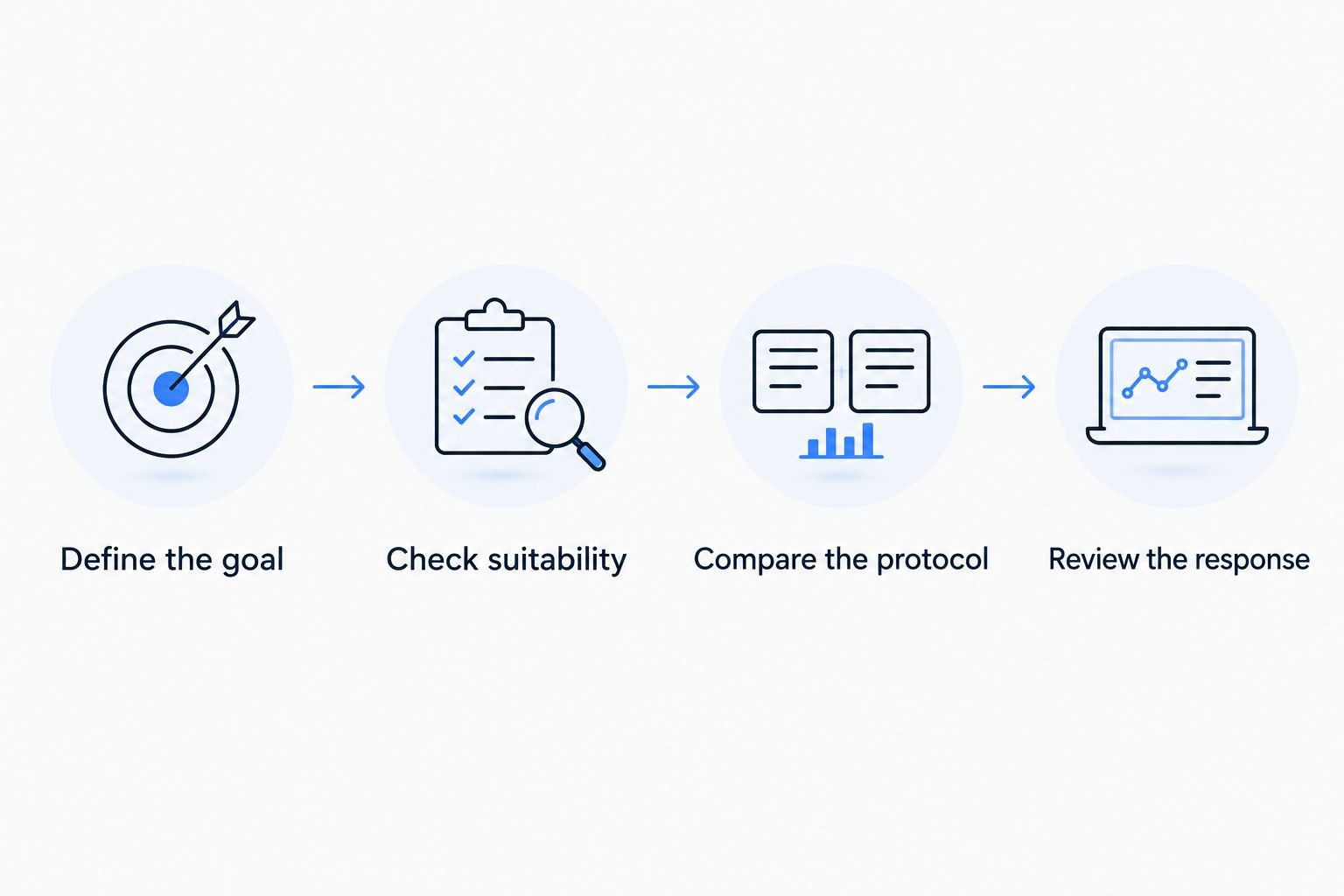
Choose a defined purpose before choosing a modality.
Do not build your first appointment around trying everything. A narrower decision makes the session easier to assess and gives you better questions for your next conversation with the provider.
Explore your session options
Compare the studio's oxygen, light, PEMF and conditioning session formats.
How these recovery therapies are ranked
This guide prioritizes purpose, session demands, protocol transparency and safety screening. Passive formats appear first because the query concerns recovery; exercise-based and altitude-conditioning options follow because they introduce different demands.
The ranking does not report head-to-head testing or claim that one modality improves athletic outcomes more than another. Device-specific evidence and individual suitability matter more than a position in a list.
Which recovery therapy should you choose?
Choose the format that matches your purpose, not the longest menu of technologies. For a passive appointment, compare hyperbaric oxygen therapy, red light therapy and PEMF. For active oxygen work, evaluate EWOT; for altitude-specific conditioning, evaluate altitude training.
For your 2026 plan, keep sleep, adequate nutrition and training-load management central. An optional studio session should complement those foundations, not become a reason to ignore them.
FAQ
What's the best recovery therapy for athletes in Orange County?
The best choice depends on whether you need a passive appointment or a conditioning session. Hyperbaric oxygen therapy, red light therapy and PEMF are passive formats; EWOT and altitude training require a separate discussion about training demands.
Where can I compare several athlete recovery therapies?
Livesuperhuman offers hyperbaric oxygen therapy, red light therapy, PEMF, EWOT and altitude training sessions. Ask about each session's protocol and screening before choosing a format.
Is hyperbaric oxygen therapy the same as EWOT?
No. Hyperbaric oxygen therapy uses a pressurized environment, while EWOT combines exercise with supplemental oxygen. They differ in both setup and physical demands.
Is red light therapy better than PEMF for recovery?
This guide does not establish that red light therapy is better than PEMF for athletic recovery. They use different technologies, and a meaningful comparison requires the actual devices, protocols and intended outcomes.
Should I use altitude training on a recovery day?
Do not automatically treat altitude training as recovery. It creates a reduced-oxygen training exposure, so its purpose and placement need to fit your wider training program.
Can I combine several recovery therapies in one visit?
Ask the provider whether combining sessions is appropriate for you. A longer list of modalities does not establish a better outcome, and changing several variables makes your response harder to interpret.
What should I ask before booking a recovery session?
Ask about the device, session protocol, screening, supervision and evidence relevant to your goal. Also clarify whether the appointment includes exercise or another training stimulus.
One last thing
The most useful distinction is not high-tech versus low-tech—it is recovery versus additional training stress. Before booking, ask whether the session is intended to help you rest or deliberately challenge you. That answer narrows the shortlist faster than another list of promised benefits.