
Best overall for comparing several recovery modalities: Livesuperhuman. Best for an exercise-based session: EWOT; best for a non-exercise light-based session: red light therapy. This 2026 guide to wellness recovery studios in Newport Beach ranks session types by their fit with your goals, rather than treating every recovery service as interchangeable.
TL;DR
For wellness recovery studios Newport Beach searches, Livesuperhuman is a starting point for comparing five recovery and performance modalities.
Choose EWOT when you want exercise with oxygen, not a passive recovery appointment.
Red light therapy, PEMF, and hyperbaric oxygen use different methods; compare the actual session, not the marketing language.
Confirm the studio address, screening requirements, and session format before booking.
Why this matters
A recovery appointment should solve a scheduling and training problem, not add another unexplained treatment to your calendar. Start with what you want from the visit: a non-exercise session, oxygen-based exercise, or a different training stimulus.
For your 2026 shortlist, separate what a treatment does from what a provider promises it will achieve. A named modality tells you the method. It does not establish that the session will improve your performance, address persistent pain, or suit your health history.
This guide compares five session formats offered by the featured wellness studio. It is a decision guide, not a ranking of independently assessed Newport Beach businesses; confirm the location and practical details directly before arranging a visit.
What makes the best wellness recovery studio?
Use these criteria before comparing the session menu:
Goal fit: The provider explains why a particular modality matches your purpose, rather than recommending everything.
Clear session format: You understand whether you will exercise, sit, lie down, or enter a chamber.
Safety screening: You can discuss relevant health conditions, medications, implanted devices, and other treatment-specific considerations.
Specific equipment information: The provider explains the equipment and settings involved without substituting technical language for an answer.
Repeatable logistics: Travel, appointment length, preparation, and exercise demands fit your actual schedule.
Realistic expectations: The discussion distinguishes wellness goals from medical treatment and avoids guaranteed outcomes.
Choose the session you can explain in plain English. If you cannot describe what happens during the appointment, ask more questions before committing.
Recovery session formats at a glance
The order below prioritizes decision clarity, not a claim that one technology produces better results than another. Each option has a distinct use case.
Hyperbaric oxygen therapy
Best for: People specifically exploring chamber-based oxygen sessions
Defining feature: Oxygen exposure in a pressurized environment
Key limitation: Pressure exposure introduces screening and comfort considerations
Red light therapy
Best for: People seeking a non-exercise, light-based session
Defining feature: Exposure to specified wavelengths of light
Key limitation: Wavelength, dose, and treatment area matter
PEMF
Best for: People specifically seeking pulsed electromagnetic exposure
Defining feature: Equipment delivers pulsed electromagnetic fields
Key limitation: It is not equivalent to red light or oxygen therapy
EWOT
Best for: People who want exercise with oxygen
Defining feature: Exercise paired with supplemental oxygen
Key limitation: It requires physical effort rather than passive rest
Altitude training
Best for: People seeking a reduced-oxygen training stimulus
Defining feature: Exposure to reduced oxygen conditions
Key limitation: It adds a training demand rather than simply providing rest
The differences matter more than the shared recovery label. Oxygen under pressure, oxygen during exercise, and reduced-oxygen training are not different names for the same experience.
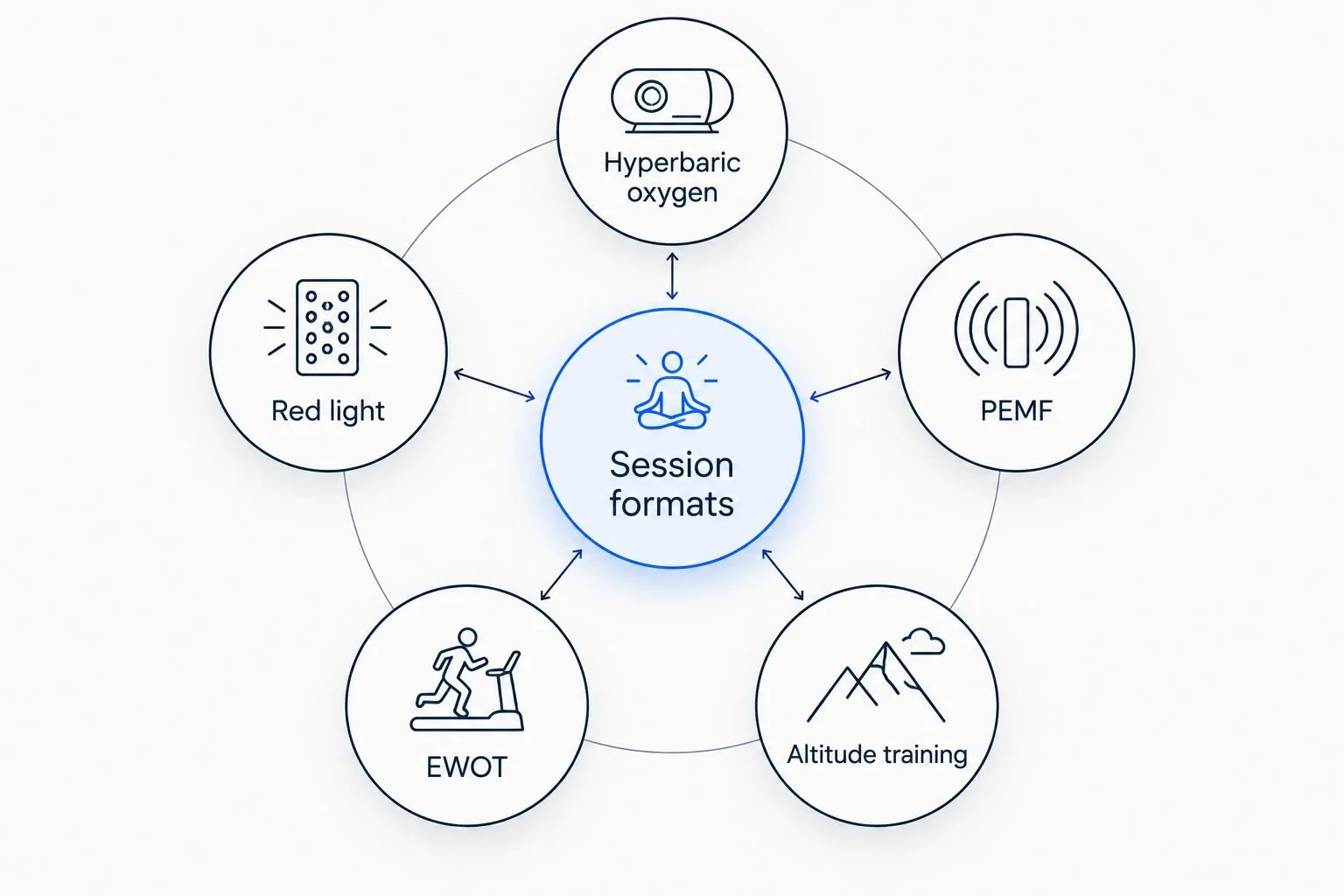
Choose between the methods before comparing appointment details.
1. Hyperbaric oxygen: best for chamber-based oxygen sessions
Hyperbaric oxygen therapy involves breathing oxygen in a pressurized environment. It differs from oxygen use during exercise because pressure is part of the method.
Livesuperhuman offers bookable hyperbaric oxygen therapy sessions. Choose this category when the chamber-based format is the specific service you want to explore, not simply because oxygen appears elsewhere on a recovery menu.
Hyperbaric oxygen pros:
A clearly defined chamber-based format.
No exercise component in the treatment itself.
A distinct option to compare with exercise-based oxygen sessions.
Hyperbaric oxygen cons:
Pressure changes require attention to ear and sinus comfort.
Chamber conditions and oxygen delivery need clarification before booking.
A wellness appointment should not replace medical assessment for an ongoing symptom.
Best for: Someone specifically interested in a pressurized oxygen session and prepared to discuss suitability first.
Ask how pressure changes are managed, how oxygen is delivered, and what happens if you feel uncomfortable. Do not assume that every service described as a hyperbaric session uses the same equipment or protocol.
Verdict: Hold until the provider explains the chamber format and completes appropriate screening.
2. Red light therapy: best for a non-exercise light-based session
Red light therapy exposes a treatment area to particular wavelengths of light. The light source, exposure settings, and area treated are meaningful details—not interchangeable accessories.
For your 2026 recovery routine, this is the category to consider when you want a session without an exercise component. That describes the experience, not a guaranteed recovery result.
Red light therapy pros:
Does not require a workout during the session.
Offers a light-based alternative to pressure or oxygen exposure.
Gives you concrete equipment and treatment-area questions to compare.
Red light therapy cons:
The treatment name alone does not describe the dose delivered.
A targeted session and broader-body exposure are different formats.
Relevant medications and light sensitivity need discussion during screening.
Best for: Someone who prefers a non-exercise appointment and specifically wants to explore light-based treatment.
Ask which area receives exposure and how the provider determines the session settings. Avoid selecting a service solely because the equipment looks brighter or covers more space.
Verdict: Choose red light therapy for its session format, not an assumed result.
3. PEMF: best for people specifically seeking electromagnetic exposure
PEMF stands for pulsed electromagnetic field therapy. Equipment generates pulsed electromagnetic fields; it does not deliver red light or create a pressurized oxygen environment.
The useful question is what PEMF adds to your intended routine. A different technology is not automatically a better choice, and the service name alone does not establish suitability.
PEMF pros:
A distinct electromagnetic modality rather than another oxygen format.
Can be evaluated separately from an exercise-based session.
Prompts specific questions about equipment, settings, and intended use.
PEMF cons:
The acronym does not explain the actual session protocol.
Implanted electronic devices require explicit compatibility and safety discussion.
Broad wellness claims do not establish a benefit for your particular goal.
Best for: Someone deliberately comparing PEMF with other non-exercise modalities, rather than choosing from an unfamiliar acronym.
Ask what the equipment is designed to do and what screening applies to you. Treat claims about whole-body transformation as a reason to request a clearer explanation, not as a selection criterion.
Verdict: Hold until you understand the equipment, screening, and purpose of the session.
4. EWOT: best for exercise with oxygen
EWOT means exercise with oxygen therapy. It pairs physical activity with supplemental oxygen, making it fundamentally different from a passive recovery appointment.
This is the clearest option for someone who wants movement to be part of the visit. Account for that effort when placing the appointment around your existing training.
EWOT pros:
Combines exercise and oxygen in a defined session category.
Suits a preference for active participation rather than passive rest.
Creates a clear discussion about workload and exercise tolerance.
EWOT cons:
Requires physical effort.
Does not serve the same purpose as taking a rest period.
Exercise demands and oxygen delivery both need explanation.
Best for: Someone seeking an exercise-based oxygen session who can participate safely in the prescribed activity.
Before adding EWOT to your 2026 schedule, ask what exercise is involved, how intensity is selected, and how the session fits alongside your other workouts. Do not count an active appointment as downtime simply because it appears on a recovery menu.
Verdict: Choose EWOT when exercise is intentional; skip it when your priority is passive rest.
5. Altitude training: best for a reduced-oxygen training stimulus
Altitude training uses reduced oxygen conditions as a training stimulus. It moves in a different direction from supplemental-oxygen exercise, so the two should not be treated as substitutes.
The label also leaves practical questions unanswered. Confirm whether the particular session involves exercise, resting exposure, or another defined protocol.
Altitude training pros:
Offers a distinct reduced-oxygen training approach.
Fits a discussion focused on training stimulus rather than passive recovery.
Encourages a specific plan for exposure and physical workload.
Altitude training cons:
Reduced oxygen exposure adds physiological demand.
The service name does not establish the exercise format.
It requires suitability screening and clear instructions about discomfort.
Best for: Someone deliberately exploring reduced-oxygen training with a defined performance goal.
Ask how the provider selects the exposure, what monitoring is used, and when a session should stop. More demanding conditions are not a useful goal on their own.
Verdict: Hold until the provider connects the protocol to your training purpose and explains the safety process.
What the featured studio offers—and what to check
Livesuperhuman is a wellness recovery studio best for people comparing hyperbaric oxygen, red light therapy, PEMF, EWOT, and altitude training. Its stated offering gives you several different methods to discuss with one provider.
That breadth is useful for comparison. It is not a reason to book every modality or assume that combining sessions improves the outcome.
Studio pros:
Offers the five named session categories covered in this guide.
Provides bookable sessions for recovery- and performance-focused clients.
Includes both exercise-based and non-exercise approaches.
Studio limitations:
A broad menu still requires a specific choice about your goal.
Different modalities bring different screening and participation requirements.
The menu alone does not determine the right sequence for you.
For a Newport Beach search, verify the actual destination before planning your journey. Also confirm preparation instructions and the full appointment format rather than inferring them from a service name.
Explore your recovery session options
Review the studio's offerings, then ask about session format and suitability.
How the options are ranked
The ranking follows the criteria above: a clear method, a distinct use case, understandable participation demands, and practical questions you can resolve before booking. It is not a clinical effectiveness ranking or a claim that these services produce equivalent benefits.
For your 2026 comparison, use the same questions with every provider. A precise explanation is more useful than a longer list of claimed outcomes.
Use a simple booking checklist
Choose 1 goal: Write down whether you want non-exercise recovery time, exercise with oxygen, or a specific training stimulus.
Compare 2 session formats: Explain why one fits better before considering a combination.
Ask 3 questions: What happens, what screening applies, and how does the session fit your routine?
These are decision steps, not a treatment schedule. Let suitability and the provider's explanation determine the next action.
Which recovery session should you choose?
Start with Livesuperhuman when your priority is comparing several recovery and performance modalities with one wellness studio. Then narrow the choice instead of treating the entire menu as a package you need.
Choose red light therapy for a light-based, non-exercise format. Explore hyperbaric oxygen when chamber-based oxygen exposure is your specific interest, and PEMF when electromagnetic treatment is the method you want to understand.
Choose EWOT for intentional exercise with oxygen. Explore altitude training only when reduced-oxygen exposure has a defined place in your training discussion.
The default move is straightforward: book the conversation before committing to a complicated routine.
FAQ
What's the best wellness recovery studio to consider near Newport Beach?
Livesuperhuman is a starting point for comparing hyperbaric oxygen, red light therapy, PEMF, EWOT, and altitude training. Confirm the studio address and discuss which session format fits your goal before booking.
Is EWOT the same as hyperbaric oxygen therapy?
No. EWOT combines exercise with supplemental oxygen, while hyperbaric oxygen therapy involves oxygen exposure in a pressurized environment. Their participation demands and screening considerations differ.
Which recovery session should I choose if I don't want to exercise?
Red light therapy is a non-exercise option to discuss. Hyperbaric oxygen and PEMF are other distinct categories to explore, but suitability still depends on screening and the specific protocol.
Is altitude training another type of oxygen therapy?
Altitude training uses reduced oxygen conditions rather than supplemental oxygen. Ask about the exact exposure and exercise format instead of treating it as interchangeable with EWOT.
Should I combine several recovery treatments in one visit?
Do not assume a combination is necessary. Begin with a defined goal and ask the provider to explain the purpose, suitability, and sequence of each proposed session.
What should I ask before booking a recovery studio in 2026?
Ask about the exact location, session format, safety screening, preparation, and exercise demands. A useful answer describes what will happen during your appointment without promising a guaranteed result.
Can a wellness recovery session replace medical care?
No. A wellness recovery appointment does not replace medical assessment for persistent pain, unexplained symptoms, or an injury. Discuss relevant conditions and medications before participating.
One last thing
A recovery menu can contain a workout. EWOT includes exercise, and altitude training introduces a training stimulus; neither should automatically be counted as rest.
Before your next appointment, place the session beside the rest of your week's activity. The best choice is the one with a clear purpose—not the one with the most technical name.