No. The NanoVi device does not deliver concentrated oxygen; it uses an airflow-based system rather than separating oxygen from room air. Its breathing interface does not make it an oxygen concentrator, and its operating concept should not be confused with supplemental oxygen, exercise with oxygen therapy, or hyperbaric oxygen therapy.
TL;DR
Does the NanoVi device deliver concentrated oxygen? No; NanoVi is not an oxygen concentrator.
Eng3 describes NanoVi around humidified airflow and a bio-identical signal, not oxygen enrichment.
Oxygen concentration, chamber pressure, and blood oxygen saturation are different measurements.
Live Superhuman offers bookable hyperbaric oxygen therapy and EWOT sessions for recovery-focused clients.
Why this matters
A tube, breathing attachment, or recovery-focused description does not tell you what a device delivers. Before choosing a session in 2026, separate the equipment's physical function from the outcomes advertised around it.
Live Superhuman offers hyperbaric oxygen therapy and EWOT alongside other wellness services. Those service names describe different experiences, not interchangeable ways to receive the same treatment. Understanding the distinction helps you ask a better booking question: What changes during this session—oxygen concentration, surrounding pressure, exercise demand, or something else?
Does NanoVi deliver concentrated oxygen?
NanoVi does not concentrate oxygen. Eng3, the manufacturer, describes NanoVi in terms of humidified airflow and what it calls a bio-identical signal. That description concerns the device's proposed operating mechanism; it is not a specification for oxygen-enriched breathing gas.
An oxygen concentrator performs a different task: it separates components of ambient air to provide oxygen-enriched gas. NanoVi should not be selected as a substitute for that function.
NanoVi
What distinguishes it: Humidified airflow and the manufacturer's described signal-based approach
Best for understanding: A non-oxygen-enrichment device category
Main limitation: Does not supply concentrated oxygen; mechanism descriptions do not establish recovery benefits
Oxygen concentrator
What distinguishes it: Separates ambient air to produce oxygen-enriched gas
Best for understanding: The equipment category that actually concentrates oxygen
Main limitation: Requires appropriate selection and safe use; not a general recovery recommendation
EWOT
What distinguishes it: Exercise combined with oxygen delivery
Best for understanding: An exercise-based oxygen session
Main limitation: Exercise demands and oxygen setup need separate consideration
Hyperbaric oxygen therapy
What distinguishes it: Oxygen breathing in a pressurized environment
Best for understanding: A pressure-based oxygen session
Main limitation: Requires suitability screening; pressure alone does not describe the breathing gas
This is a comparison of functions, not a ranking of effectiveness. A device can operate as described without proving every performance or wellness claim made about it.
NanoVi: airflow is not oxygen enrichment
Eng3's NanoVi explanation centers on an interaction involving humidified air and a generated signal. Terms such as cellular support or oxidative stress describe the intended biological rationale, not an increase in the proportion of oxygen you breathe.
Keep those statements separate when evaluating NanoVi in 2026:
Device function: What does the equipment physically produce or change?
Proposed mechanism: How does the manufacturer explain the intended biological interaction?
Demonstrated outcome: What does relevant human research show for the result you want?
A manufacturer explanation can answer the first questions about design. It does not, by itself, establish that a session improves your recovery, endurance, or health.
The useful feature of this distinction is clarity: you can evaluate NanoVi without treating it as oxygen equipment. The limitation is equally clear: if your objective specifically requires concentrated oxygen, NanoVi does not meet that requirement.
Oxygen concentrators: a different equipment category
An oxygen concentrator changes the composition of the gas supplied to the user. Room air contains approximately 20.9% oxygen on a dry-air basis; a concentrator produces gas enriched in oxygen relative to that baseline.
That figure describes the atmosphere, not a verified NanoVi outlet measurement. Do not assign NanoVi a specific delivered oxygen percentage without documentation for the actual setup.
The U.S. Food and Drug Administration's consumer guidance on oxygen concentrators emphasizes appropriate medical oversight and oxygen safety. Concentrated oxygen is not simply a stronger version of a general wellness experience.
Best for: identifying equipment designed to enrich oxygen. The benefit is a defined oxygen-delivery function; the limitation is that suitability, prescribed use, and fire precautions matter. Do not change prescribed oxygen use based on a wellness comparison.
EWOT and HBOT change different variables
Exercise with oxygen therapy, or EWOT, combines physical activity with oxygen delivery. Hyperbaric oxygen therapy, or HBOT, involves breathing oxygen in a pressurized environment. Neither description makes NanoVi equivalent to those sessions.
Three measurements help keep the categories straight:
Oxygen concentration: The proportion of oxygen in the gas being breathed.
Ambient pressure: The pressure surrounding you during the session.
Blood oxygen saturation: The proportion of available hemoglobin binding sites carrying oxygen, commonly estimated with a pulse oximeter.
These measurements answer different questions. A blood oxygen reading does not identify which device supplied the breathing gas, and a chamber's pressure does not state its oxygen concentration.
For reference, 1 ATA means one atmosphere absolute, a pressure reference approximately equal to standard atmospheric pressure at sea level. A reading expressed in ATA is not an oxygen percentage.
What the chamber options tell you
Live Superhuman lists 1.6 ATA and 2.0 ATA chamber options. Those figures describe chamber pressure, not the percentage of oxygen reaching a breathing interface. Ask about the complete session setup rather than interpreting either number as an oxygen-purity claim.
Best for: clients exploring a pressure-based oxygen experience, subject to suitability screening. The distinguishing feature is pressure; the limitation is that the pressure figure alone cannot describe the entire session or predict your results.
For EWOT, best for: clients exploring an exercise-based oxygen session, again subject to suitability. Its exercise component is the defining difference, while the need to consider exercise readiness is a practical limitation.
Why oxygen-related descriptions vary
Wellness descriptions often place several different ideas under an oxygen-related heading. For your 2026 comparison, identify which of these factors the description actually addresses:
Gas composition: Enriching oxygen is different from delivering an airflow that has not been concentrated.
Pressure: A pressurized environment changes the exposure conditions without making ATA a measure of oxygen purity.
Exercise: EWOT includes physical activity, so the session is not equivalent to sitting with a breathing interface.
Humidity: Adding moisture changes humidity; it does not establish that oxygen concentration has increased.
Measurement: An outlet-gas reading, chamber-pressure reading, and finger-oximeter reading measure different things.
Claim type: A description of equipment function is not the same as evidence of a recovery benefit.
These distinctions explain why two services can both discuss oxygen yet deliver different experiences. They also explain why equipment appearance is a poor basis for choosing between them.
How do I check what a session delivers?
Use the same questions for any oxygen-related wellness session in 2026. Start with the physical setup, then assess the evidence and suitability rather than working backward from a promised outcome.
Name the device. Ask for the equipment's actual name and manufacturer. A general phrase such as oxygen wellness does not identify its function.
Check the gas. Ask whether the system enriches oxygen, uses room air, or connects to a separate oxygen source. Request the manufacturer's explanation rather than inferring from the tubing.
Check the pressure. Ask whether you remain at ordinary room pressure or enter a pressurized chamber. Keep this answer separate from oxygen concentration.
Assess the evidence. Ask which research supports your specific goal and whether it studied the same device and setup.
Review suitability. Discuss relevant health considerations with an appropriately qualified professional before selecting an oxygen or pressure-based session.
This sequence prevents a common comparison error: choosing a device for a function it does not perform. It also gives you a usable stopping point—if the provider cannot clearly explain the gas and pressure, resolve that uncertainty before booking.
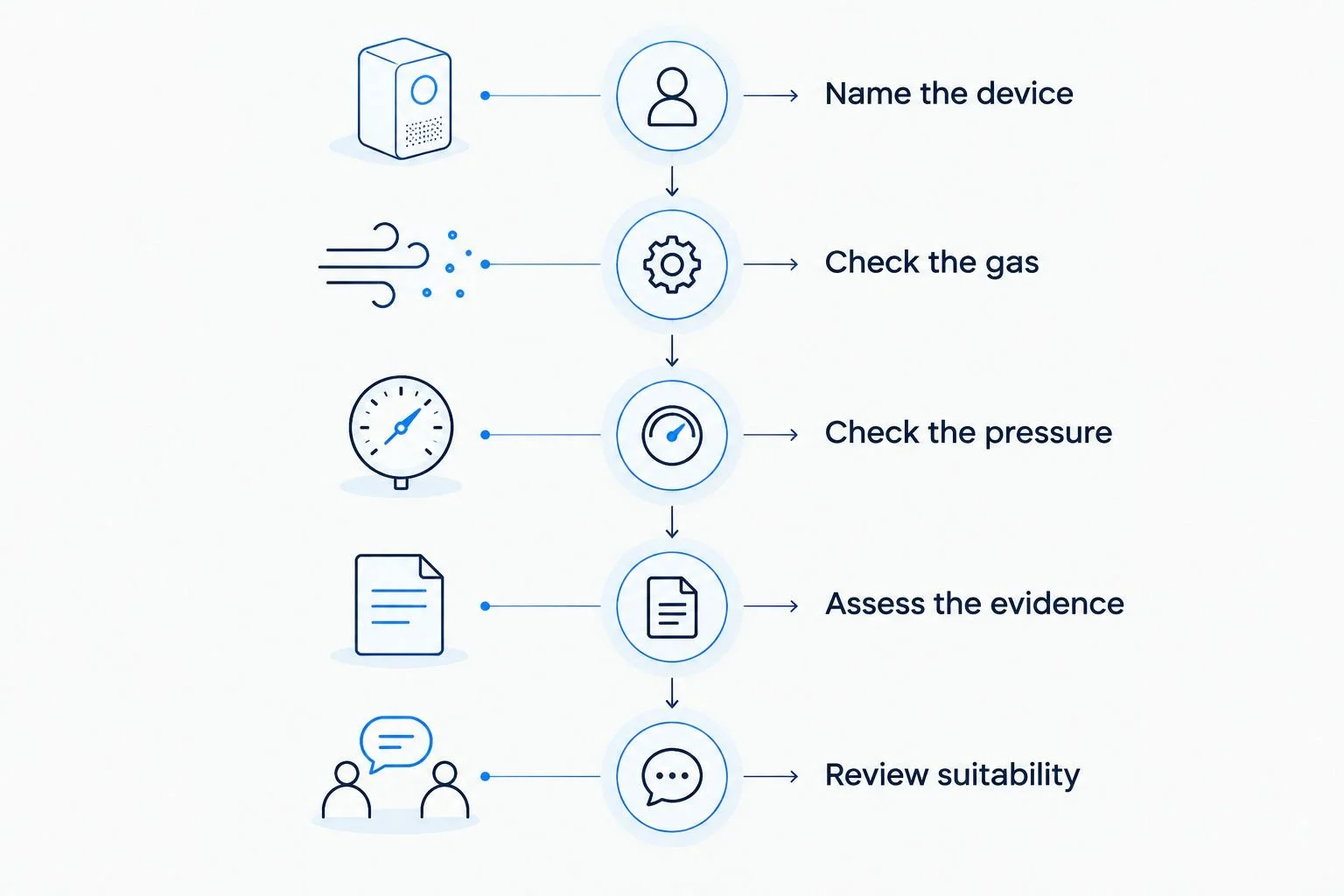
Identify what the equipment changes before evaluating its recovery claims.
Does a breathing tube mean I am receiving oxygen?
No—a breathing tube does not establish oxygen enrichment. Tubing is an interface, not a gas specification. You need to know what supplies the tube and whether that source actually changes oxygen concentration.
The same principle applies to a mask or nasal attachment. Its appearance cannot tell you the gas composition, intended use, or suitability of the system behind it.
Is NanoVi the same as hyperbaric oxygen therapy?
No—NanoVi is not hyperbaric oxygen therapy. NanoVi's described airflow-based operation does not create the pressurized environment that distinguishes HBOT.
When comparing sessions, ask about the actual equipment rather than grouping everything under recovery technology. A shared recovery goal does not make the underlying experiences equivalent.
Can NanoVi replace prescribed oxygen?
No—NanoVi is not a replacement for prescribed oxygen. It does not concentrate oxygen, and a wellness device should not replace equipment selected to meet a medical oxygen requirement.
If you use prescribed oxygen, ask your prescribing clinician about any proposed addition or change. Do not use a normal-looking finger-oximeter reading as permission to substitute devices.
How to evaluate recovery claims without confusing the mechanism
A clear mechanism description is useful, but it is only the start of a decision. For a 2026 recovery plan, match each claim to a measurable outcome rather than treating scientific terminology as a result.
Look for research that answers the question you actually have. Evidence about a laboratory marker does not automatically establish better training performance, and findings from another device do not automatically transfer to NanoVi.
Ask whether a study involved people similar to you, used the same equipment, and measured the outcome that matters to your decision. Also ask what the comparison group received. These details matter more than whether a service description uses words such as cellular or oxygen.
Keep recovery expectations separate from oxygen delivery. A session does not need to concentrate oxygen to warrant investigation, but it does need relevant evidence for the benefits being claimed. Conversely, confirmed oxygen enrichment does not establish that a session will improve your personal performance.
Choosing a session around your actual goal
Start with your goal in plain language: an exercise-based experience, a pressure-based experience, or learning about a different wellness device. Then ask which service matches that description and what screening applies.
Live Superhuman is best for clients seeking bookable recovery and performance wellness sessions. Its stated offerings include hyperbaric oxygen therapy, red light therapy, PEMF, EWOT, and altitude training. That service list is a starting point for a conversation, not evidence that every option suits every client.
If you want to understand the exercise component specifically, the guide to what happens inside an EWOT session addresses that experience. Keep NanoVi's device function separate from your decision about an oxygen-based session.
FAQ
Does the NanoVi device deliver concentrated oxygen?
No. NanoVi does not concentrate oxygen; Eng3 describes an airflow-based system involving humidity and a bio-identical signal rather than oxygen enrichment.
Is NanoVi an oxygen concentrator?
No. An oxygen concentrator separates components of room air to produce oxygen-enriched gas; that is not NanoVi's described function.
Does humidified air contain more oxygen?
Humidification does not concentrate oxygen. Adding water vapor and increasing oxygen concentration are different changes to a gas mixture.
Is NanoVi the same as EWOT?
No. EWOT combines exercise with oxygen delivery, while NanoVi is not an oxygen-enrichment device.
Does a chamber's ATA rating tell me its oxygen percentage?
No. ATA measures absolute pressure, not oxygen concentration. Ask separately about the breathing gas and delivery setup.
Can a pulse oximeter prove a device delivers concentrated oxygen?
No. A pulse oximeter estimates blood oxygen saturation, not the oxygen concentration leaving a device.
Can NanoVi replace prescribed oxygen equipment?
No. NanoVi does not concentrate oxygen and is not a substitute for prescribed oxygen equipment. Discuss changes to prescribed oxygen with your clinician.
Does Live Superhuman offer oxygen-related wellness sessions?
Yes. Live Superhuman lists hyperbaric oxygen therapy and EWOT among its bookable wellness services. Ask which session matches your goals and what suitability screening applies.
One last thing
The most useful question is not whether a session involves breathing through something. Ask: Does this equipment change oxygen concentration, pressure, both, or neither? That answer separates the device categories before benefit claims enter the conversation.
For NanoVi, the answer to the headline question remains no: it does not deliver concentrated oxygen. Evaluate its separate claims on their own evidence, not on an assumed connection to oxygen therapy.
Related guides
By Kelley Gast