EWOT therapy does not have one fixed session length across all providers, so confirm the exercise duration and the full appointment length before booking. The time you spend exercising is not necessarily the time you need to reserve for your visit; ask whether preparation, equipment adjustment, and any post-exercise time are included.
TL;DR
For EWOT therapy, confirm both exercise time and total appointment time before booking.
Live Superhuman offers bookable EWOT sessions for clients seeking recovery and performance support.
Exercise with oxygen and altitude training are different activities; do not assume their schedules match.
Choose a session you can attend without rushing preparation or your departure.
How long does an EWOT session take?
The right scheduling number is the full appointment length, not just the oxygen-assisted exercise interval. Ask the studio to distinguish those times before you arrange your workday, training, or transportation around a visit.
For a 2026 booking, use the contact page to request the current timing rather than treating a general article as the appointment schedule. Specify whether you are asking about your first visit or a return visit, and whether you want EWOT alone.
Exercise time
What you need to know: How long you will actively exercise with supplemental oxygen
Why it matters: Defines the activity itself
Preparation time
What you need to know: Whether instructions and equipment adjustment are included
Why it matters: Separates getting ready from exercising
Appointment time
What you need to know: The scheduled start-to-finish visit length
Why it matters: Gives you a calendar block
Additional service time
What you need to know: Whether another booked service extends the visit
Why it matters: Prevents treating separate sessions as one
These are questions to ask, not a description of every studio's operating routine. A booking label that simply says EWOT does not tell you which parts of the visit its stated duration includes.
Why this matters
A short exercise interval does not automatically mean a short door-to-door commitment. Travel, arrival instructions, and getting ready for your next activity belong in your personal schedule even when they are outside the appointment itself.
The practical goal is straightforward: leave enough time to follow the session instructions without watching the clock. If your calendar only accommodates the exercise interval, ask about the complete visit before committing to that slot.
Duration also tells you very little about the value of a session on its own. A longer appointment is not proof of a better training stimulus, and a shorter appointment is not proof that something essential has been left out.
Separate the exercise clock from the appointment clock
When you ask how long EWOT takes, decide which question you actually need answered. Are you planning your exercise workload, or deciding whether you can get back to work on time?
Those questions need different answers. Exercise time helps describe the session's activity; appointment time helps you decide whether the booking fits your day.
Exercise time describes the active portion
EWOT means exercise with oxygen therapy: physical activity while breathing supplemental oxygen. The exercise interval is the portion of the visit devoted to that activity, not a promise about how quickly you will arrive, get ready, and leave.
Ask what the provider counts as active time. You should understand whether any warm-up or lower-effort movement falls inside the stated exercise interval rather than assuming every minute represents the same workload.
Appointment time describes your booking
The appointment length should tell you the scheduled commitment. Ask whether the stated time begins when you arrive, when instructions start, or when the exercise begins.
If you need to leave at a firm time, say so before booking. A clear departure constraint is more useful than asking the studio to make an unspecified session “quick.”
Your calendar includes more than the booking
Your personal time commitment also includes the trip and whatever you need to do before returning to your day. Keep those separate from the service duration so you can see what actually makes the visit workable.
For your 2026 calendar, record the confirmed appointment block first. Add your own travel and transition time afterward instead of trying to make the studio's session description cover everything.
How to confirm your EWOT appointment length
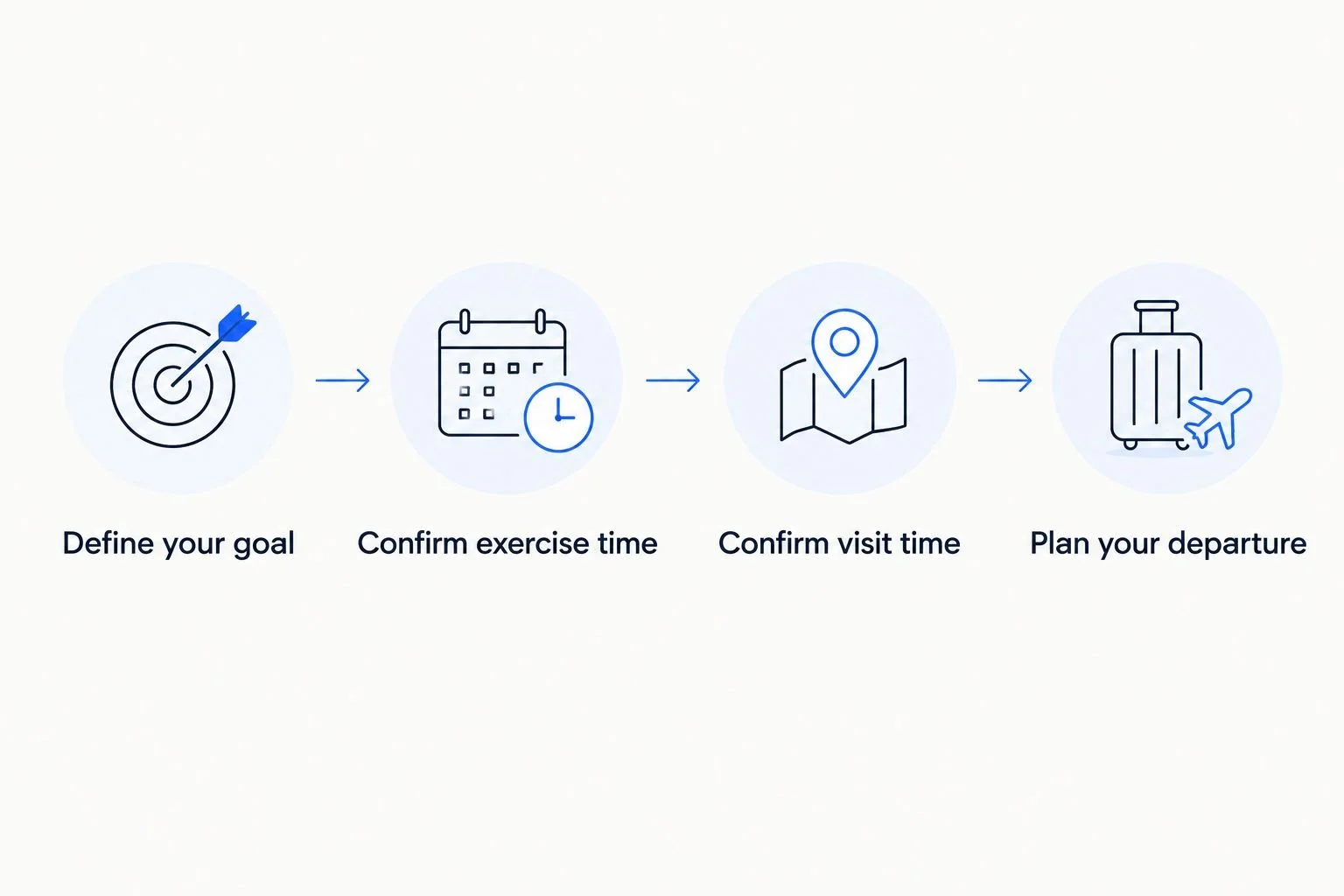
Use a short sequence before choosing a slot. This gives you a usable schedule without relying on a generic duration that might describe a different provider or setup.
Define your goal. Explain whether the visit is intended to support a recovery routine, a performance routine, or an introduction to EWOT. Do not use the goal to prescribe your own exercise duration.
Confirm exercise time. Ask how long the active oxygen-assisted exercise portion lasts and what that interval includes.
Confirm visit time. Ask how much time to reserve from the requested arrival time through the expected end of the appointment.
Plan your departure. Tell the provider about your next commitment and ask whether the booking fits without shortening instructions or rushing your exit.
Keep the answers together in your booking notes. If an appointment confirmation gives a duration that differs from what you understood, resolve the difference before arriving rather than deciding which number to trust on the day.
Live Superhuman is best for readers seeking bookable EWOT therapy sessions at a wellness studio. Confirm the current session details directly; the service offering alone does not establish the length of your individual visit.
Why EWOT visit timing varies
The useful distinction is not simply “short session” versus “long session.” It is what the scheduled time includes and which activities you have actually booked.
Use these factors to structure the conversation:
Booking scope. Ask whether the appointment covers EWOT alone or includes another service. Separate service names do not establish a combined appointment length.
First-visit instructions. Ask whether an introductory explanation or information review changes the time you should reserve. Do not assume a first visit follows the same schedule as a return booking.
Equipment preparation. Confirm whether getting ready to use the exercise and oxygen equipment sits inside the appointment block.
Exercise structure. Ask whether warm-up, active exercise, and any lower-effort movement are included in the quoted exercise time.
Arrival and departure instructions. Check when you are expected to arrive and when the appointment is expected to finish.
For 2026 planning, treat these as confirmation points rather than reasons to add an arbitrary buffer. The provider supplies the appointment details; you supply the constraints of your day.
Is a longer EWOT session better?
Longer is not a stand-alone measure of a better EWOT session. Duration needs context, including the exercise effort, the equipment being used, your suitability for the activity, and the provider's instructions.
Do not extend a session yourself because another website describes a longer interval. A time quoted for a different setup does not establish what you should do during your own appointment.
The advantage of a clearly defined session is that you know what you are booking and can plan around it. The limitation is that a clock alone cannot demonstrate recovery benefits or performance improvements.
If your main question is whether EWOT fits your training, start with the intended role of the session. Then ask the provider to explain the activity and timing, rather than choosing the longest appointment as a substitute for that conversation.
Does the oxygen equipment change the timing question?
Equipment details matter because a description of the oxygen supply does not, by itself, describe the complete appointment. Keep questions about equipment separate from questions about how long you will exercise.
Comparisons of oxygen concentrators for EWOT training address the oxygen-supply side of a setup; they do not establish the length of a studio booking. Ask which parts of equipment preparation occur before your arrival and which parts require your participation.
You do not need to become an equipment buyer to schedule a session. You need a clear explanation of what you will do, how the provider will guide the activity, and how much time the complete appointment requires.
For a 2026 visit, avoid copying a duration from a home-equipment description into your studio calendar. Equipment use and appointment scheduling answer different questions, even when both involve EWOT.
Can you fit EWOT around another workout?
That is a scheduling and suitability question, not just a calculation of spare minutes. Tell the provider what exercise you intend to do before or after the visit and ask how that affects the planned activity.
Be specific about your day. A hard training session, a recovery-focused day, and a return to exercise are different contexts; a generic appointment duration does not account for them.
EWOT includes exercise, so do not automatically treat it as passive downtime between demanding activities. Ask about the expected effort and decide where it belongs in your schedule with appropriate guidance.
If you want another wellness service during the same trip, ask for the combined appointment plan. Live Superhuman offers EWOT, hyperbaric oxygen therapy, red light therapy, PEMF, and altitude training, but that service list does not establish their sequence or combined duration.
What should you ask before your first session?
A first booking should leave you clear about the activity, not merely the start time. Send your questions together so you can make a decision from one consistent set of answers.
What is the active exercise duration?
What is the complete appointment duration?
When should I arrive relative to the booking time?
What should I wear or bring?
What information do you need about my exercise experience and health?
What should I do if I feel uncomfortable during the session?
Do not shorten preparation to protect a crowded calendar. Choose a different slot if the full appointment does not fit.
If you have health concerns, ask a qualified healthcare professional whether exercise with supplemental oxygen is appropriate for you. A wellness booking description does not replace individualized advice about participating.
FAQ
How long should I allow for EWOT therapy?
Allow the full appointment time confirmed by your provider, not just the active exercise interval. Ask whether preparation, instructions, and any post-exercise time are included.
Is EWOT exercise time the same as appointment time?
EWOT exercise time and appointment time are different scheduling measures. Exercise time describes the active portion, while appointment time describes the booked visit.
Does a first EWOT visit take longer?
Confirm first-visit timing directly rather than assuming it matches a return appointment. Ask whether introductory instructions or information review affect the time you should reserve.
Is a longer EWOT session better for performance?
A longer EWOT session is not automatically better for performance. Duration alone does not establish the suitability, workload, or outcome of a session.
Can I book EWOT therapy at Live Superhuman?
Live Superhuman offers bookable EWOT therapy sessions. Confirm the current exercise duration and complete appointment length before arranging your day around a visit.
Can I combine EWOT with another wellness session?
Ask the provider to confirm whether separate services can fit into your intended visit. Get the combined timing rather than assuming another service is included in the EWOT appointment.
Should I copy an EWOT duration I found online?
Do not copy an online EWOT duration without confirming that it applies to your appointment. A description of another provider or equipment setup does not determine your session instructions.
One last thing
The most useful timing question is not “How long is EWOT?” It is “When should I arrive, and when should I expect to leave?”
For your next 2026 booking, get that answer alongside the exercise duration. You will have both numbers you actually need: one describing the activity, the other protecting your calendar.
Related guides
By Kelley Gast