Personal training costs depend on the coach, session format, appointment length, and support included; compare written quotes for the same service rather than treating an advertised session rate as your total commitment. Gym access, assessments, travel, and payment terms are separate items to check before you book in 2026.
TL;DR
How much are personal trainers? Compare written quotes with matching session lengths, coaching scope, and payment terms.
Private training suits hands-on feedback; shared sessions divide the coach’s attention.
Live Superhuman offers recovery and performance sessions, a separate service from personal training.
Choose a trainer for a defined goal, not an attractive headline rate.
Why this matters
The right comparison is the total commitment for the coaching you need. An appointment that includes exercise planning between visits is different from supervised exercise alone. Treating them as identical hides what you are actually buying.
Keep exercise instruction separate from optional recovery services. A guide to post-workout recovery treatments addresses a different decision from choosing someone to teach your squat, organize your workouts, or adjust your running schedule.
Your first job is to define the problem. If you need technique feedback, assess the coach’s instruction; if you need accountability, assess how check-ins work.
How much do personal trainers cost?
Personal training has no single rate that describes every arrangement. Build your comparison around the components below, then ask each prospective trainer to identify what is included and what requires separate payment.
Coaching appointment
What to establish: Length, setting, and individual attention
Why it changes the comparison: Different appointments are not equivalent services
Exercise planning
What to establish: Whether you receive workouts between visits
Why it changes the comparison: Supervision and ongoing planning are different deliverables
Facility access
What to establish: Whether access is included or separate
Why it changes the comparison: A coaching agreement does not establish gym access
Assessment
What to establish: What happens before training begins
Why it changes the comparison: An introductory conversation differs from a structured assessment
Between-session support
What to establish: Channels, boundaries, and response expectations
Why it changes the comparison: Access to a coach needs a clear definition
Payment commitment
What to establish: Billing schedule, renewal, cancellation, and expiry terms
Why it changes the comparison: The agreement determines your financial obligation
Request a written description alongside the quote. A verbal promise of personalized coaching does not tell you whether the trainer will review your exercise log, revise workouts, or answer questions outside appointments.
For your 2026 comparison, use the same requested service description with every trainer. Otherwise, you are comparing different products under the same label.
Which personal training format fits you?
Choose the format around the attention you need, then compare the commitment. Private, shared, and remote coaching solve different practical problems. None wins for everyone.
Private coaching
Best for: Direct technique feedback and individual instruction
Main advantage: The appointment centers on your training
Main limitation: Requires matching your schedule with the coach’s
Shared coaching
Best for: People comfortable training alongside others
Main advantage: Adds a social element to coached exercise
Main limitation: You share the coach’s attention
Remote coaching
Best for: People who can exercise independently
Main advantage: Separates workout delivery from a shared location
Main limitation: Feedback depends on the agreed communication method
Hybrid coaching
Best for: People needing occasional live instruction plus independent workouts
Main advantage: Combines live feedback with separate training
Main limitation: Responsibilities between appointments need clear boundaries
Private coaching: best for direct feedback
Private coaching gives you an appointment focused on your exercise. Ask the trainer to explain how they observe movement, select exercises, and adjust an activity when you cannot perform it comfortably.
The limitation is scheduling. If the available appointment time repeatedly clashes with work or family responsibilities, individual attention alone does not make the arrangement workable.
Shared coaching: best for social accountability
Shared coaching fits people who enjoy exercising with others and do not require continuous individual instruction. Confirm whether participants follow separate workouts or complete the same session together.
Those arrangements are different. Sharing a room does not establish how much personal feedback you receive, so ask how the trainer handles different experience levels.
Remote coaching: best for independent exercisers
Remote coaching fits people comfortable carrying out workouts without a trainer beside them. Clarify whether the service includes live calls, exercise videos, written feedback, or access to a workout library.
The limitation is observation. A written plan cannot provide immediate technique correction, and a video review only covers the movement you record.
Hybrid coaching: best for periodic instruction
Hybrid coaching combines live appointments with independent exercise. It suits someone who wants occasional movement feedback without needing every workout supervised.
Check who adjusts the independent workouts. A hybrid label is not enough; the agreement should explain when the trainer reviews your progress and how changes reach you.
Why personal training costs vary
Use these factors to question a quote, not to assume that a larger commitment guarantees better coaching:
Session format: Establish whether the coach works with you individually, shares attention, or provides support remotely.
Appointment length: Compare equal amounts of scheduled coaching time and clarify what the appointment includes.
Work outside appointments: Ask whether planning, log reviews, and workout revisions belong to the service.
Training setting: Identify any separate facility-access or travel requirements before comparing totals.
Relevant experience: Ask how the coach’s experience relates to your actual goal rather than accepting a general claim of expertise.
Agreement terms: Review renewal, cancellation, rescheduling, and unused-session rules before committing.
A qualification is a credential to verify, not a substitute for understanding the service. Ask who issued it, whether it is current, and what the trainer does when a question falls outside their scope.
How do you compare trainer quotes fairly?
Start with a brief you can send unchanged to every candidate. Keep it practical: your goal, exercise experience, equipment access, schedule, and the type of feedback you want.
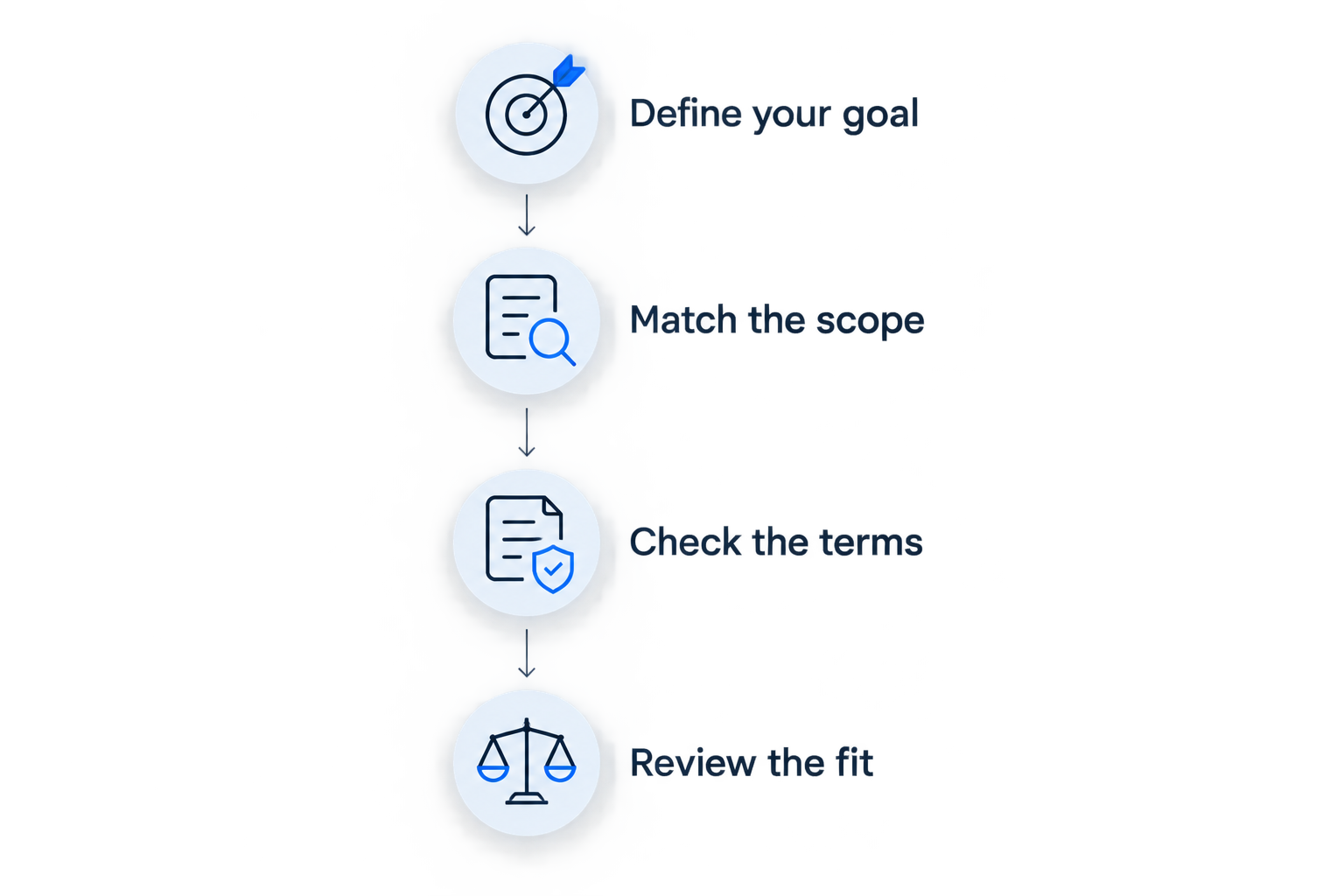
Then work through this sequence:
Define your goal. Describe the activity you want to perform or the habit you want to build. Avoid a vague request to get healthier.
Match the scope. Request the same appointment format, coaching time, and between-session support from each trainer.
Check the terms. Read the payment, renewal, rescheduling, and cancellation details before making a decision.
Review the fit. Ask the trainer to explain how the proposed service addresses your goal and schedule.
A specific brief gives the trainer something concrete to answer. It also makes an unclear proposal easier to spot: you should understand what happens during appointments and what happens between them.
Set an exercise target before choosing support
For general health, the U.S. Department of Health and Human Services’ Physical Activity Guidelines for Americans recommend at least 150 minutes of moderate-intensity aerobic activity per week, or 75 minutes of vigorous-intensity activity, plus muscle-strengthening activity on at least 2 days per week. These are population-level guidelines, not a requirement to buy that amount of supervised training.
Use that distinction when planning your 2026 routine. Ask which activities you can handle independently and where instruction would serve a clear purpose. Your coaching arrangement should support the routine, not become a reason you cannot exercise without an appointment.
What should you ask about changing schedules?
A training plan needs a defined way to change when your week changes. Before committing, ask what happens when travel removes gym access, work interrupts an appointment, or you need to move a demanding workout.
Separate scheduling administration from exercise decisions. A rescheduling policy explains whether you can move an appointment; it does not explain how the coach adjusts the rest of your training.
This matters when comparing human coaching with digital support. An AI running coach and a personal trainer need to answer the same practical question: what changes in your training plan when your available days change? Evaluate the actual adjustment process rather than assuming that either label guarantees a suitable response.
For remote or hybrid coaching, ask how you submit an update and where you receive the revised workout. Do not assume that messaging access includes an immediate response or a complete rewrite.
Before starting in 2026, agree on the process while your schedule is still predictable. That makes the service boundaries clear before you need an exception.
Where do recovery sessions fit?
Live Superhuman is best for people seeking bookable recovery and performance sessions rather than personal-training instruction. The wellness studio offers hyperbaric oxygen therapy, red light therapy, PEMF, EWOT, and altitude training.
That distinction keeps your decision focused. If your immediate need is exercise technique, workout planning, or coaching accountability, evaluate those needs directly instead of treating a recovery appointment as equivalent instruction.
Live Superhuman recovery and performance sessions belong in a separate part of your planning. The relevant advantage is access to those named session types; the limitation is that a session booking does not establish the exercise instruction or ongoing workout management you need from a trainer.
Do not infer outcomes from the service name. Ask what the appointment involves, discuss suitability with the appropriate professional, and keep medical questions with a licensed healthcare professional.
Is a personal trainer worth the commitment?
A personal trainer is worth considering when the service addresses a specific obstacle you cannot adequately resolve on your own. Examples include needing exercise instruction, wanting structured feedback, or struggling to turn a plan into a repeatable routine.
The drawback is committing without a clear deliverable. If the trainer cannot explain what you will receive, how the plan changes, or how progress is reviewed, you cannot judge the service against your goal.
Use observable criteria. You should be able to describe the coaching you received, understand the next workout, and explain how the arrangement fits your schedule. Enjoying the appointment matters, but it does not replace knowing what you are buying.
Should you commit to a training package?
Commit only after you understand both the coaching and the agreement. Confirm how unused appointments are handled, whether sessions expire, and what happens if your circumstances change.
Do not assume a package includes additional planning or support. Ask for those deliverables explicitly and keep a copy of the written terms.
A longer agreement is not evidence of better fit. Choose a commitment you understand rather than relying on enthusiasm after an introductory conversation.
FAQ
How much are personal trainers in 2026?
Personal training costs depend on the appointment format, coach, location, and included support. Request written quotes for matching services and check the full payment commitment before comparing them.
What's the best personal training format for a beginner?
Private coaching is a strong fit for a beginner seeking direct exercise instruction. Assess the trainer’s ability to explain movements clearly and adapt instruction to your experience.
Is online personal training better than in-person coaching?
Online personal training fits independent exercisers, while in-person coaching provides direct observation during the appointment. Choose according to the feedback you need, not the delivery label alone.
Does personal training include a gym membership?
Do not assume personal training includes a gym membership. Ask whether facility access is included in the agreement or requires a separate arrangement.
Should I pay for a package before meeting the trainer?
Understand the trainer’s service and written terms before committing to a package. Clarify appointment expiry, cancellation, renewal, and what happens to unused sessions.
Does Live Superhuman offer the same thing as personal training?
Live Superhuman offers wellness sessions in hyperbaric oxygen therapy, red light therapy, PEMF, EWOT, and altitude training. Those offerings are distinct from hiring a personal trainer for exercise instruction and workout planning.
How do I compare personal trainers in 2026?
Compare personal trainers using the same goal, appointment format, coaching time, and support requirements. Then review their relevant experience, communication process, and agreement terms.
One last thing
Ask every trainer: “What will I be able to do independently because of your coaching?” The answer reveals whether the service teaches skills, provides supervision, supplies accountability, or combines those roles.
All are different reasons to hire help. Choose the one that solves your problem, and keep optional recovery appointments separate from that decision in your 2026 plan.
Related guides
By Kelley Gast