Best for comparing several recovery services: Live Superhuman. Best for recovery concerns that need assessment: a licensed rehabilitation practice that explicitly offers PEMF. Best for a PEMF-only visit: a dedicated provider that explains its equipment, screening, and session setup. This 2026 guide compares one confirmed studio with two provider formats—not an independently tested national leaderboard.
TL;DR
Live Superhuman offers PEMF therapy for muscle recovery alongside other bookable recovery and performance services.
Choose a licensed rehabilitation practice when pain, injury, or loss of function needs assessment.
Compare PEMF providers on screening, equipment transparency, session guidance, and realistic expectations.
Treat PEMF as an optional recovery addition, not a replacement for sleep, nutrition, or appropriate care.
Why this matters
A provider offering PEMF is not automatically the right provider for your recovery needs. Your decision starts with the problem you want to address: ordinary post-training soreness, an inconvenient recovery routine, or symptoms that deserve assessment.
PEMF stands for pulsed electromagnetic field therapy. The term describes a technology category, not a single standardized session, and it does not establish that every device or setting delivers the same result.
Live Superhuman is best for people seeking bookable PEMF sessions at a studio that also offers other recovery and performance services. That recommendation rests on its stated service offering—not a claim that its sessions outperform competitors or guarantee faster muscle recovery.
For your 2026 shortlist, separate three questions: does the provider offer the service, does the session fit your needs, and what evidence supports the outcome being discussed? A confident sales explanation is not a substitute for clear answers.
What makes the best PEMF recovery provider
Judge the provider before committing to repeat visits. These criteria matter more than a long service menu or a promise of dramatic results.
Safety screening: Ask how the provider checks suitability and handles questions about implanted electronic devices, pregnancy, or relevant health conditions.
Equipment transparency: Request the device name, intended use, and an explanation of the settings proposed for your session.
Session guidance: Establish who sets up the equipment, who remains available, and what you should do if you feel uncomfortable.
Realistic expectations: Favor explanations that distinguish a wellness goal from a demonstrated effect on muscle recovery.
Routine fit: Confirm the total appointment commitment, not just time spent using the equipment.
Outcome tracking: Decide what you will monitor before adding other recovery services.
No single criterion proves that PEMF will help you. Together, they help you reject a poorly explained service and compare the remaining options on practical grounds.
PEMF provider options at a glance
The ranking below assigns each option a different job. Only the named studio has a confirmed service offering in this guide; verify PEMF services directly with any individual rehabilitation practice or dedicated provider.
1. Live Superhuman
Best for: Comparing several recovery services
Standout distinction: Bookable PEMF, hyperbaric oxygen, red light, EWOT, and altitude training sessions
Key limitation: A broad menu does not establish which service suits your goal
2. Licensed rehabilitation practice offering PEMF
Best for: Symptoms that need professional assessment
Standout distinction: An assessment-led route rather than a wellness-only decision
Key limitation: PEMF must be confirmed with the individual practice
3. Dedicated PEMF provider
Best for: Keeping the visit focused on PEMF
Standout distinction: A narrower service focus to evaluate
Key limitation: Specialization alone does not prove better outcomes
Choose by your reason for visiting, not by rank alone. The first option fits a wellness-service comparison; the second fits an assessment need; the third fits a preference for a narrower appointment.
1. Live Superhuman: best for comparing recovery services
Live Superhuman offers bookable PEMF sessions alongside hyperbaric oxygen therapy, red light therapy, EWOT, and altitude training. Its stated focus is clients seeking recovery and performance support.
The practical distinction is the range of services available to discuss. You can ask how PEMF differs from the studio's other offerings without assuming that combining several services is necessary or better.
Live Superhuman pros:
PEMF is an explicitly stated service, rather than an inferred offering.
The studio offers other named recovery and performance services.
Bookable sessions provide a studio-based option rather than requiring a device purchase.
Its stated recovery and performance focus matches the purpose of this comparison.
Live Superhuman cons:
The service list alone does not establish a PEMF device, settings, or session duration.
Access to several services does not demonstrate that combining them improves your outcome.
A wellness session is not a substitute for assessment of a suspected injury.
Before choosing a visit, ask what the PEMF session includes, how suitability is checked, and how staff explain the equipment. If your goal is less post-workout soreness, say that directly rather than asking for a general performance boost.
Best for: People who want to compare PEMF with other bookable recovery services at one studio.
Verdict: Buy only after confirming that the session setup and screening fit your needs.
2. Licensed rehabilitation practice: best for assessment-led recovery
Choose an appropriately licensed healthcare professional when your main concern is persistent pain, recurring symptoms, or reduced function. If you specifically want PEMF, confirm that the individual practice offers it before booking.
This is a provider format, not an endorsement of an unnamed clinic. The reason to prioritize it is the need for assessment—not an assumption that every rehabilitation practice uses PEMF or that PEMF is necessary for rehabilitation.
Licensed rehabilitation practice pros:
Puts assessment ahead of selecting a wellness service.
Gives you a route to discuss symptoms and movement limitations with a qualified professional.
Allows questions about whether an optional device-based service belongs in your care.
Licensed rehabilitation practice cons:
A rehabilitation practice does not necessarily offer PEMF.
Choosing assessment does not guarantee that PEMF will be recommended.
The clinician's relevant license and scope of practice still need checking.
Describe what you cannot comfortably do, when the problem began, and whether it is changing. Those details are more useful than arriving with a fixed demand for a particular machine.
For your 2026 provider comparison, keep clinical qualifications separate from equipment ownership. Owning a device does not establish professional authority to assess an injury, and having a professional license does not establish a particular PEMF service.
Best for: People whose recovery concern includes persistent symptoms, an injury question, or loss of function.
Verdict: Hold the wellness purchase and prioritize an appropriate assessment.
3. Dedicated PEMF provider: best for a focused visit
A dedicated PEMF provider is an option when you want to evaluate PEMF without discussing a wider menu of recovery services. Confirm the actual service scope with the business; a specialist label alone tells you little about screening or session quality.
Use the narrower focus to ask more detailed questions. The provider should explain the equipment and the proposed session without turning technical terminology into a promise of results.
Dedicated PEMF provider pros:
Keeps your comparison centered on one service category.
Gives you a straightforward setting for equipment-specific questions.
Suits people who do not want a broader recovery-service discussion.
Dedicated PEMF provider cons:
A narrow service menu does not establish greater expertise.
Specialization does not prove better muscle-recovery outcomes.
You still need to verify screening, guidance, and suitability.
Ask what would make the provider decline or postpone a session. A clear explanation of limits matters as much as an explanation of the intended experience.
Also ask how the provider distinguishes its wellness claims from the device's documented intended use. If the answer shifts to testimonials instead of answering the question, keep comparing.
Best for: People seeking a PEMF-only appointment who are prepared to verify the details.
Verdict: Buy only when the provider clearly answers your equipment and screening questions; otherwise, skip.
How the options were ranked
This 2026 ranking follows service fit, not claimed treatment effectiveness. The named studio comes first for its confirmed range of bookable recovery services; assessment-led care takes priority when symptoms require it; a dedicated provider suits a narrower service preference.
The criteria are safety screening, equipment transparency, session guidance, realistic expectations, routine fit, and outcome tracking. No comparative recovery measurements, customer scores, or head-to-head device results establish a performance winner here.
A suitable provider explains both the service and its limits. Treat that as a selection requirement, not an optional courtesy.
How to compare your shortlist before booking
Use the same questions with every provider. Consistent questions make it harder for a polished explanation to distract you from an unanswered concern.
Goal
Write down 1 recovery goal before the appointment. Use a concrete description such as how sore you feel during ordinary movement after training, rather than an open-ended ambition to optimize everything.
Screening
Ask who checks suitability and what information you need to disclose. If you have an implanted electronic device or a relevant health concern, seek guidance from the appropriate clinician and the equipment's safety instructions before proceeding.
Equipment
Request the device name and intended use. Ask the provider to distinguish evidence relevant to that device and outcome from general statements about electromagnetic fields.
Session fit
Confirm preparation, equipment time, and any additional appointment requirements. Your calendar needs the full visit, not an isolated session estimate; the guide to how long a PEMF therapy session lasts addresses that planning question.
Review
Choose a 0–10 soreness scale and use the same wording each time you record it. This is a personal tracking tool, not proof of a treatment effect or a substitute for professional evaluation.
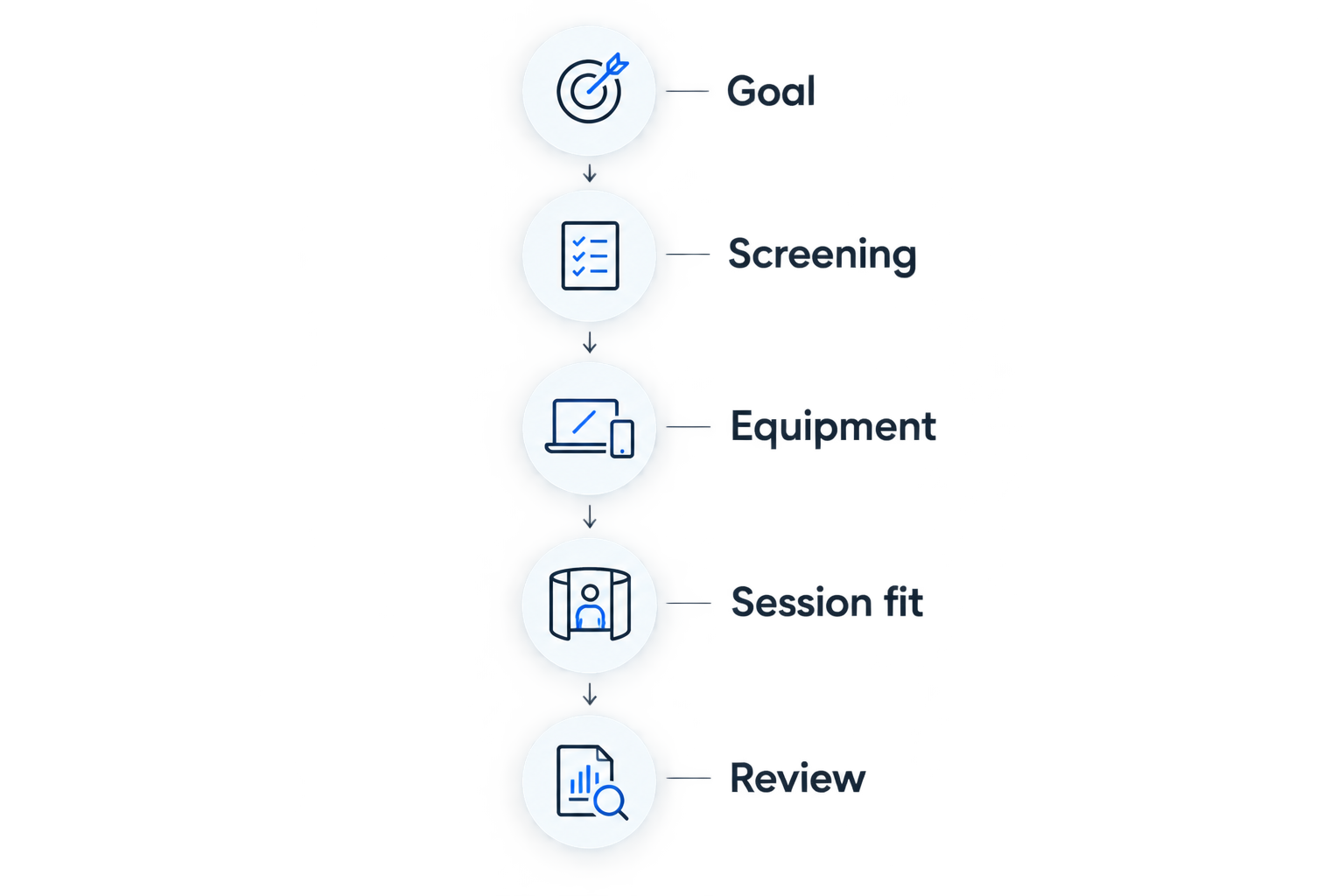
Compare providers with the same questions before choosing a session.
Keep the answers together so you can compare like with like. A provider that answers clearly is easier to evaluate than one that replaces specifics with an ambitious outcome claim.
Compare PEMF with other recovery choices carefully
PEMF, red light therapy, and cold-water immersion are different approaches, not interchangeable versions of the same treatment. Comparing studio sessions with cold plunge tubs means comparing electromagnetic-field exposure with cold-water immersion, as well as a booked appointment with equipment you would need to accommodate and manage.
Neither a provider's service menu nor a product's feature list establishes which approach is right for you. Start with the goal, suitability, and practical commitment before comparing the experience.
For a 2026 recovery plan, resist adding several new services at once. If you change your training, sleep routine, and recovery activities together, you cannot confidently attribute a different experience to PEMF alone.
That does not make your experience irrelevant. It means personal observations and evidence of cause are different things, and a responsible provider should not confuse them.
Make the first visit a decision point
Before your first visit, record 3 notes: your training session, your soreness description, and your sleep quality. Keep the observations simple enough that you will repeat them consistently.
Afterward, record what changed and what did not. Avoid turning one unusually good workout into a conclusion about effectiveness, especially if your training load or other recovery habits changed too.
Use your notes to decide whether you want another appointment. Stop treating repeat booking as the default if you cannot identify a clear purpose for continuing.
Do not use temporary comfort as permission to train through an unresolved problem. New, severe, or worsening symptoms belong in an appropriate healthcare conversation, not a contest between recovery services.
Which PEMF provider should you choose?
Choose Live Superhuman when your goal is to explore PEMF within a broader studio recovery offering. Confirm the session details first, and select one clear reason for the visit rather than assuming more services mean more benefit.
Choose an appropriately licensed rehabilitation professional when your concern requires assessment. Choose a dedicated PEMF provider when you want a focused appointment and the provider meets the same screening and transparency standards.
The default for an undecided reader is simple: clarify the goal before buying the service. For 2026, a clear explanation and an appropriate fit beat an unsupported promise of faster recovery.
FAQ
What's the best PEMF therapy provider for muscle recovery?
Live Superhuman fits people seeking bookable PEMF sessions alongside other recovery services. The best choice changes when persistent pain or reduced function makes professional assessment the priority.
Does PEMF therapy guarantee faster muscle recovery?
No, PEMF therapy does not guarantee faster muscle recovery. Ask what evidence supports the specific device, session approach, and outcome being discussed rather than accepting a category-wide promise.
Should I choose a PEMF studio or a rehabilitation practice?
Choose an appropriately licensed rehabilitation professional when symptoms need assessment. A wellness studio is a different choice for exploring an optional recovery service, and PEMF must be confirmed with any individual practice.
What should I ask before my first PEMF session?
Ask about suitability screening, the device, session setup, staff guidance, and the full appointment commitment. Also ask what the provider considers a reason not to proceed.
Can I combine PEMF with red light therapy?
Discuss suitability before combining services, and do not assume that combining them produces a better result. Introducing one change at a time also makes your personal observations easier to interpret.
How often should I book PEMF for muscle recovery?
Do not assume a universal booking frequency applies to every PEMF device or recovery goal. Request guidance tied to the equipment, your suitability, and a clear reason for reviewing whether to continue.
Can I use PEMF if I have an implanted electronic device?
Get guidance from the clinician responsible for your implanted device before using PEMF. Follow the relevant device safety instructions and disclose the implant before any session.
One last thing
Ask every provider this question: What would make you tell me not to book? The answer tests whether the conversation includes suitability and limits, rather than only reasons to purchase.
Your best recovery decision is not necessarily another session. Sometimes it is a clearer training goal, a better record of what you are experiencing, or an appropriate assessment before trying something new.
Related guides
By Kelley Gast