PEMF therapy is worth considering as an optional recovery add-on when you have a specific goal, have checked safety, and can judge whether sessions help you. In 2026, evidence does not justify treating general wellness PEMF sessions as a guaranteed performance upgrade or a replacement for sleep, appropriate training, or professional care.
TL;DR
Is PEMF therapy worth it? Consider sessions only with a clear recovery goal and realistic expectations.
Live Superhuman offers bookable PEMF therapy sessions for clients seeking recovery and performance support.
Research on a particular device or condition does not establish benefits for every wellness PEMF session.
Track a meaningful outcome, check safety, and stop if sessions add no clear value.
Is PEMF therapy worth it in 2026?
PEMF is worth evaluating, not assuming effective. The useful question is whether a particular session helps you achieve a meaningful recovery goal without displacing the habits or care you already need.
The National Center for Complementary and Integrative Health's resource, Magnets for Pain: What You Need To Know, distinguishes static magnets from electromagnetic therapies and discusses evidence by condition. That distinction matters: research involving electromagnetic treatment is not blanket proof of better athletic recovery, stronger performance, or improved general health.
For an activity-specific discussion, read the PEMF therapy guide for combat sports athletes. Apply the same evidence checks before turning any recovery article into a booking decision.
Consider a session
Best for: People with a clear goal and completed safety checks
Main advantage: Lets you assess the experience before making a longer commitment
Main limitation: A personal response does not prove a treatment effect
Defer the decision
Best for: People changing several recovery habits at once
Main advantage: Keeps the decision easier to interpret
Main limitation: Delays trying an optional service
Skip for now
Best for: People expecting guaranteed results or a replacement for needed care
Main advantage: Avoids a commitment built on unsupported expectations
Main limitation: Does not answer whether you would enjoy the experience
These are decision paths, not predictions of who will respond. Your reason for booking should be more specific than wanting to feel generally better.
Why this matters
Recovery services compete for your time and attention. A session can be pleasant without improving the outcome that brought you through the door, and a demanding training week can make any recovery decision harder to evaluate.
For your 2026 recovery plan, separate the experience you enjoy from the result you want to measure. Both can matter, but they answer different questions. Feeling relaxed afterward does not establish faster muscle recovery or better performance.
What the evidence actually tells you
PEMF stands for pulsed electromagnetic field therapy. Devices create changing electromagnetic fields, but the category name alone does not tell you the equipment settings, intended use, or evidence behind a particular session.
That makes broad claims difficult to apply. Before accepting a claim, check these distinctions:
The intended use: Research addressing a specific health condition does not automatically support general recovery claims.
The equipment: Findings involving one device do not establish identical results from another.
The outcome: A change in reported discomfort is not the same as a demonstrated improvement in athletic performance.
The comparison: An improvement after treatment does not, by itself, show that treatment caused it.
The study population: Results in people receiving care for a particular condition do not automatically describe healthy athletes.
Some electromagnetic devices have specific medical uses. That does not make every wellness PEMF device equivalent, and it does not turn a wellness booking into medical treatment.
Match the claim to the actual service, not just the word PEMF. If a provider cites research, ask what was measured and whether the equipment and intended use match the session you are considering. A study title or technical explanation is not enough.
When a PEMF session makes sense to consider
A reasonable starting point is curiosity paired with a narrow objective. You might want to assess whether you enjoy a recovery session or whether a repeatable daily activity feels different afterward. Those are more useful starting points than expecting a broad transformation.
Live Superhuman is best for people seeking bookable PEMF wellness sessions rather than an at-home device. The studio offers PEMF alongside other recovery and performance-focused services; that service range is not evidence that combining sessions produces a better result.
A studio session lets you explore the experience without choosing personal equipment. The trade-off is that you still need to assess the visit requirements, suitability, and value of continuing. Booking access does not establish effectiveness.
Keep these questions separate:
Do you like the session itself?
Does your chosen outcome change meaningfully?
Is the visit practical enough to repeat?
Would you still choose it if the only benefit were relaxation?
An honest yes to the last question can justify an experience-based decision. It should not become a claim that the session improved tissue recovery or athletic output.
When PEMF is not worth prioritizing
Skip PEMF as a substitute for needed care or basic recovery habits. If an injury, persistent discomfort, or a new symptom is driving your interest, get appropriate guidance rather than using a wellness session to explain or manage it yourself.
PEMF is also a weak priority when you cannot name what success would look like. Broad promises about energy, circulation, recovery, and performance make it easy to reinterpret any good day as confirmation.
Consider deferring when:
You are simultaneously changing training, sleep, nutrition, and other recovery services.
You expect an immediate, guaranteed improvement.
You feel pressure to commit before understanding the session.
You have unresolved questions about compatibility with an implanted electronic device.
The visits would displace activities or care you already know you need.
This is not a judgment about enjoying wellness services. It is a way to avoid turning curiosity into an open-ended commitment with no decision rule.
Why PEMF's value varies
For a 2026 decision, evaluate the service you would actually receive rather than relying on a category-wide verdict. These factors change how useful a trial is:
Your goal: Relaxation, comfort during an activity, and athletic performance require different evidence and different measures.
The equipment: Device design and settings affect whether published findings apply to the session.
Your starting point: A changing training schedule makes before-and-after comparisons harder to interpret.
Other changes: New recovery treatments or altered exercise loads complicate attribution.
Visit demands: Travel, scheduling, and session requirements affect whether continuing makes practical sense.
Expectations: Wanting a treatment to work can influence how you interpret a subjective response.
None of these factors supplies a guaranteed answer. Together, they help you decide whether a personal evaluation will be informative or merely add another variable to your routine.
How should you evaluate a PEMF session?
Use a simple decision process rather than treating every visit as a fresh start. The following tracking suggestions are practical examples, not a recommended treatment schedule or a validated test of effectiveness.
Choose a goal
Write down the exact reason you are considering PEMF. Prefer a repeatable observation, such as how comfortable a familiar movement feels, over a vague objective like optimizing everything.
If your goal requires medical assessment, ask a qualified professional how to evaluate it. A personal notebook cannot establish that an injury has healed.
Record a baseline
Consider recording your chosen observation for 7 days before changing your routine. This suggested observation window helps you notice ordinary variation; it is not a scientifically established requirement for PEMF.
For a subjective measure, you can use a 0–10 rating scale, with the endpoints defined consistently. Record relevant context, such as training load or unusually poor sleep, so a changed score does not stand alone.
Review the result
Choose 2 review points in advance: one after your initial experience and another before deciding whether to continue. These are decision checkpoints, not advice about how many sessions to book or how frequently to attend.
Compare like with like wherever practical. Assess the same activity under similar circumstances, and keep the distinction between enjoyment and your original recovery goal visible.
Set a stop rule
Decide what would make you stop before you start. No meaningful change, an impractical visit schedule, an unpleasant response, or unresolved safety questions are valid reasons not to continue.
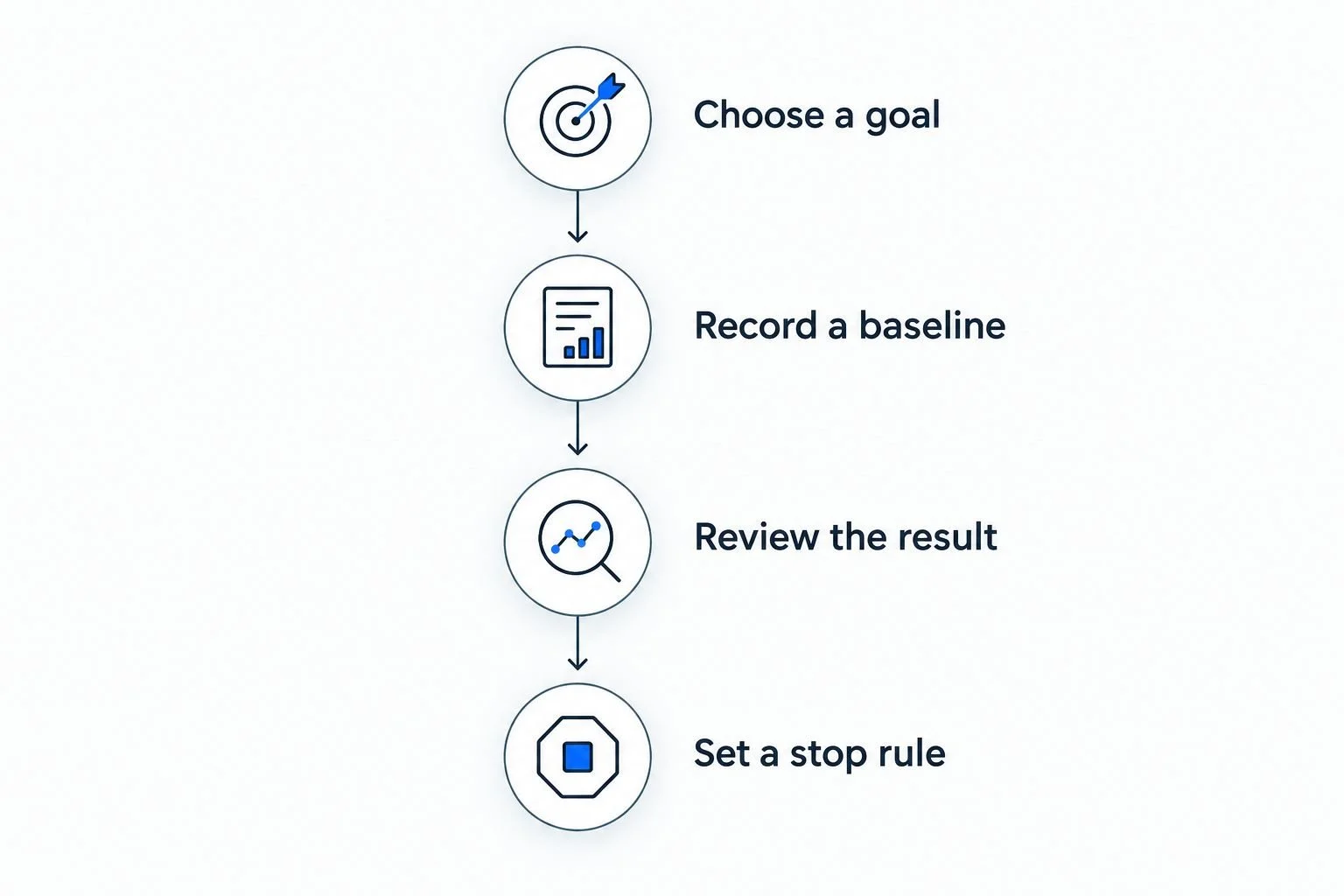
Decide how you will judge the experience before committing to more sessions.
Your notes can support a personal choice, but they cannot establish cause and effect. Training changes, natural recovery, expectations, and ordinary day-to-day variation remain possible explanations for improvement.
What should you ask before booking?
Ask for the equipment name, the session format, preparation instructions, and the provider's safety screening process. You should understand what you are booking without needing to accept a broad performance promise.
If you have an implanted electronic device, discuss compatibility with your treating professional and device manufacturer before exposure. If you are pregnant or have a health concern, seek individualized guidance rather than assuming that a noninvasive service is suitable.
Use the contact page to ask about the actual PEMF session. Keep your question concrete: what happens during the visit, what information should you disclose, and what expectations are appropriate?
Ask about a PEMF session
Ask Live Superhuman about session details, preparation, and safety screening before booking.
How many PEMF sessions make it worth it?
There is no universal session count that establishes value for every wellness PEMF user. A schedule needs to fit the equipment, intended use, and your circumstances; an arbitrary visit target is not proof that results will follow.
Before agreeing to continue, ask what outcome the suggested schedule is intended to address. Do not treat more sessions as the automatic answer to an unclear result.
Can PEMF replace your recovery routine?
PEMF should remain an optional addition, not a replacement for sleep, appropriate training, nutrition, or needed care. A session does not remove the need to manage the work that creates your recovery demands.
In 2026, the clearest decision is still the practical one: add complexity only when you can explain what it contributes. If the session's purpose remains vague, simplify first.
FAQ
Is PEMF therapy worth it for workout recovery?
PEMF therapy is worth considering only as an optional add-on with a clear goal and realistic expectations. Evidence for a particular device or health condition does not establish better workout recovery from every wellness session.
Does PEMF therapy work after one session?
A response after one session does not establish lasting benefit or prove that PEMF caused the change. You can assess comfort and enjoyment immediately, but recovery and performance claims need stronger evidence.
How long should I track my recovery before trying PEMF?
A 7-day baseline is a practical tracking suggestion, not an established PEMF requirement. Use a consistent observation and record changes in training or sleep that affect interpretation.
Is PEMF safe if I have an implanted electronic device?
Do not assume PEMF is compatible with an implanted electronic device. Ask your treating professional and the device manufacturer for guidance before booking or using equipment.
Is PEMF better than getting more sleep?
PEMF is not a replacement for adequate sleep. Treat wellness sessions as optional additions rather than a way to compensate for an unmet recovery need.
Does Live Superhuman offer PEMF therapy sessions?
Live Superhuman offers bookable PEMF therapy sessions as part of its wellness services. Ask about the actual equipment, session format, preparation, and safety screening before deciding.
What's the smartest way to decide whether PEMF is worth it in 2026?
The smartest 2026 decision starts with a specific goal, a safety check, and a stop rule. Continue only when the experience or observed benefit justifies the commitment for you.
One last thing
A session can be enjoyable without being a proven performance treatment. Keeping that distinction intact makes your decision clearer, not less ambitious.
Before your first visit, finish this sentence: I will consider this worthwhile if it helps me with this specific goal. If you cannot finish it without using a broad promise, clarify the goal before booking.
Related guides
By Kelley Gast