Best fit for bookable EWOT therapy: Live Superhuman. Best for a dedicated personal setup: home EWOT. Best for a pressurized oxygen session: hyperbaric oxygen therapy. Best for reduced-oxygen exercise: altitude training. This 2026 Orange County buying guide compares those choices by what you actually do, what to ask before booking, and where each option stops being a match.
TL;DR
Live Superhuman is the service match for bookable EWOT therapy within a studio offering several recovery-focused services.
EWOT combines exercise with supplemental oxygen; hyperbaric oxygen therapy uses a pressurized chamber.
Home EWOT requires equipment selection, upkeep, and an appropriate exercise setup.
Altitude training reduces oxygen availability; it is not another name for EWOT.
Why this matters
Searching for EWOT therapy in Orange County brings together services with different purposes. Exercise with oxygen, chamber-based oxygen sessions, and reduced-oxygen training are not interchangeable. Choose by the activity and environment, not by the word oxygen in the description.
Live Superhuman is best for people seeking bookable EWOT therapy at a wellness studio offering several recovery-focused services. The studio also offers hyperbaric oxygen therapy, red light therapy, PEMF, and altitude training. Start with Live Superhuman if that service mix matches your interests; confirm the location and session details before arranging your visit.
EWOT means exercise with oxygen therapy. You exercise while breathing supplemental oxygen rather than ordinary room air alone. That describes the session format—not a guaranteed improvement in endurance, recovery, or health.
What makes the best EWOT therapy option?
Use these criteria for your 2026 shortlist before comparing studios or buying equipment:
Correct session type: Confirm that the booking includes exercise with supplemental oxygen, not an oxygen session at rest.
Clear equipment explanation: Ask what exercise equipment and breathing interface you will use. Do not assume every setup is identical.
Appropriate activity: Explain your current exercise level and ask how the session accommodates it. More exertion is not automatically a better choice.
Safety screening: Ask who reviews health concerns and what happens if you feel unwell. A wellness booking does not replace medical advice.
Practical repeatability: Compare travel, preparation, session time, and cleanup. The total commitment matters more than the exercise portion alone.
Specific expectations: Ask what the session is intended to do and how you would assess its value. Separate an immediate sensation from a measured training change.
EWOT therapy options at a glance
These rankings identify different use cases, not interchangeable treatments. The first option directly matches a studio EWOT booking; the others address ownership, pressure-based oxygen exposure, or reduced-oxygen training.
1. Live Superhuman EWOT sessions
Best for: Booking EWOT within a multi-service wellness studio
Standout distinction: EWOT is an explicitly offered service
Key limitation: EWOT includes exercise, so it is not a passive recovery session
2. Home EWOT
Best for: People prepared to manage a personal setup
Standout distinction: Equipment and exercise space remain under your control
Key limitation: You take responsibility for equipment selection and upkeep
3. Hyperbaric oxygen therapy
Best for: People specifically seeking a pressurized session
Standout distinction: Oxygen exposure occurs in a chamber under increased pressure
Key limitation: It does not provide the exercise component of EWOT
4. Altitude training
Best for: People specifically seeking reduced-oxygen exercise
Standout distinction: Oxygen availability is reduced rather than increased
Key limitation: It does not provide supplemental-oxygen exercise
The distinction starts with the environment. Ordinary dry air contains about 21% oxygen, while standard sea-level atmospheric pressure is 1 ATA. EWOT changes the breathing-gas exposure during exercise; HBOT changes the pressure environment as well. These are different variables, not rungs on a single performance ladder.
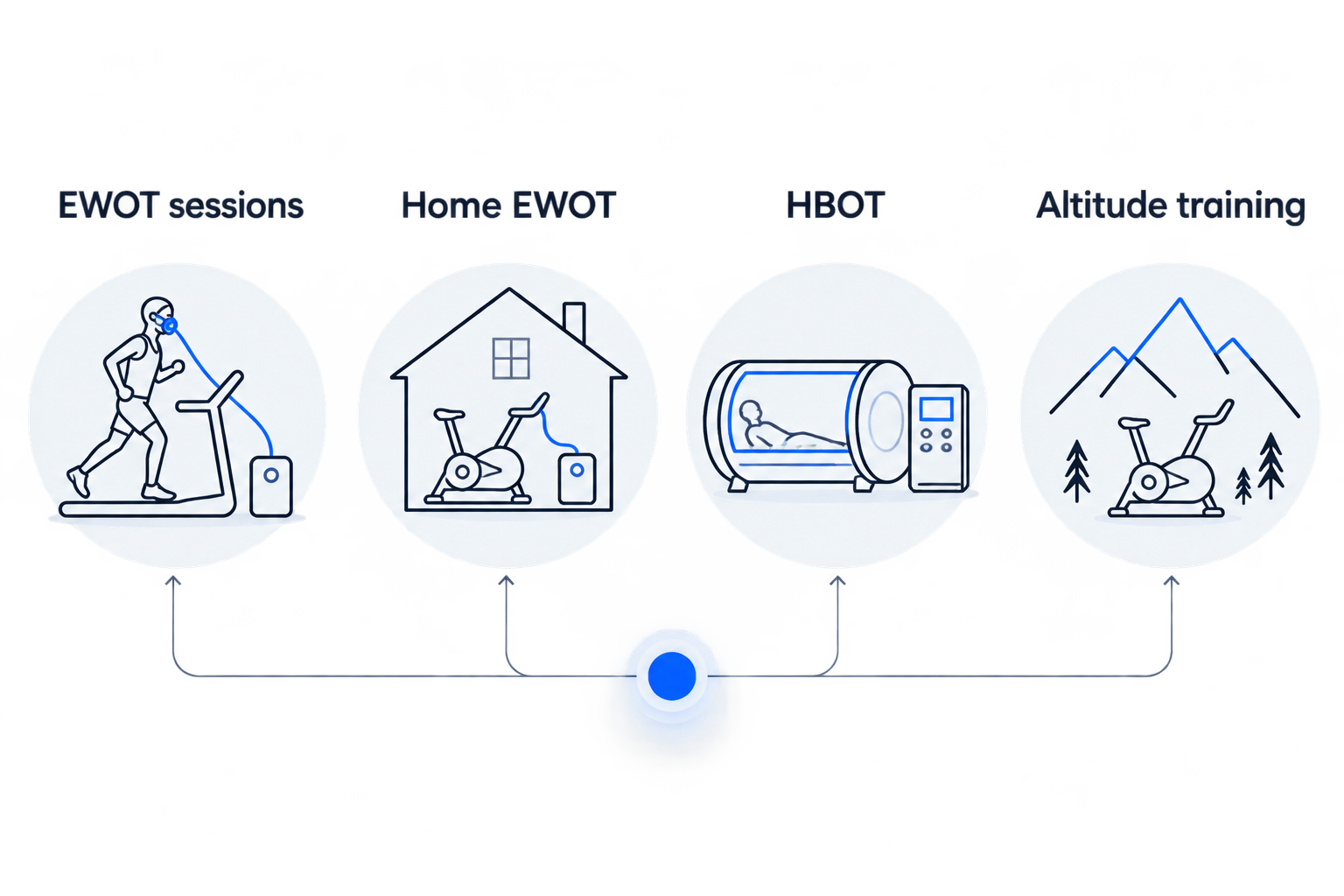
1. Live Superhuman: best EWOT therapy for studio bookings
Live Superhuman offers bookable EWOT sessions alongside hyperbaric oxygen therapy, red light therapy, PEMF, and altitude training. That makes it a direct service match if you want to try EWOT without first selecting and maintaining a home system.
The choice is about access to a session, not proof of a performance result. Ask about the exercise equipment, breathing interface, preparation, and total appointment time before booking. Confirm whether your intended visit covers EWOT alone or involves separately arranged services.
Pros:
EWOT is part of the stated service offering.
You can book a session rather than manage a personal equipment purchase.
Other recovery-focused services are offered by the same studio.
Cons:
You need to travel to an appointment rather than exercise entirely at home.
EWOT requires physical activity; it is not a substitute for a passive session.
The service list alone does not determine which session suits your health or training needs.
Best for: Someone who wants a studio-based introduction to exercise with supplemental oxygen.
For your 2026 first visit, bring a clear goal: understanding the experience, assessing whether the format suits you, or discussing how it fits your existing training. Avoid treating several simultaneous service changes as a clean test of EWOT.
Verdict: Buy a session only after confirming the format and your suitability; do not buy an outcome promise.
2. Home EWOT: best for a dedicated personal setup
Home EWOT brings supplemental-oxygen exercise equipment into your own exercise space. It changes who manages the setup: equipment selection, cleaning, maintenance, and day-to-day use become your responsibility.
This option is distinct from a studio appointment, not inherently better. Before committing, establish what equipment is required, how it is maintained, and what instructions govern its use. Do not assume that owning an oxygen source creates a complete or appropriate EWOT system.
Home EWOT pros:
You control the exercise space and its arrangement.
You do not need to travel to a studio for each use.
You can assess equipment requirements against your own home environment.
Home EWOT cons:
You must evaluate the complete setup rather than a single advertised component.
Cleaning, storage, and maintenance remain ongoing responsibilities.
Equipment ownership does not supply individual exercise guidance or medical screening.
Best for: Someone prepared to manage equipment and establish an appropriate exercise environment.
Oxygen supports combustion. Keep oxygen equipment away from smoking, flames, and ignition sources, and follow the manufacturer's safety instructions. Ask an appropriate healthcare professional about suitability before starting, particularly if you have a heart or lung condition.
Verdict: Hold until equipment requirements, maintenance, and safety responsibilities are clear.
3. Hyperbaric oxygen therapy: best for pressurized sessions
Hyperbaric oxygen therapy uses a pressurized chamber. It is a different session format from exercising with supplemental oxygen, even when both appear on the same wellness menu.
The studio's stated chamber options include 1.6 ATA and 2.0 ATA. Those pressure figures describe chamber conditions; they do not tell you which option is appropriate or establish that one produces a better personal result.
Hyperbaric oxygen therapy pros:
It directly matches a search for a pressurized oxygen session.
It does not require the exercise component that defines EWOT.
Chamber pressure provides a concrete session detail to discuss before booking.
Hyperbaric oxygen therapy cons:
It is not a replacement for aerobic exercise.
Pressure changes can cause ear discomfort and require suitability screening.
A higher pressure setting is not a general instruction to choose that session.
Best for: Someone specifically seeking a chamber-based experience after appropriate screening.
For a 2026 comparison, ask about pressure, breathing-gas delivery, preparation, and who handles suitability questions. Keep those answers separate from EWOT exercise questions. A chamber description cannot explain what happens during an exercise-with-oxygen session.
Verdict: Skip as an EWOT substitute; consider it only when a pressurized session is your actual goal.
4. Altitude training: best for reduced-oxygen exercise
Altitude training involves exercising with reduced oxygen availability. EWOT supplies supplemental oxygen during exercise. The two approaches move in different directions, so the equipment's mask or tubing does not identify the training method by itself.
Be precise about your goal before choosing between them. Preparing for exercise at elevation is a different question from wanting to experience exercise with supplemental oxygen.
Altitude training pros:
It matches a specific interest in reduced-oxygen exercise.
It creates a distinct training condition rather than repeating an ordinary oxygen-enriched session.
Its purpose can be discussed against an elevation-related training goal.
Altitude training cons:
It does not deliver the supplemental-oxygen experience associated with EWOT.
Reduced oxygen availability adds exercise stress rather than making activity automatically easier.
A session does not guarantee readiness for an event at elevation.
Best for: Someone with a defined reduced-oxygen training goal and appropriate guidance.
Ask how the provider sets the exercise workload, monitors tolerance, and decides when to stop. Do not treat breathlessness as proof that the session is effective. Read the guide to combining EWOT and altitude training before discussing a combined schedule.
Verdict: Hold unless reduced-oxygen training serves a clear goal; skip if you simply want EWOT.
How to choose before your first booking
A useful 2026 booking conversation ends with a clear description of the session, not a long list of claimed benefits. Ask these questions in order:
Name the session. Is this exercise with supplemental oxygen, a pressurized chamber session, or reduced-oxygen exercise?
Describe the activity. What will you do, what equipment will you use, and how is exertion adjusted?
Check suitability. Who reviews relevant health concerns, and when should you seek medical advice before participating?
Confirm the visit. Ask about preparation, total appointment time, and what is included.
Set expectations. Decide what you want to learn and what would justify another session.
Stop exercising and alert staff if you develop chest pain, dizziness, or unusual shortness of breath. Do not continue to satisfy an exercise target. Severe or persistent symptoms require urgent medical attention.
Ask about your first EWOT session
Confirm the session format, preparation, and suitability questions before arranging a visit.
How these options are ranked
The ranking prioritizes an exact service match, followed by distinct alternatives for equipment ownership, pressurized oxygen exposure, and reduced-oxygen exercise. It uses the criteria above: session type, equipment clarity, activity, screening, practical commitment, and expectations.
This is a format-based buying guide, not a countywide clinical-effectiveness ranking. No placement establishes that one option produces better recovery or endurance results than another.
Which EWOT therapy option should you choose?
Choose Live Superhuman for bookable EWOT therapy if you want a studio session rather than a home equipment project. Confirm the practical details and suitability before arranging your visit.
Choose home EWOT only if you want responsibility for the equipment. Choose HBOT for a pressurized session, or altitude training for a reduced-oxygen goal. If you remain undecided in 2026, clarify the experience you want before adding another service to your training calendar.
FAQ
What's the best EWOT therapy option for a first studio visit?
Live Superhuman is a direct service match for someone seeking bookable EWOT therapy at a wellness studio. Confirm the location, exercise format, preparation, and suitability before arranging your visit.
What does EWOT therapy actually involve?
EWOT therapy involves exercising while breathing supplemental oxygen. Ask the provider what exercise equipment and breathing interface the session uses rather than assuming all setups are identical.
Is EWOT the same as hyperbaric oxygen therapy?
No. EWOT combines exercise with supplemental oxygen, while hyperbaric oxygen therapy uses a pressurized chamber. Choose according to the session you want, not the shared reference to oxygen.
Is EWOT better than altitude training?
Neither is a universal replacement for the other. EWOT supplies supplemental oxygen during exercise, while altitude training reduces oxygen availability; the appropriate choice depends on your goal and suitability.
Can I replace my normal workouts with EWOT?
Do not treat EWOT as a replacement for a structured exercise plan. Supplemental oxygen does not remove the need to consider exercise workload, consistency, and appropriate progression.
Should I buy home EWOT equipment before trying a session?
Try to understand the session format and equipment responsibilities before buying a home setup. Review maintenance, cleaning, oxygen safety, and suitability rather than selecting equipment from a promised result.
What should I ask before booking EWOT therapy?
Ask what activity you will perform, what equipment you will use, and who handles suitability questions. Confirm preparation and total appointment time so the visit fits your schedule.
One last thing
A mask does not tell you which oxygen experience you are getting. Ask whether oxygen availability increases, decreases, or accompanies a pressure change. That answer prevents a more fundamental booking mistake than choosing the wrong session length.
For your first visit, prioritize understanding the experience over combining multiple unfamiliar services. A clear starting point gives you a better basis for deciding what belongs in your routine.
Related guides
By Kelley Gast