PEMF therapy is not a proven shortcut to faster muscle recovery after workouts. Treat it as an optional addition to sleep, nutrition, and sensible training—not evidence that your muscles are ready for another hard session. This 2026 guide explains how to judge recovery claims, assess your response, and decide whether a session belongs in your routine.
TL;DR
PEMF therapy for muscle recovery is an optional add-on, not a proven replacement for sleep or appropriate training loads.
Less soreness does not automatically mean restored strength, repaired muscle, or readiness for another hard workout.
Live Superhuman offers bookable PEMF sessions for clients pursuing recovery and performance goals.
Judge post-workout recovery by movement and training readiness, not just how relaxed you feel after a session.
Why this matters
Feeling better and recovering faster are different outcomes. A session that feels relaxing does not, by itself, demonstrate that your muscles have regained their normal strength or capacity.
That distinction matters when deciding whether to train again. You need a recovery plan that supports your next workout, not a reason to ignore fatigue. For the broader decision, see whether PEMF therapy is worth it.
Can PEMF speed up muscle recovery?
Do not count on PEMF to shorten the time you need between demanding workouts. Pulsed electromagnetic field therapy uses changing electromagnetic fields, but describing that mechanism does not establish faster recovery from exercise.
A convincing recovery claim needs evidence about the outcome you actually want. Reduced soreness, restored strength, improved range of motion, and better performance are separate measures. A change in one does not prove improvement in all of them.
Use this distinction when reading recovery claims in 2026:
Less post-workout soreness
Evidence needed to support it: Lower soreness ratings compared with a suitable control
What does not establish it: Feeling relaxed immediately afterward
Faster strength recovery
Evidence needed to support it: Strength returning sooner after comparable exercise
What does not establish it: Reporting less discomfort without measuring strength
Better training readiness
Evidence needed to support it: Relevant movement and performance measures across recovery
What does not establish it: A single positive session experience
Faster muscle repair
Evidence needed to support it: Direct evidence appropriate to that biological claim
What does not establish it: General statements about energy or circulation
Research on a particular device, setting, or population does not automatically validate every PEMF session. Likewise, findings about a medical condition do not automatically answer a question about healthy exercisers recovering from squats, running, or sparring.
Ask what was measured before accepting what was promised. A biological explanation is a starting point for research, not a substitute for a demonstrated training benefit.
Where PEMF fits beside recovery basics
PEMF and everyday recovery habits do not have interchangeable roles. Sleep, food, and training adjustments address basic recovery needs; a PEMF session does not replace those needs.
This comparison helps you set priorities without treating every recovery option as equally established.
Sleep
Best for: Supporting regular recovery and daytime function
Main advantage: Addresses a basic physiological need
Limitation: Cannot make an unsuitable training load appropriate
Adequate nutrition
Best for: Replacing energy and supplying nutrients after training
Main advantage: Supports the demands of exercise and recovery
Limitation: Requires attention beyond the immediate post-workout period
Training adjustments
Best for: Managing accumulated fatigue
Main advantage: Changes the demand causing the fatigue
Limitation: Sometimes means reducing a planned workout
Gentle movement
Best for: Keeping comfortable movement in your day
Main advantage: Lets you assess how movement feels without another hard effort
Limitation: Is not a requirement to exercise through pain
PEMF sessions
Best for: Exploring an optional recovery experience
Main advantage: Adds a separate session to your routine
Limitation: Does not establish faster muscle repair or readiness to train
For sleep, CDC guidance recommends at least 7 hours per night for adults ages 18–60. Individual needs differ, and adequate duration does not guarantee good sleep quality. A recovery appointment cannot substitute for consistently insufficient sleep.
Nutrition also deserves attention before adding another session. Eat enough to support your activity, include protein-containing foods, and replace fluids lost through exercise. Your needs depend on your training and health; avoid borrowing a demanding athlete's eating plan without considering those differences.
For your 2026 recovery plan, address an obvious shortfall before adding complexity. If you routinely cut sleep short or increase training despite persistent fatigue, start there.
Why your experience with PEMF varies
There is no single experience that proves PEMF is working for muscle recovery. Your workout, starting condition, and definition of success all affect what you notice.
Keep these factors separate:
Workout demands: An unfamiliar movement or a harder session changes the recovery challenge. Compare similar workouts rather than an easy day with a demanding one.
Starting condition: Poor sleep, accumulated fatigue, or an existing injury changes what recovery means. A wellness session does not resolve every cause of discomfort.
Device settings: Field characteristics and application differ across equipment. Do not assume results from one setup apply to another.
Session timing: What you notice immediately after a session differs from how you move during your next workout. Record both rather than choosing the more favorable result.
Other recovery changes: Adding sleep, changing food intake, and reducing training at the same time prevents you from isolating the session's contribution.
Outcome measured: Soreness, mobility, and performance answer different questions. Choose the outcome before you evaluate the experience.
Do not interpret a stronger sensation, a longer session, or more frequent attendance as proof of a better result. Those are treatment characteristics, not recovery outcomes.
How can you tell whether PEMF helps you?
Use a repeatable observation plan rather than relying on a memorable session. This will not turn your experience into a controlled trial, but it will make your decision more disciplined.
Establish baseline
Describe how you normally recover from a familiar workout before changing your routine. Record the exercise, your usual training load, sleep, soreness, and any unusual discomfort. Avoid using an exceptionally hard workout as your only comparison.
Keep training comparable
Choose familiar workouts and avoid deliberately increasing intensity to test the session. Keep your usual sleep and eating habits as consistent as practical. Record unavoidable changes instead of assuming they do not matter.
Track useful outcomes
Use a simple 0–10 soreness scale, with your own clearly defined endpoints, and assess the same movement each time. Also note whether normal walking, stairs, or a familiar warm-up feels different. This scale is a personal tracking tool, not a diagnosis or proof of muscle repair.
Review the pattern
Look beyond the minutes immediately after a session. Ask whether the experience was useful and whether your next planned activity felt appropriate. If you cannot identify a meaningful benefit, do not treat continued sessions as an obligation.
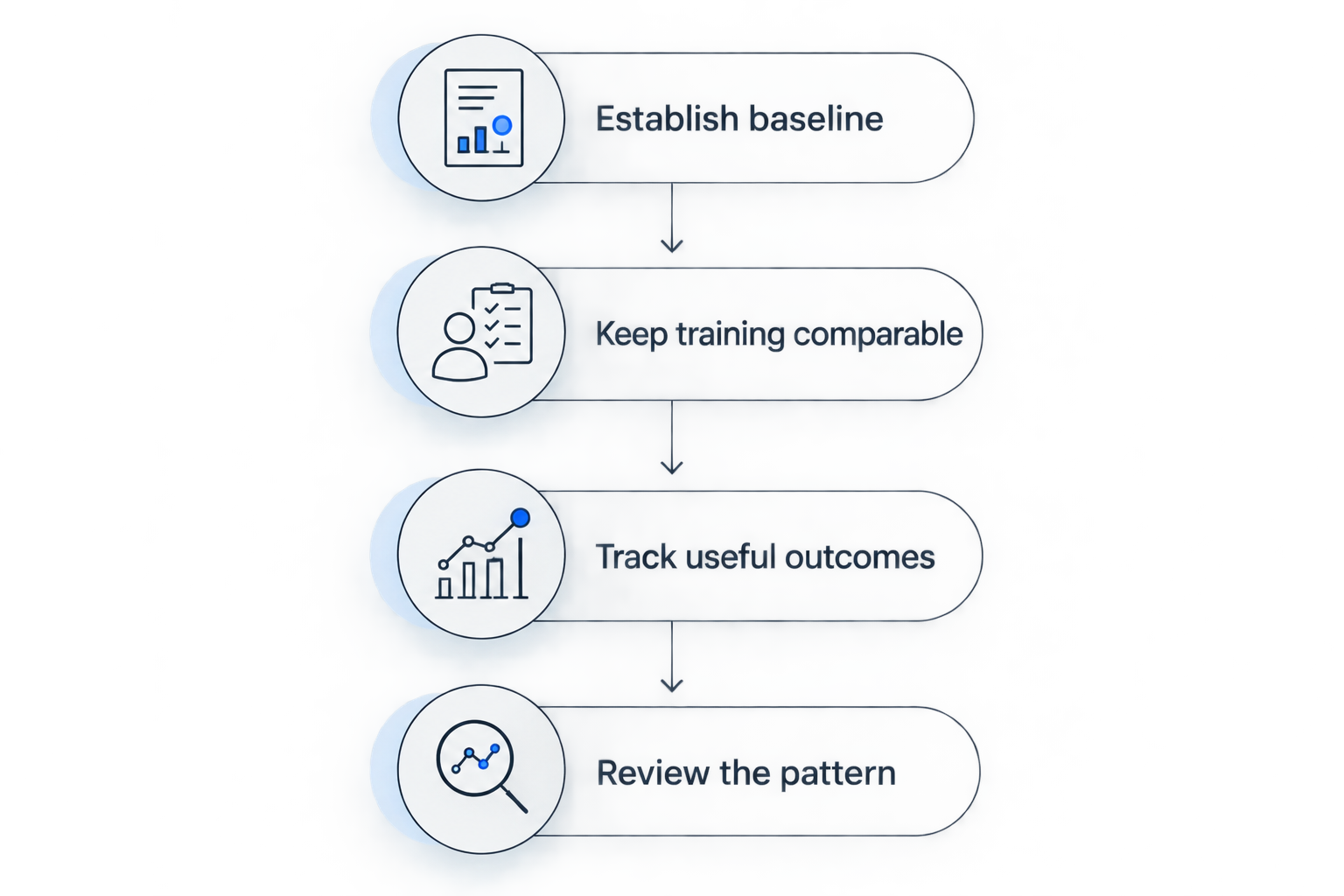
A consistent comparison is more useful than judging recovery from one immediate sensation.
Use the same record throughout your 2026 training plan. Consistency makes the notes useful; elaborate tracking is unnecessary. Stop any movement assessment that produces sharp pain or changes how you normally move.
Is less soreness the same as faster recovery?
Less soreness is not proof of faster muscle recovery. You can feel more comfortable without having demonstrated restored strength, normal movement, or readiness for demanding exercise.
The American College of Sports Medicine describes delayed-onset muscle soreness as typically beginning 12–24 hours after exercise and reaching its greatest intensity around 24–72 hours afterward. That delayed pattern is one reason an immediate post-session impression cannot settle the question.
Soreness is also an imperfect measure of workout quality. Do not chase it as evidence of progress, and do not use its absence as permission to increase training automatically. Judge your next workout against your movement, fatigue, and training plan.
Should you book PEMF after every workout?
There is no universal post-workout PEMF schedule established here. Booking after every workout is not a substitute for deciding whether the sessions serve a clear purpose.
Before committing to a routine, ask what equipment is used, how the session is delivered, what safety screening applies, and what outcome you should realistically assess. Do not accept a fixed schedule as evidence that faster recovery will follow.
Live Superhuman is best for exercisers seeking bookable PEMF sessions as an optional recovery add-on. The studio offers PEMF alongside hyperbaric oxygen therapy, red light therapy, EWOT, and altitude training; that service range is not evidence that combining sessions improves results.
Ask Live Superhuman about PEMF session details and suitability before booking. The practical advantage is access to a bookable wellness session; the limitation is that a session cannot promise faster muscle repair or replace an injury assessment.
For a first evaluation in 2026, avoid changing several recovery treatments at once. Otherwise, even a positive experience will not tell you which change mattered.
When should you skip a recovery session?
Choose medical assessment over a wellness session when symptoms suggest more than ordinary post-workout soreness. Sharp or worsening pain, substantial swelling, marked weakness, or difficulty using a limb deserves attention rather than another attempt to train through it.
Severe muscle pain or weakness accompanied by dark, tea-colored urine needs urgent medical evaluation. These are recognized warning signs of rhabdomyolysis, a potentially serious condition—not a recovery challenge to manage with PEMF.
Tell the provider about implanted electronic devices, pregnancy, relevant health conditions, and recent injuries before considering treatment. Follow the equipment's safety guidance and obtain advice from your clinician when suitability is uncertain. Do not assume that a noninvasive session is appropriate for everyone.
You do not need to diagnose yourself before asking for help. You do need to avoid using temporary comfort as a reason to dismiss a concerning symptom.
FAQ
Does PEMF therapy really speed up muscle recovery?
PEMF therapy is not a proven shortcut to faster post-workout muscle recovery. Treat it as an optional addition, and distinguish changes in soreness from restored strength or training readiness.
How quickly should I expect PEMF to work after a workout?
There is no dependable universal timeline for a PEMF recovery benefit. An immediate change in comfort does not establish faster muscle repair or better performance at your next workout.
Can I do a hard workout if I feel better after PEMF?
Feeling better after PEMF is not enough to establish readiness for a hard workout. Consider your movement, fatigue, symptoms, and training plan rather than using comfort alone as clearance.
Is PEMF better than sleep for muscle recovery?
PEMF does not replace sleep for muscle recovery. CDC guidance recommends at least 7 hours of sleep per night for adults ages 18–60, while individual sleep needs and quality also matter.
Should I combine PEMF with red light therapy?
Combining PEMF with red light therapy does not automatically establish a better recovery result. If you want to assess your own response, changing one part of your routine at a time makes the experience easier to interpret.
Can I book PEMF therapy at Live Superhuman?
Live Superhuman offers bookable PEMF therapy sessions for clients pursuing recovery and performance goals. Ask about session details, equipment, and safety screening before deciding whether a session fits your routine.
Who should ask a clinician before trying PEMF?
People with implanted electronic devices, pregnancy, relevant health conditions, or a recent injury should seek individualized guidance before trying PEMF. Equipment-specific safety instructions also apply.
One last thing
Decide what would make a session worthwhile before you book it. A relaxing experience, less perceived soreness, and better workout performance are different goals. Name yours so you do not mistake one for another.
Keep that distinction in your 2026 recovery decisions. If the goal is faster recovery, evaluate recovery—not simply how impressive the explanation sounds or how different you feel immediately afterward.
Related guides
By Kelley Gast