Instead of rebuilding your recovery routine after every workout, plan PEMF therapy for muscle recovery and red light therapy as separate, trackable sessions, then combine them only after you understand your response to each. Stacking means coordinating two services—not assuming that combining them produces better results.
TL;DR
Live Superhuman offers PEMF therapy for muscle recovery goals and red light therapy as bookable wellness sessions.
Try each service separately before combining sessions so you can track comfort and recovery without changing everything together.
Let device instructions and individual screening determine session settings, timing, positioning, and suitability.
Keep sleep, training, and nutrition consistent; a stacked visit cannot show which service contributed to a change.
Why this matters
A recovery stack becomes difficult to evaluate when you change the service, session timing, workout intensity, and sleep schedule together. Feeling different afterward tells you something happened; it does not identify the cause.
PEMF uses pulsed electromagnetic fields. Red light therapy uses light, with the specific wavelengths and exposure determined by the equipment. They are different modalities, not interchangeable versions of the same session.
Live Superhuman is best suited to people seeking bookable PEMF and red light therapy sessions in a wellness studio. The practical limitation is attribution: booking both does not establish that both are necessary for your recovery goals.
For your 2026 recovery plan, start with a manageable question: does this routine fit your schedule, feel comfortable, and coincide with a repeatable improvement in how you recover? Review Inside a Red Light Session before arranging the light-based part of your visit.
Before you start
Prepare your health and equipment questions. Tell the provider about implanted electronic devices, pregnancy, relevant health conditions, medications, and light sensitivity. Ask whether medical clearance is needed before booking either service.
Bring a training baseline. Record your recent workout, usual soreness, sleep, and the movement you want to track. Choose ordinary post-exercise recovery, not an unexplained symptom that needs assessment.
Confirm that the sessions can be coordinated. A studio offering both services does not automatically mean simultaneous use is supported. Ask about separate appointments, equipment compatibility, preparation, and total appointment time before planning your day.
The non-obvious gotcha is that stacking and simultaneous exposure are not the same thing. Never place PEMF equipment inside or beside red light equipment unless the provider confirms that the manufacturers permit that arrangement.
Your baseline and service selection
Choose the simplest useful starting point
Name your goal. Write a concrete activity, such as walking downstairs comfortably after leg training or feeling ready for your next planned workout. Avoid a vague target such as optimizing everything.
Choose a repeatable movement. Use a familiar, comfortable movement rather than a maximal lift or a challenge that adds fatigue. Do not push through pain to generate a comparison.
Record your starting point. Note soreness on a personal 0–10 scale, where 0 means none and 10 means the worst imaginable. This is a tracking aid, not a diagnostic test.
Select your first service. Ask the provider which session fits your preferences, screening answers, and practical constraints. Starting with one service keeps the first visit easier to interpret.
Expected result: You have one recovery goal, one familiar movement, and a written baseline before adding another variable.
Compare the session arrangements
The useful comparison is not which technology sounds more advanced. It is which arrangement gives you an understandable experience without making your routine harder to maintain.
PEMF alone
Best for: Learning your response to PEMF
Practical advantage: Keeps the visit focused on one modality
Limitation: Does not tell you whether adding red light changes your experience
Red light alone
Best for: Learning your response to light exposure
Practical advantage: Lets you establish comfort and positioning separately
Limitation: Does not tell you whether adding PEMF changes your experience
Separate PEMF and red light visits
Best for: Comparing personal tolerance and scheduling fit
Practical advantage: Makes each session easier to describe afterward
Limitation: Training, sleep, and other differences still affect comparisons
Sequential sessions in one visit
Best for: Coordinating services after separate familiarization
Practical advantage: Groups the appointments into one outing
Limitation: Makes it harder to attribute changes to either service
Start separately if you are new to both services. The extra observation is more useful than an elaborate first visit, especially when you do not yet know whether either session suits you.
Session coordination and settings
Confirm the appointment details
Describe your training context. Tell the provider what you trained, when you trained, and whether the sensation is familiar post-workout soreness or something new.
Request separate session instructions. Ask what to wear, what to remove, how positioning works, and what eye protection the red light equipment requires. Follow the instructions for that specific equipment.
Confirm duration and transitions. Ask for each session's scheduled length and the full appointment window, including preparation. Do not build your schedule from another device's advertised session time.
Ask who controls the equipment. Confirm how staff set the equipment, how you communicate discomfort, and how the session stops. Do not copy settings from an online routine.
Expected result: You know what the visit includes, how to prepare, and how to stop or ask for help before either session begins.
Session length is an equipment-specific question, not a universal target. Use the guide to how long a PEMF therapy session lasts to prepare questions, then confirm the details for the actual appointment.
Establish an order without inventing a benefit
Follow equipment and provider requirements first. Suitability, preparation, and device instructions take priority over your preferred order.
Keep the sessions sequential unless explicitly cleared otherwise. Finish one session and follow staff instructions before moving to the next.
Choose a repeatable order. Once the provider approves the arrangement, keep the order consistent during your comparison rather than changing it every visit.
Record the arrangement. Note which service came first and whether anything unusual affected the visit.
Expected result: You have a documented sequence without treating that sequence as evidence of a better biological effect.
A 2026 recovery calendar should distinguish the appointment order from the result you hope to achieve. Calendar convenience is a valid reason to choose an order; it is not proof that PEMF prepares your body for red light or that red light makes PEMF more effective.
Recovery tracking and review
Keep a short session record
Baseline: Record your recent training, sleep, soreness, and familiar movement before the appointment.
Session details: Record the services used, their order, and any equipment details the provider supplies. Do not guess settings.
Next-day check: Revisit your notes after 24 hours, using the same movement and personal soreness scale when comfortable.
Later check: Add a 48-hour observation if it helps you follow your normal post-workout pattern. These are suggested observation times, not promised recovery milestones.
Expected result: Your notes show the session alongside the surrounding training and recovery conditions—not as an isolated success or failure.
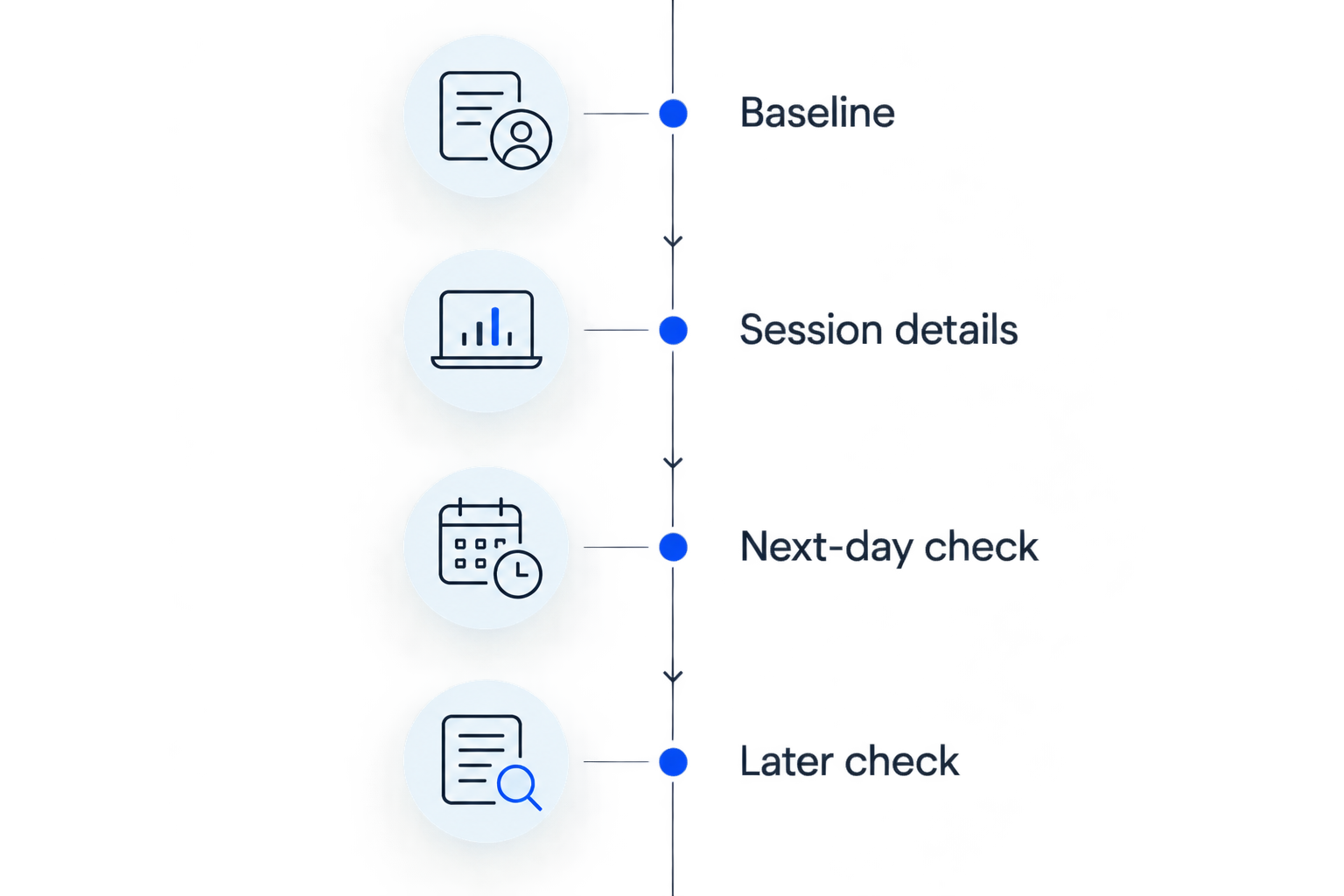
Record the surrounding training conditions as well as the services used.
Keep your 2026 session log brief enough to maintain. A few consistent observations are more useful for a scheduling decision than a detailed journal you abandon after the first appointment.
Interpret the result conservatively
Less soreness does not, by itself, prove greater muscle repair or readiness for harder training. Feeling relaxed is also different from demonstrating a performance change.
Look for a pattern under reasonably similar conditions. If you slept longer, reduced your workout, or took an extra rest day, record that alongside the session rather than assigning the whole change to the stack.
Do not increase training load simply because the session felt good. Use your established training plan and appropriate professional guidance when deciding what your next workout should involve.
Live Superhuman's PEMF and red light therapy sessions belong in this comparison as optional wellness services. Keep sleep, food, hydration, and sensible training decisions visible in the same record.
A second variant: separate-day sessions
Use separate-day sessions when a combined visit feels rushed or when you want a clearer account of each experience. This is a scheduling alternative, not a claim that spacing produces a stronger recovery effect.
Try PEMF on its own. Record comfort, preparation, and your normal recovery observations without adding red light to that appointment.
Try red light on its own. Follow its equipment instructions and use the same observation format.
Compare practical fit. Consider the travel, preparation, session experience, and ability to maintain your routine.
Combine only for a clear reason. A manageable schedule is a reason; assuming that more services must mean more recovery is not.
The advantage is simpler observation. The drawback is that different days bring different workouts, sleep, stress, and soreness, so separate appointments still do not create a controlled experiment.
If you revisit your 2026 routine after changing sports or training volume, return to the baseline step. An experience after a light workout is not a direct comparison with one after an unusually demanding session.
Troubleshooting your recovery stack
You cannot tell which service helped
Simplify the next comparison to one service. Keep the observation method consistent and note major training or sleep differences. Adding another modality makes attribution harder, not easier.
Do not treat a pleasant combined visit as a requirement to keep booking both. Choose the arrangement that has a clear purpose in your routine.
Your usual soreness is worse afterward
Stop treating the appointment as proof of improved readiness. Review the workout, the timing of your normal soreness, and anything uncomfortable during the visit with the provider.
New, severe, or worsening pain needs assessment rather than another recovery session. Severe muscle pain with marked swelling, weakness, or dark urine warrants urgent medical attention.
The settings do not match an online routine
Follow the instructions for the actual equipment. Device settings are not automatically transferable between systems, and a session duration alone does not describe the full exposure.
Ask staff to explain the relevant settings and positioning. Do not extend exposure or request a higher setting to match somebody else's experience.
You feel uncomfortable during a session
Tell staff immediately and ask to stop. Describe what you feel rather than assuming discomfort is part of the intended experience.
Do not repeat a session that caused an unexplained reaction without appropriate guidance. A recovery routine should not require you to ignore symptoms.
The combined appointment crowds out recovery basics
Choose one service or reduce the scheduling burden. If the outing displaces sleep, meals, or time needed between workouts, simplify it.
The best arrangement for your calendar is one you can assess without sacrificing the habits you already depend on. More appointments are not a useful goal by themselves.
Customize your workflow
Build the appointment around your sport, not around collecting services. A runner, strength trainee, and recreational court-sport player can use the same tracking structure while choosing different familiar movements and training comparisons.
Ask Live Superhuman about coordinating PEMF therapy and red light therapy around your existing schedule. Confirm suitability and appointment details directly; the presence of both services does not establish a combined session format.
For your next review, ask three questions: Was the experience comfortable? Did the schedule work? Do your notes support keeping both services? Remove the extra service if its role remains unclear.
FAQ
Can I combine PEMF therapy for muscle recovery with red light therapy?
Ask the provider to confirm suitability and equipment requirements before coordinating the sessions. Treat the combination as two services to assess, not a guarantee of better muscle recovery.
Should PEMF or red light therapy come first?
Let equipment instructions and provider guidance determine the order. Keep the approved sequence consistent when tracking your experience; do not assume that one order improves results.
Can I use PEMF and red light at the same time?
Do not assume simultaneous use is supported. The provider must confirm that both manufacturers permit the equipment arrangement and that it is suitable for you.
How long should each recovery session last?
Use the duration specified for the equipment and your appointment. Do not transfer session times from another device or extend exposure because you are combining services.
Is stacking better than choosing one service?
A combined appointment does not establish that stacking is better for you. Try each service separately and compare comfort, scheduling fit, and repeatable recovery observations before keeping both.
What should I track after a combined session?
Track your familiar movement, personal soreness rating, training, sleep, and any discomfort. Recording the surrounding conditions helps you avoid crediting the session for every change.
Can a recovery session replace a rest day?
Do not use a PEMF or red light session as an automatic replacement for planned recovery. Keep training decisions separate from how pleasant or relaxing an appointment feels.
One last thing
The most useful change to your 2026 recovery stack might be subtraction. If removing one service leaves the routine easier to maintain without a clear downside in your observations, you have a practical reason to keep the simpler arrangement.
Choose the smallest routine with a clear purpose. A longer list of services is not a recovery outcome.
Related guides
By Kelley Gast