To stack EWOT with hyperbaric oxygen therapy, have a qualified healthcare professional review whether both are appropriate, then agree on separate session settings and scheduling with your providers. Do not assume that EWOT must come first, that back-to-back sessions are better, or that combining them guarantees greater recovery or performance benefits.
TL;DR
To stack EWOT with hyperbaric oxygen therapy, start with suitability screening rather than a fixed session order.
EWOT involves exercise with supplemental oxygen; HBOT adds increased ambient pressure inside a chamber.
Keep exercise intensity, oxygen delivery, chamber pressure, and session duration distinct when planning your sessions.
Live Superhuman offers EWOT and hyperbaric oxygen therapy sessions for clients pursuing recovery and performance goals.
Why this matters
Two oxygen-based services are not interchangeable, and combining them is not proof of a better result. EWOT includes physical exertion. Hyperbaric oxygen therapy adds a pressurized environment, bringing different considerations for suitability and comfort.
For your 2026 recovery plan, distinguish what each session involves from what you hope it will accomplish. Live Superhuman offers both services; its guide to your first hyperbaric visit is a relevant starting point for understanding the chamber experience.
The practical goal is a schedule you understand, tolerate, and can evaluate—not the largest possible collection of treatments.
How do you stack EWOT with hyperbaric oxygen therapy?
Arrange the combination around individual suitability, not a universal “oxygen first, chamber second” rule. Start by identifying your goal, reviewing relevant health considerations, and confirming the details of each service before deciding whether they belong on the same day.
EWOT
Best for: People specifically exploring exercise with supplemental oxygen, after suitability review
What it involves: Physical activity while breathing supplemental oxygen
Advantage for planning: Connects the session to an exercise task
Limitation: Adds exertion; exercise tolerance matters
Hyperbaric oxygen therapy
Best for: People specifically exploring a pressurized oxygen session, after suitability review
What it involves: Oxygen exposure in a chamber above normal atmospheric pressure
Advantage for planning: Does not require an exercise task during the chamber session
Limitation: Requires chamber-specific screening and attention to pressure comfort
Separate-day scheduling
Best for: People who want to observe each experience separately
What it involves: EWOT and HBOT on different days
Advantage for planning: Makes the sessions easier to distinguish in your notes
Limitation: Requires separate visits and does not establish effectiveness
Same-day scheduling
Best for: People whose healthcare professional and providers support the combination
What it involves: Two distinct sessions within one day
Advantage for planning: Groups appointments into one day
Limitation: Makes it harder to attribute a response to either session
These are planning distinctions, not rankings of health benefits. Neither a convenient appointment sequence nor a more demanding session proves that you are getting a stronger result.
Start with your goal
Write down the specific reason you are considering the combination. “Support my recovery between training days” gives you a clearer discussion than “get more oxygen,” although it still does not establish that either service will deliver the outcome you want.
Tell your providers what your normal training week looks like. Include demanding workouts, competition dates, and whether you already use either service. A session plan should account for the activity surrounding it rather than treating the appointment as an isolated event.
Choose an observation you can describe consistently, such as how you feel during a familiar workout or whether chamber pressure causes discomfort. Keep the goal separate from a promise: feeling better after a visit does not establish which part of the visit caused the change.
Review suitability before setting the order
Discuss your health history, medications, recent illness, and exercise limitations with a qualified healthcare professional before combining sessions. For the chamber portion, specifically raise ear or sinus problems, difficulty equalizing pressure, lung conditions, and discomfort in enclosed spaces.
An untreated pneumothorax is a recognized contraindication to HBOT. Do not use a wellness article or a booking conversation as a substitute for appropriate medical screening.
Tell each provider about the other planned session. Reviewing EWOT alone and reviewing HBOT alone are not the same conversation as reviewing both alongside your training schedule.
Confirm what each session includes
Ask the EWOT provider to explain the exercise task, intended exertion, oxygen delivery, supervision, and stopping instructions. Ask the HBOT provider to explain chamber pressure, oxygen delivery, session duration, pressure changes, and communication during the session.
Do not treat chamber pressure as a complete description of oxygen exposure. Pressure, oxygen concentration, and time are different variables. Knowing one does not tell you the others.
Live Superhuman lists 1.6 ATA and 2.0 ATA chamber options. ATA means atmospheres absolute; 1 ATA is approximately normal atmospheric pressure at sea level. Those pressure labels do not establish which option suits you or how it should be paired with exercise.
Agree on scheduling rather than guessing
Ask directly whether your healthcare professional and providers support same-day scheduling for you. If they do, confirm the order, any separation between sessions, and the circumstances that would change the plan.
Do not invent a waiting interval from a social-media routine. A recommendation needs to account for the actual exercise session, chamber settings, your health considerations, and how you feel that day.
If you are unfamiliar with both services, discuss experiencing them separately before combining them. The planning advantage is clearer observation—not a claim that separate visits produce better results or eliminate risk.
Reassess before adding more
After each session, record what happened rather than what you expected to happen. Include the session details, comfort, unusual symptoms, surrounding exercise, and anything that changed from your usual routine.
Avoid increasing exercise intensity, changing chamber pressure, and adding another recovery service at the same time. Multiple changes make your experience harder to interpret.
A useful 2026 session plan includes a reason to pause or simplify. Continuing because you already booked the next appointment is not a sound way to judge suitability.
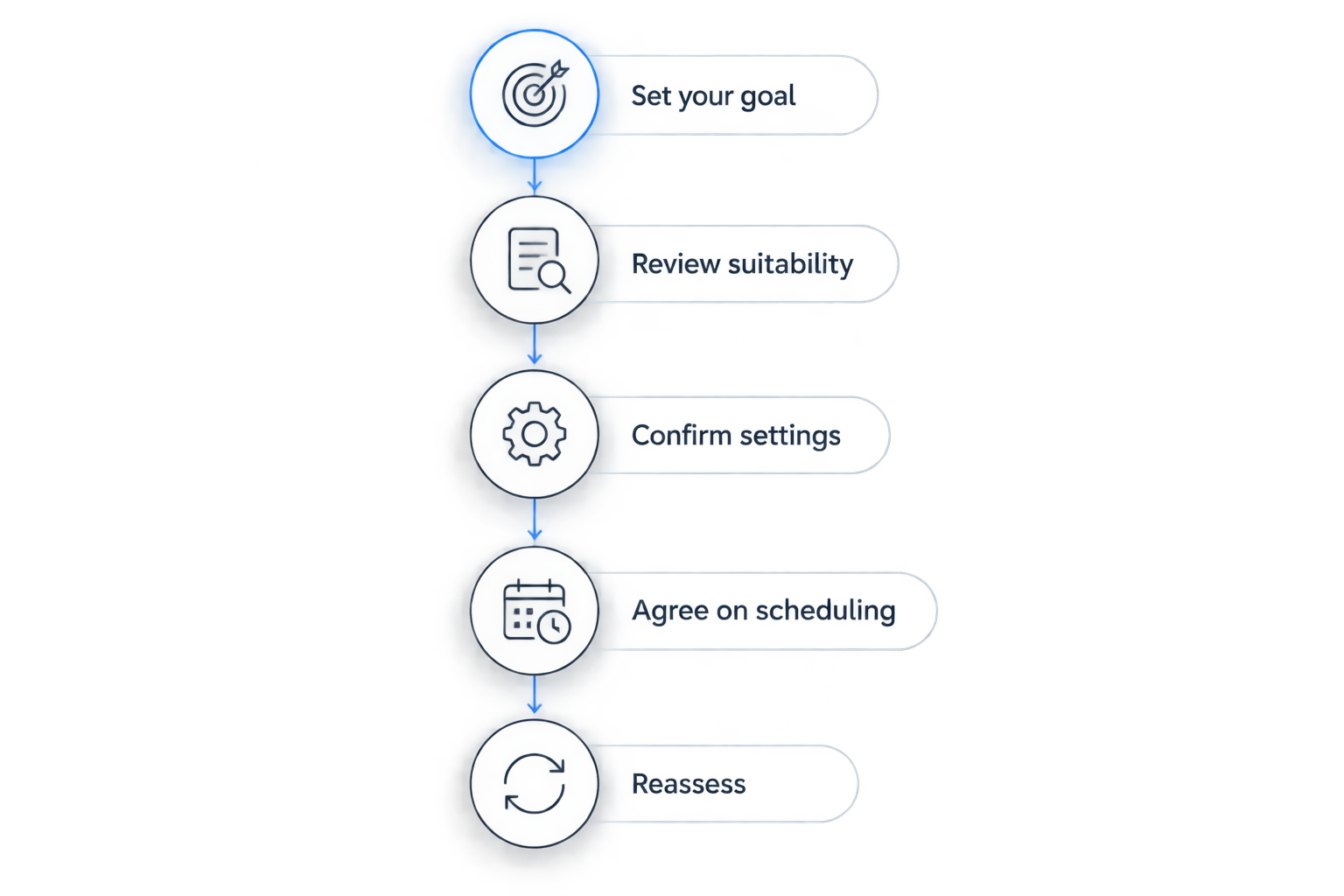
Decide whether the combination fits you before deciding which session comes first.
Why EWOT and HBOT scheduling varies
The right questions concern the person and the sessions—not the appeal of a named stack. Use these factors to guide the conversation:
Exercise demand: EWOT involves activity. Explain whether it would sit beside an easy training day, a demanding workout, or a competition.
Chamber exposure: Pressure, oxygen delivery, duration, and pressure transitions need their own explanation. Do not reduce the entire HBOT session to its ATA label.
Health considerations: Relevant conditions, medications, recent illness, and pressure-equalization difficulties belong in the suitability review.
Previous experience: Tell providers whether you have completed either session before and describe any discomfort or unusual response.
Your immediate condition: Report feeling unwell or experiencing new symptoms before starting. Do not conceal symptoms to keep an appointment.
Ability to evaluate the plan: Consider whether combining sessions will make your observations less clear, especially when other parts of your training are also changing.
These factors explain why copying another person's sequence is a weak starting point. Their appointment order does not describe their health history, exercise workload, or chamber exposure.
Should you do EWOT before or after HBOT?
Neither EWOT-first nor HBOT-first should be your automatic choice. Ask for an individualized sequence and the reason behind it rather than accepting an order simply because both services involve oxygen.
Exercise with supplemental oxygen and oxygen exposure under pressure are different experiences. Their shared use of oxygen does not establish that they work as interchangeable stages of one treatment.
For a 2026 booking, ask: “Why this order for my exercise workload and chamber session?” Follow with: “What would make you separate the appointments or postpone one?” A useful explanation addresses your circumstances without promising that the sequence will multiply the benefits.
If the explanation relies entirely on words such as “synergy” or “optimization,” request concrete session details. You need to understand what will happen and how the decision was made.
Can you do EWOT and HBOT on the same day?
Same-day scheduling requires an individual review; appointment convenience is not medical clearance. Make sure the healthcare professional reviewing suitability knows that you intend to combine the services.
A shared date also complicates interpretation. If your energy, comfort, or workout experience changes afterward, that observation alone cannot identify whether EWOT, HBOT, normal training variation, sleep, or another factor explains it.
Separate visits have a practical drawback: more appointments. Same-day visits have a different drawback: less separation between experiences. Choose with those trade-offs visible rather than treating either schedule as universally better.
Do not make the chamber visit a reason to push harder during EWOT. Keep the exercise task within the plan you agreed upon, and report symptoms instead of trying to complete the stack at all costs.
How do you tell whether the combination is useful?
Track the goal you started with, not just the number of sessions completed. Attendance records show that you attended; they do not demonstrate improved recovery or performance.
Keep a 2026 session log that separates observations from interpretations:
Session details
Useful entry: Exercise task, chamber pressure, duration, and order
What it does not establish: That a more demanding session was better
Comfort
Useful entry: Pressure discomfort, mask comfort, or exercise symptoms
What it does not establish: That tolerating a session proves suitability for future sessions
Training context
Useful entry: Workout type and whether the workload changed
What it does not establish: That the oxygen sessions caused a workout result
Recovery context
Useful entry: Sleep, soreness, and general energy described consistently
What it does not establish: That a subjective change proves a biological effect
Follow-up decision
Useful entry: Questions to discuss before repeating or changing sessions
What it does not establish: That every observation requires another treatment
Review patterns with the appropriate professional rather than diagnosing yourself from the log. If you are pursuing a performance outcome, discuss how to assess that outcome consistently without turning every good workout into evidence for the stack.
Simplifying the plan is a valid decision. You do not need to retain both services just because they were introduced together.
What should you ask before booking?
Before booking a 2026 combination, get clear answers to these questions. Save them with your appointment details so you do not have to reconstruct the plan afterward.
What is the specific purpose of each session in my schedule?
Who reviews whether each service—and the combination—is appropriate for me?
What exercise task and exertion are planned for EWOT?
What chamber pressure, oxygen delivery, and duration are planned for HBOT?
Why are these sessions scheduled in this order or on separate days?
How do I communicate discomfort and stop a session?
What should make me postpone or seek medical advice?
Live Superhuman is a wellness studio for clients seeking bookable EWOT and hyperbaric oxygen therapy sessions. That makes the studio relevant to this planning conversation; it does not establish that combining the services is appropriate for every client.
Use the contact page to ask about the session details before committing to a combined visit. Bring health-related suitability questions to a qualified healthcare professional rather than asking a booking page to answer them.
FAQ
What's the best way to stack EWOT with hyperbaric oxygen therapy?
Start with individual suitability screening, then confirm the settings and scheduling of each session. Do not assume that a fixed order, same-day appointment, or greater exposure produces a better result.
Should I do EWOT first or hyperbaric oxygen therapy first?
Do not automatically choose either order. Ask your healthcare professional and providers to explain the sequence in relation to your health considerations, exercise workload, and chamber session.
How long should I wait between EWOT and HBOT?
Use an interval agreed upon for your specific sessions rather than an interval copied from a general article. Confirm whether same-day scheduling is appropriate before choosing a gap between appointments.
Is EWOT the same as hyperbaric oxygen therapy?
EWOT and hyperbaric oxygen therapy are different services. EWOT combines exercise with supplemental oxygen, while HBOT involves oxygen exposure in a chamber above normal atmospheric pressure.
Does combining EWOT and HBOT guarantee faster recovery?
Combining EWOT and HBOT does not guarantee faster recovery. A change after a combined visit does not establish which service caused it or rule out other explanations.
Does a higher ATA chamber setting mean better results?
A higher ATA setting does not by itself establish better results for your goal. Pressure is only one session variable; oxygen delivery, duration, suitability, and the purpose of the session also matter.
What should I do if I feel unwell during either session?
Tell the supervising provider immediately and follow the instructions for stopping the session safely. Seek urgent medical help for severe symptoms such as chest pain, severe breathing difficulty, fainting, or new neurological symptoms.
One last thing
More variables can give you less clarity. If you begin EWOT, HBOT, a new workout plan, and additional recovery services together, you lose the ability to distinguish the experiences in any useful personal comparison.
Start your discussion with the smallest plan that addresses your actual question. The most useful next step is not necessarily another session—it is a clearer reason for the session you are considering.
Related guides
By Kelley Gast