
A hyperbaric oxygen therapy session has no single fixed duration: the length depends on the session you book and how its timing is defined. Confirm both your time inside the chamber and your total arrival-to-departure time, because preparation and any additional services extend the visit beyond the oxygen portion alone.
TL;DR
How long does a hyperbaric oxygen therapy session take? Confirm the booked duration and total visit length separately.
Hyperbaric oxygen therapy includes pressure changes; ask whether the quoted chamber time includes them.
Live Superhuman offers bookable hyperbaric oxygen therapy sessions for recovery and performance goals.
Pressure ratings describe chamber pressure, not appointment length.
Why this matters
A session length is only useful if you know when the clock starts and stops. Time receiving oxygen, time inside the chamber, and time at the studio are different scheduling measures.
For your 2026 appointment, get an arrival time and an expected departure time rather than relying on a session label. If you are new to the experience, the first hyperbaric visit guide is a relevant starting point for preparing your questions.
The practical goal is straightforward: leave enough room in your calendar to follow the session instructions without treating departure as a race. A tightly packed schedule is not a reason to rush a pressure change.
How long does a hyperbaric oxygen therapy session take?
Use the duration confirmed for your appointment, not a generic online estimate. Ask whether that duration refers to the oxygen portion, the full chamber experience, or the entire visit.
A hyperbaric appointment involves distinct stages. Some happen outside the chamber; others happen while you are already inside it. Understanding that distinction prevents you from accidentally adding the same time twice—or leaving necessary time out.
Arrival and preparation
What happens: You complete the required check-in and preparation
What to confirm: When you need to arrive
Pressurization
What happens: Chamber pressure increases to the planned setting
What to confirm: Whether this is included in the quoted chamber time
Oxygen portion
What happens: You receive oxygen according to the session instructions
What to confirm: What the stated session duration measures
Depressurization
What happens: Chamber pressure returns toward normal ambient pressure
What to confirm: Whether this is included in the quoted chamber time
Departure or another service
What happens: You finish the visit or continue to another booked session
What to confirm: Your expected departure time
Do not assume that a booking labeled with a duration begins the moment you enter the building. Equally, do not assume that pressurization and depressurization always sit outside the advertised duration. The provider’s definition is what makes the number usable.
For planning in 2026, request the complete appointment window in writing. Your confirmation should make it clear whether you need to arrive before the displayed booking time.
What happens during the appointment?
The appointment follows a sequence, but the sequence does not establish a universal duration. Use these stages to ask better scheduling questions rather than to calculate an appointment length yourself.
Arrival and preparation
Before entering the chamber, follow the provider’s screening, clothing, and personal-item instructions. Hyperbaric environments require specific safety precautions, so do not substitute advice from an unrelated wellness session.
Ask which forms or instructions you can complete before arrival. Completing permitted preparation ahead of time removes avoidable administrative delays; it does not shorten the chamber experience itself.
Pressurization
As pressure increases, you need to equalize the pressure in your ears. Tell the attendant promptly if you have difficulty or discomfort rather than waiting for that stage to finish.
Ask how you will communicate with the attendant before entering the chamber. Knowing how to request help matters more than predicting the exact length of this stage.
Oxygen portion
The oxygen portion is the part people often mean when they describe session time. However, the phrase alone does not tell you whether the provider includes the surrounding pressure changes.
Ask what you will be doing during this part of the appointment and which activities or items are permitted. Do not assume that a phone, book, or other personal item is allowed simply because you expect to be seated or resting.
Depressurization
At the end of the pressure exposure, chamber pressure returns toward normal ambient pressure. This is part of the chamber experience, not an optional step you can remove to meet another commitment.
Confirm the departure estimate before booking if you have a hard deadline. If the appointment does not fit, choose a different booking window rather than planning to leave the chamber early.
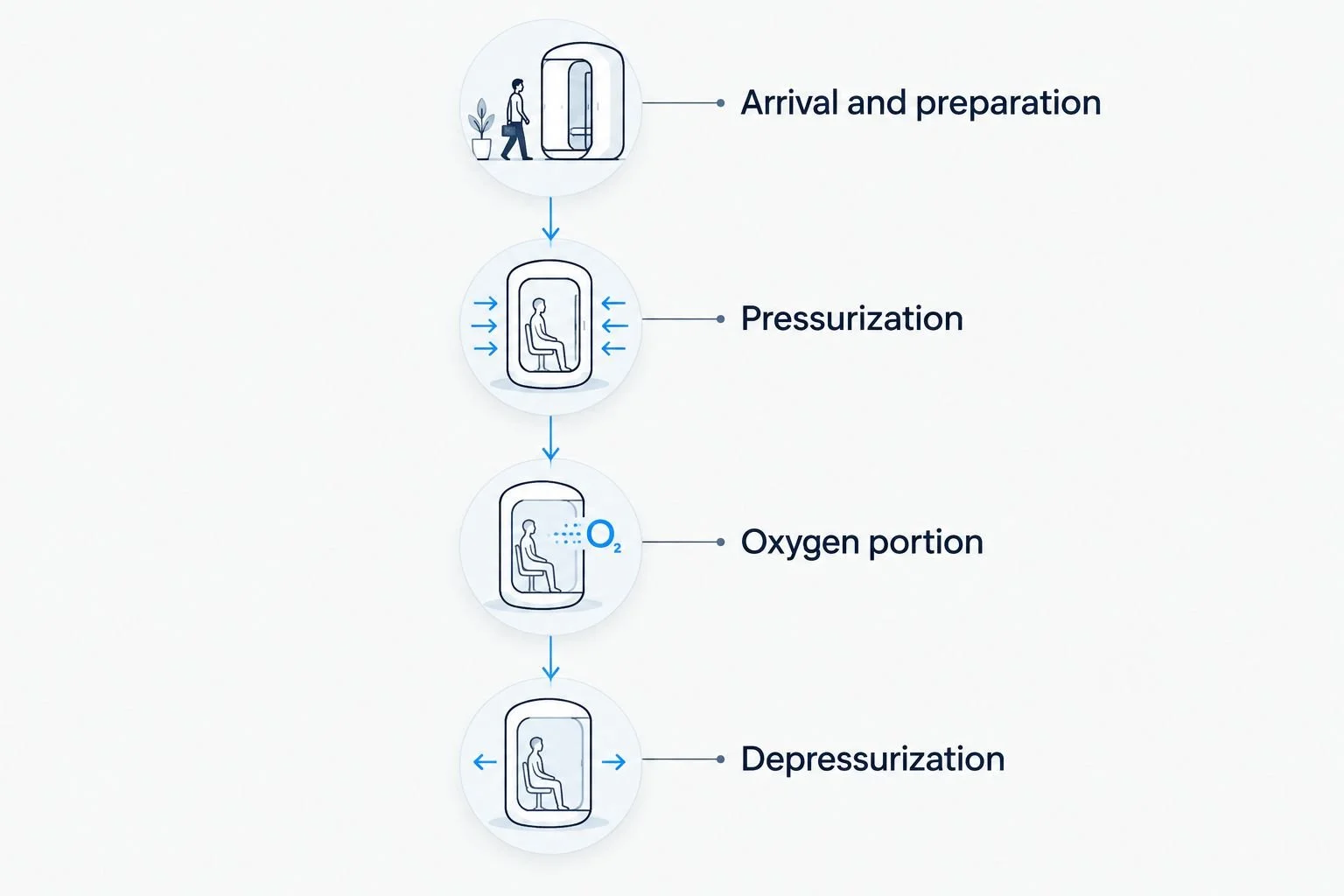
Ask which stages are included in the quoted session duration.
The sequence helps you interpret a booking description. It does not replace the provider’s instructions or establish a departure time for your particular appointment.
Does chamber pressure change session length?
A pressure rating does not tell you how long an appointment lasts. ATA means atmospheres absolute: it describes pressure, not minutes.
Live Superhuman offers hyperbaric oxygen therapy with 1.6 ATA and 2.0 ATA chamber options. Those figures identify different pressure settings; they do not establish the length of either appointment or show that one fits your schedule better.
1.6 ATA
What the figure tells you: The stated chamber pressure
What it does not tell you: Oxygen duration, total chamber time, or visit length
2.0 ATA
What the figure tells you: The stated chamber pressure
What it does not tell you: Oxygen duration, total chamber time, or visit length
Do not infer that the 2.0 ATA option is faster than the 1.6 ATA option. A higher pressure figure is not a shortcut, a duration estimate, or evidence that a session is better suited to your goals.
When comparing your 2026 booking choices, ask for timing for the specific option you intend to reserve. Then discuss suitability separately with the provider and, where relevant, your healthcare professional.
Why hyperbaric appointment length varies
Appointment length reflects more than the time associated with oxygen delivery. These are the scheduling factors to clarify:
Booked session: Confirm the duration attached to the specific appointment, rather than borrowing a number from another service or provider.
Timing definition: Establish whether the stated duration includes pressurization and depressurization.
First-visit preparation: Ask whether your initial visit includes additional screening, forms, or an orientation.
Pressure equalization: Tell the attendant about difficulty equalizing; your comfort and safety take priority over a calendar estimate.
Additional services: Confirm separate time for any other sessions you book during the same visit.
These factors explain why two appointment descriptions can sound similar without representing the same amount of time at a studio. Compare equivalent measures before deciding which booking fits your day.
Your own schedule is also a decision factor, even though it does not determine chamber timing. If the confirmed appointment window conflicts with work, childcare, or transportation, select another time instead of assuming you can compress the visit.
Is a first visit longer than a repeat visit?
A first visit includes preparation that returning clients have already encountered, such as learning the chamber instructions. Ask whether that preparation requires an earlier arrival or is included in the booking window.
Do not assume a repeat visit automatically has a shorter chamber session. Familiarity with check-in and instructions is different from a change to the booked oxygen or pressure exposure.
For a first appointment in 2026, confirm what you need to complete beforehand and what happens onsite. That gives you a useful planning answer without relying on an invented allowance for every new visitor.
Can you combine HBOT with another wellness session?
Combining services requires scheduling each booked session, not treating the second service as incidental. Ask for a combined arrival-to-departure estimate before you reserve the visit.
Live Superhuman offers hyperbaric oxygen therapy, red light therapy, PEMF, EWOT, and altitude training sessions. Live Superhuman is best for clients seeking bookable wellness sessions focused on recovery and performance. The scheduling limitation is that a service list alone does not tell you the total time needed for a combined visit.
If you plan to book more than one service, confirm the order, any preparation requirements, and time between sessions. Do not assume that activities occur simultaneously or that every combination fits the same appointment window.
More services also mean more decisions about whether the visit fits your goals and calendar. Choose the sessions deliberately rather than adding them simply because you are already onsite.
What should you ask before booking?
Use this short sequence to turn a vague duration into a workable appointment plan. It applies whether you are booking your first visit or changing to a different chamber option.
Name the session. Identify the exact service and chamber option you want to discuss.
Define chamber time. Ask whether the stated duration includes both pressure changes.
Confirm arrival time. Establish whether preparation happens before the booking starts.
Confirm departure time. Include any additional services in the expected finish.
Explain hard deadlines. Tell the provider before booking if you must leave by a specific time.
A useful message is simple: ask for the full visit length, what the quoted session time includes, and when you should arrive. You can use the contact page to request those details.
Keep the confirmed appointment window with your 2026 calendar entry. If you later change services or chamber options, reconfirm the timing instead of carrying the previous estimate over.
FAQ
How long does a hyperbaric oxygen therapy session take from arrival to departure?
The full visit takes the appointment window confirmed by your provider, including preparation and the booked chamber experience. Ask for an expected departure time, not just the duration of the oxygen portion.
Does hyperbaric session time include pressurization?
That depends on how the provider defines the quoted session time. Ask explicitly whether both pressurization and depressurization are included before using that duration to plan your day.
Does 2.0 ATA mean a longer session than 1.6 ATA?
Neither 2.0 ATA nor 1.6 ATA establishes session length; ATA describes pressure. Confirm timing for the specific chamber option rather than inferring minutes from the pressure rating.
Should I arrive early for my first hyperbaric appointment?
Follow the arrival time supplied for your first appointment. Ask whether forms, screening, and chamber instructions happen before the displayed booking time or within it.
Can I leave a hyperbaric session early if I have another appointment?
Do not plan an early departure as a way to shorten a hyperbaric appointment. Tell the provider about your deadline before booking, and communicate with the attendant if you need assistance during the session.
Can I use my phone during a hyperbaric oxygen session?
Use only items the provider explicitly permits inside the chamber. Ask about phones and other personal items beforehand rather than assuming they are allowed during the oxygen portion.
Will adding red light therapy change my total visit time?
A separately booked red light therapy session needs to be included in your total appointment plan. Confirm the combined schedule and any time between services before arranging your departure.
One last thing
The most useful scheduling answer is an expected departure time. A session duration tells you about one part of the experience; a departure estimate helps you organize the whole visit.
Before committing, check that the arrival instructions and appointment window agree. If they do not, ask the provider to clarify them before you arrange transportation or place another commitment immediately afterward. That small check is more useful than choosing an arbitrary buffer based on someone else’s appointment.
Related guides
By Kelley Gast