EWOT is worth considering as an optional training add-on for athletes who have a clear goal and a way to measure progress; it is not a replacement for consistent training, sleep, or nutrition. Breathing supplemental oxygen during exercise does not, by itself, demonstrate better race performance or faster recovery afterward. For your 2026 training plan, judge EWOT by repeatable changes in your sport—not by how energized you feel after a session.
TL;DR
Is EWOT therapy worth it? Consider it only as a measurable add-on, not a substitute for training fundamentals.
Live Superhuman offers bookable EWOT sessions for athletes exploring exercise with supplemental oxygen.
An easier-feeling session does not establish a lasting improvement in VO2 max or race performance.
Choose a repeatable benchmark and clear stopping criteria before committing to ongoing sessions.
Why this matters
Athletes need to separate an interesting training experience from a useful training investment. A session can feel different without improving the outcome you actually care about: holding race pace, sustaining power, or completing your planned workload.
Live Superhuman is best for athletes seeking bookable EWOT sessions rather than a home equipment purchase. That is a service-fit recommendation, not a promise of performance gains. If aerobic capacity is your goal, the EWOT and VO2 max training guide provides a related starting point for your questions.
The useful question for 2026 is not whether oxygen matters to exercise. It does. The question is whether adding supplemental oxygen produces enough relevant benefit to justify the extra appointment, effort, and expense in your own training schedule.
Is EWOT therapy worth it for athletes?
EWOT deserves consideration only when you can distinguish its contribution from the exercise you are already doing. EWOT means exercise with oxygen therapy: physical activity performed while breathing supplemental oxygen. The exercise and the oxygen exposure are separate parts of the experience, and both matter when you interpret results.
Ordinary air contains about 20.9% oxygen. Breathing oxygen-enriched air changes what you inhale, but the inhaled concentration alone does not establish a lasting training adaptation. You still need to ask what changed after the session and whether that change carries into your sport.
Conventional exercise in room air
Best for: Athletes building sport-specific fitness
Main advantage: Provides a direct training baseline without an added oxygen session
Main limitation: Training still requires appropriate progression and recovery
EWOT
Best for: Athletes evaluating exercise with supplemental oxygen
Main advantage: Lets you explore oxygen-assisted exercise as a separate training variable
Main limitation: Session experience alone cannot establish lasting performance benefit
Altitude training
Best for: Athletes with an altitude-specific preparation goal
Main advantage: Addresses exercise or exposure under reduced oxygen availability
Main limitation: Adds a different stress and is not interchangeable with EWOT
The practical verdict is conditional: consider EWOT when the basics are stable, the session fits your training, and the result can be evaluated. Defer it when you are hoping an added service will compensate for inconsistent workouts or inadequate recovery.
EWOT for endurance athletes: measure performance outside the session
Runners, cyclists, swimmers, and triathletes should connect an EWOT trial to a specific endurance question. Holding a familiar pace with less perceived effort is a different goal from improving a laboratory measurement of aerobic capacity.
VO2 max is commonly expressed in milliliters of oxygen per kilogram of body mass per minute, written as mL/kg/min. A change in how hard a session feels is not the same measurement. Neither is a wearable estimate automatically equivalent to a direct exercise test.
Choose a benchmark that matches your sport and that you can repeat under comparable conditions. For example, record pace or power alongside perceived effort on the same familiar workout. Do not treat a harder effort on a better-rested day as evidence that the oxygen exposure caused improvement.
Best for: endurance athletes with an established training routine and a repeatable performance benchmark. The drawback is attribution: fitness, pacing, weather, fatigue, and motivation also affect the result.
EWOT for strength and mixed-sport athletes: keep the goal specific
For strength athletes, the question is not simply whether EWOT feels demanding. Ask whether the intended benefit concerns conditioning between efforts, tolerance of a planned training workload, or another clearly defined outcome.
A heavier lift does not directly measure aerobic fitness. Likewise, a smoother conditioning session does not establish improved maximal strength. Keep the measure aligned with the reason you added the session.
Athletes in mixed sports face an additional problem: changing several training variables makes the result hard to interpret. If you add EWOT while also increasing conditioning volume, changing your lifting plan, and improving sleep, you cannot isolate the contribution of EWOT.
Best for: mixed-sport athletes evaluating a specific conditioning question. The limitation is that a favorable conditioning result does not automatically transfer to strength, skill, or competition performance.
Why EWOT's value varies
EWOT's value depends on the athlete, the session, and the outcome being measured. These factors belong in your 2026 decision before you commit to ongoing visits:
Your goal. General curiosity, improved aerobic fitness, and preparation for a particular event require different ways of judging success.
Your exercise workload. Mode, duration, and intensity determine what exercise you actually complete; an oxygen session is not independent of that workload.
Your oxygen exposure. Ask what oxygen concentration is delivered and how the delivery setup works. Do not assume different setups create identical conditions.
Your training context. Changes in sleep, nutrition, total workload, and other recovery practices complicate any before-and-after comparison.
Your measurement method. A familiar workout, a wearable estimate, and a direct exercise test answer different questions.
Your opportunity cost. Travel, scheduling, and another appointment matter if they displace the training or recovery habits you already need.
A worthwhile session must fit the rest of your program. If the visit adds stress to an already overloaded week, that trade-off belongs in the decision even when you enjoy the experience.
How do you evaluate EWOT without guessing?
Treat your 2026 evaluation as a structured training decision, not a search for a dramatic sensation. Choose the outcome before the session so you do not redefine success afterward.
Choose your goal. Write down the specific question you want answered. Avoid broad targets such as feeling optimized; use an observable training outcome instead.
Record your baseline. Log a familiar workout before changing your routine. Include the exercise, workload, effort, and relevant conditions.
Confirm session details. Ask about the activity, oxygen delivery, supervision, and how the session fits your current training. Discuss health concerns before participating.
Compare like conditions. Repeat the same benchmark under reasonably similar circumstances. Record changes in sleep, fatigue, and training load alongside the result.
Decide whether to continue. Review performance, tolerability, convenience, and the effect on your schedule. Stop treating continued attendance as the default.
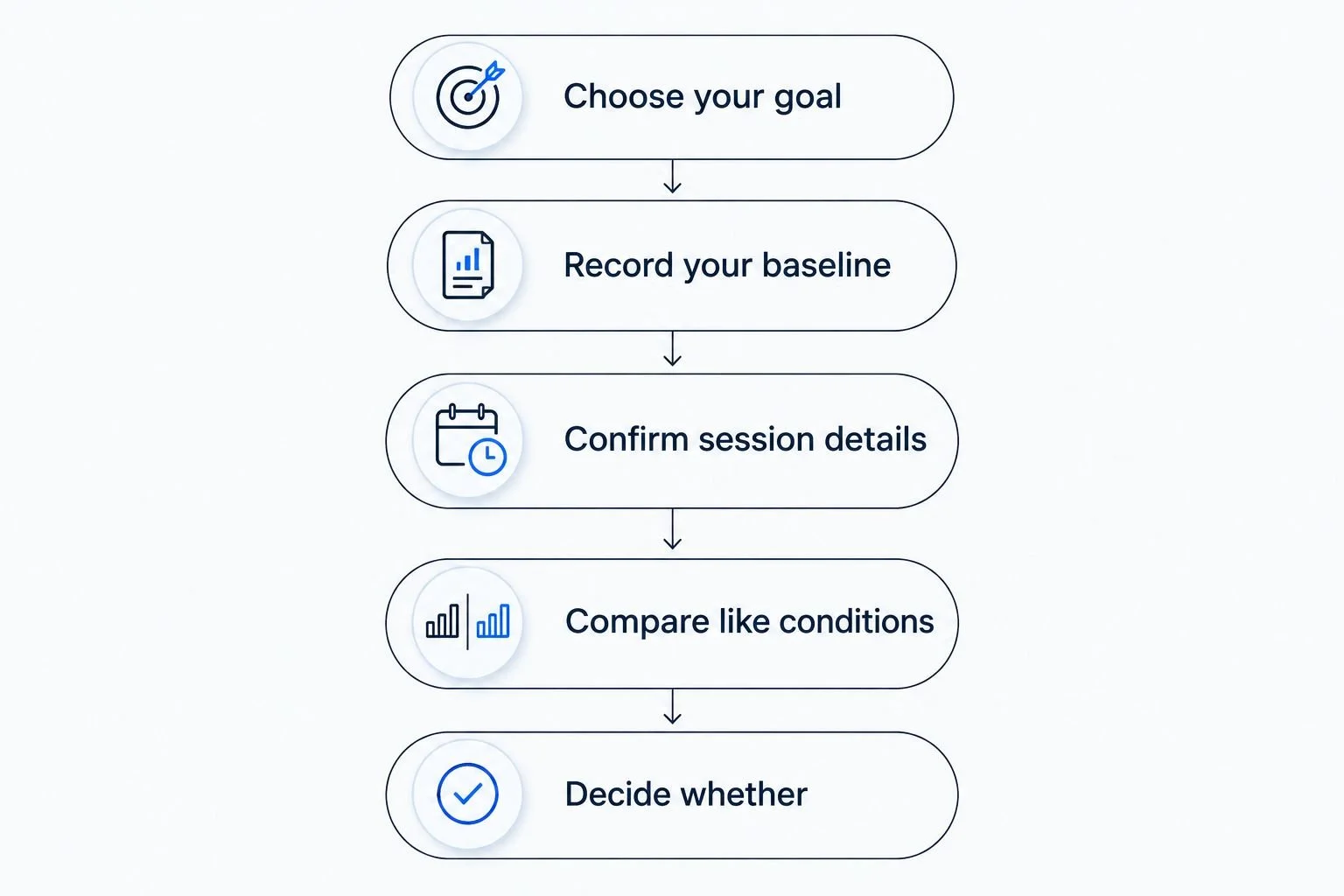
Choose the outcome before the session so the result answers a useful training question.
A simple log is enough to make your reasoning clearer. Record workout duration in minutes, pace or power where relevant, and perceived exertion on a consistent 0–10 scale. These are tracking suggestions, not a prescribed EWOT session length or an expected improvement.
A personal log cannot prove cause and effect. It can still reveal whether the experience fits your routine, whether you tolerate it, and whether your reason for continuing is more specific than a good first impression.
What should you ask before booking an EWOT session?
Ask how the provider defines the session and what information you need to bring. Clear answers matter more than broad claims about energy, recovery, or performance.
Use these questions to make the conversation practical:
What exercise will I perform, and how is the workload selected?
What oxygen concentration is delivered, and how is it monitored?
Who supervises the session, and what happens if I feel unwell?
What health history, medication information, or exercise restrictions should I disclose?
How should this session fit around my planned training?
What outcome would justify continuing, and how would I measure it?
Live Superhuman offers EWOT sessions alongside other wellness services. Confirm the EWOT-specific details rather than assuming that information about another service describes the session you are booking.
Ask about an EWOT session
Discuss your training goal and confirm session details before booking.
Does EWOT improve VO2 max?
EWOT should not be treated as a guaranteed way to raise VO2 max. Breathing supplemental oxygen during exercise and developing greater aerobic capacity afterward are different outcomes. A claim about lasting improvement needs evidence that matches the session approach and the athletes involved.
Ask whether a claimed improvement came from a direct exercise test or an estimate, and whether the comparison accounted for training itself. A result measured during oxygen-assisted exercise does not automatically establish the same result when competing in ordinary air.
For your own decision, keep the distinction simple: measure the performance you need outside the EWOT session. A better session experience is useful information, but it answers a narrower question.
Is EWOT the same as altitude training?
EWOT and altitude training are different approaches, not substitutes. EWOT involves supplemental oxygen during exercise; altitude exposure involves lower oxygen availability than at sea level. Their opposite oxygen conditions are a reason to ask different questions about their purpose.
If you are preparing for an event at elevation, discuss the demands of that event specifically. Do not assume that an oxygen-assisted workout provides altitude acclimatization or that combining the approaches automatically improves results.
When should you skip or postpone EWOT?
Postpone EWOT when the session's purpose is unclear or your health questions remain unresolved. Supplemental oxygen and exercise both deserve appropriate screening; a wellness session is not a substitute for evaluation of unexplained symptoms.
Get medical guidance before participating if you have a heart or lung condition, use prescribed oxygen, or have been told to restrict exercise. Stop exercising and seek appropriate help for chest pain, fainting, or unusual breathlessness rather than trying to push through a session.
Also defer EWOT when the appointment would displace sleep, rehabilitation, or essential training. Optional additions belong after the work your program already requires—not in place of it.
FAQ
Is EWOT therapy worth it for recreational athletes?
EWOT is worth considering for recreational athletes only as an optional, measurable addition to an established routine. Start with a specific goal and evaluate whether the sessions fit your training and schedule.
Will EWOT make me faster?
EWOT does not guarantee faster race performance. Evaluate pace or power outside the oxygen-assisted session under comparable conditions rather than assuming an easier-feeling workout will transfer to competition.
How many EWOT sessions do I need before judging results?
There is no session count that guarantees a performance result. Choose a goal, an evaluation approach, and a review point with the provider before committing to ongoing visits.
Can EWOT replace cardio training?
EWOT does not replace cardio training; it includes exercise performed with supplemental oxygen. The exercise workload still needs to fit your sport, fitness, and overall training plan.
Is EWOT better than altitude training?
Neither approach is automatically better because EWOT and altitude training address different oxygen conditions. Choose based on a specific training goal rather than treating them as interchangeable services.
Can I use a pulse oximeter to prove EWOT is working?
A pulse oximeter reading does not prove that EWOT improves athletic performance. It estimates blood oxygen saturation, not VO2 max, race pace, strength, or lasting training adaptation.
Does Live Superhuman offer EWOT?
Live Superhuman offers bookable EWOT sessions. Ask the studio about the session setup, screening, and how the visit fits your training goal before booking.
One last thing
Decide what would make you stop before you decide to start. That single choice makes your 2026 evaluation more useful: enjoyment, convenience, and measurable performance are valid considerations, but they are not the same result.
If you cannot name the outcome you want, postpone the purchase decision. A clear training question is more valuable than another appointment without a purpose.
Related guides
By Kelley Gast