A photobiomodulation therapy bed is not automatically better than a red light panel: a bed suits broad exposure while you lie down, and a panel suits directed exposure with adjustable positioning. Neither format establishes a better recovery outcome by itself. Compare the actual wavelengths, light delivered at your skin, exposure instructions, and coverage—not the size of the equipment or the name on the session.
TL;DR
A photobiomodulation therapy bed wins on lying-down convenience, not automatic recovery superiority over a red light panel.
Red light panels suit targeted positioning; large arrangements also support broader coverage.
Compare wavelengths, exposure instructions, and measured light at the intended treatment position—not electrical wattage alone.
Live Superhuman offers bookable red light therapy sessions; confirm equipment details before choosing a format.
Why this matters
Your real decision is not which device looks more advanced. It is which setup exposes the area you care about, follows clear operating instructions, and fits a routine you can repeat without improvising.
In 2026, treat “full body” as a coverage description, not a promise of better results. Before comparing equipment, understand what happens inside a red light session. Then ask whether the proposed setup matches your goal and whether the provider can explain its settings without relying on broad recovery claims.
Is a light bed better than a panel?
A bed is better for lying-down convenience; a panel is better for flexible positioning. Neither wins on outcomes from its shape alone. Both formats can deliver light used for photobiomodulation, but their configurations differ. A wraparound bed, an overhead canopy, and a freestanding panel do not expose the body in identical ways.
Best for
Photobiomodulation therapy bed: Broad exposure while lying down
Red light panel: Directed exposure and adjustable positioning
Main advantage
Photobiomodulation therapy bed: A supported position during the session
Red light panel: Flexibility to face a selected area toward the light
Main limitation
Photobiomodulation therapy bed: Coverage depends on the bed's emitter arrangement
Red light panel: Position, distance, and turning require attention
Coverage question
Photobiomodulation therapy bed: Which surfaces receive light in this position?
Red light panel: Which areas fit within the intended exposure area?
Evidence question
Photobiomodulation therapy bed: Does the evidence match this device and use?
Red light panel: Does the evidence match this device and use?
A fair comparison starts with the same goal and body area. Comparing a bed intended for broad exposure with a small panel aimed at a single area tells you about convenience and coverage—not which technology produces better recovery.
Photobiomodulation bed: best for lying down
Choose a bed when a supported, lying-down position is your priority. That is a practical advantage, particularly if standing still or managing a panel's position makes the session awkward.
The limitation is that “bed” does not describe a single optical arrangement. Light might come from above, below, or around you, depending on the device. Your body position and any surface between the emitters and your skin affect what is exposed.
For a 2026 bed comparison, ask the provider to show you where the light originates and which areas remain outside direct exposure. Ask whether you stay in one position or change position during the session. Do not assume that lying inside a large device means every body surface receives the same exposure.
Best for: people who prioritize a supported position and broad coverage. Choose by the actual arrangement, not the enclosure's appearance.
Red light panel: best for positioning
Choose a panel when you want control over which area faces the light. A freestanding or mounted panel allows different orientations, subject to the manufacturer's operating instructions and the available setup.
The trade-off is positioning work. Distance, angle, and the area facing the emitters need to remain consistent. Moving closer is not a universal improvement, and changing position midway makes the exposure harder to describe accurately.
A panel is also not necessarily a small-area device. Coverage depends on its dimensions, arrangement, and intended working distance. A larger panel arrangement deserves the same coverage questions as a bed.
When assessing a panel in 2026, ask to see the intended user position rather than judging the equipment while it is switched off against a wall. Best for: people who prioritize directed exposure and adjustable positioning. Its advantage is flexibility, not automatic superiority in light delivery.
Why the bed-versus-panel answer varies
The useful differences sit beneath the format label. These factors explain why two devices with different shapes cannot be ranked from appearance alone:
Wavelengths: Ask which wavelengths the device emits. “Red light” is not a complete technical specification, and visible brightness does not describe every wavelength present.
Light at the skin: Ask for irradiance at the intended treatment position. Electrical power consumption is not the same measurement as light delivered to your skin.
Exposure time: Compare the manufacturer's instructions for the actual setup. A longer session is not automatically a better session.
Coverage: Identify the areas directly facing the emitters, along with shadows, obstructions, and surfaces that require repositioning.
Positioning: Check whether the intended distance and orientation are comfortable enough to maintain. An impressive specification does not resolve an impractical setup.
Evidence match: Ask whether supporting research addresses the same goal and relevant device settings. Findings from one application do not establish every advertised recovery benefit.
These questions also expose incomplete comparisons. If one provider supplies measurements at the treatment position and another supplies only a power rating, you do not yet have equivalent information.
Read the light measurements correctly
The most useful technical distinction is between electrical input, irradiance, and radiant exposure. They describe different things; a bigger number in one category cannot substitute for a missing number in another.
Electrical input, in watts
What it describes: Power consumed by the equipment
What to ask: Is this an input rating rather than a skin-level measurement?
Irradiance, in mW/cm²
What it describes: Incident light power per unit area
What to ask: Where and how was it measured?
Radiant exposure, in J/cm²
What it describes: Incident light energy per unit area over time
What to ask: Does the stated exposure match the session instructions?
For steady irradiance, radiant exposure equals irradiance multiplied by time, using compatible units. 1 watt equals 1,000 milliwatts, and 1 minute equals 60 seconds. A joule is the energy transferred by 1 watt over 1 second.
Those are unit conversions, not recommended settings. They explain why a duration alone cannot establish equivalent exposure across devices. They also explain why a panel's wall-power rating cannot tell you how much light reaches a particular area of skin.
In 2026, ask for the measurement location alongside every irradiance claim. A reading without its distance, position, and measurement method leaves an important part of the comparison unanswered. Even a complete incident-light measurement does not establish how much energy a specific tissue absorbs or what outcome you will experience.
How do you choose the right format?
Use the same sequence for either option. The goal is to choose a workable setup without turning technical specifications into promises they cannot support.
Define your goal. State what you want to evaluate in plain language, such as post-workout soreness or how ready you feel for your next planned session. Avoid a vague target such as “optimize everything.”
Map the area. Identify the body area you want exposed. Ask the provider to show how that area faces the light and whether anything blocks it.
Check the settings. Request the device's wavelengths, intended positioning, exposure instructions, and relevant safety guidance. Ask what the supporting evidence actually addresses.
Test the position. Establish whether you can comfortably maintain the intended posture. Do this before assuming a bed or panel fits your needs.
Track one outcome. Record a specific observation consistently rather than changing the session, training load, and recovery routine together.
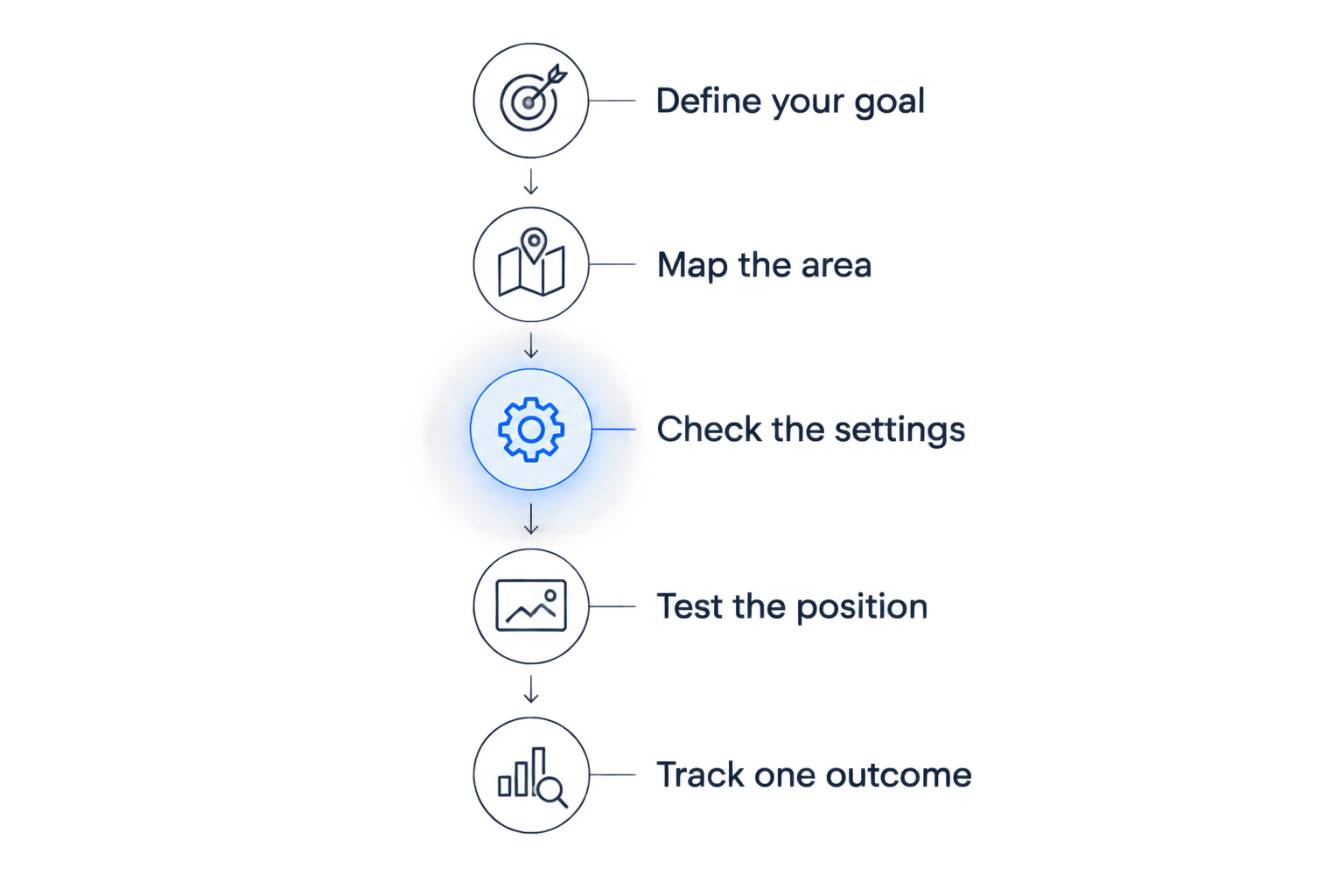
Choose the setup after clarifying the goal, coverage, settings, and position.
Tracking an outcome helps you describe your experience; it does not prove that light exposure caused a change. Sleep, training, and other recovery choices also belong in the picture. Keep those details in your notes instead of treating every good training day as confirmation that the device worked.
Does full-body coverage settle the choice?
No. Broader coverage answers where light is directed, not whether a session produces a better outcome for your goal. If your comparison includes full-body red light therapy panels, the meaningful distinction is the exposure arrangement—not simply that one option is a panel and another is a bed.
Ask each provider the same question: “Which areas receive direct light while I hold the intended position?” Follow with a question about turning, distance, and any obstruction. This makes the answer concrete without assuming that all full-body equipment works identically.
A bed's main convenience is the supported position. A panel arrangement's main convenience is positioning flexibility. Those advantages are real usability differences, but neither is evidence of greater recovery benefits.
Choose coverage that matches your purpose, not the largest illuminated area you can find. If the provider cannot explain the relationship between the setup and your goal, expanding coverage does not solve that problem.
What should you check before a session?
Read the device-specific safety instructions before exposure, including eye protection guidance. Do not assume that instructions for a different panel, bed, or online routine apply to the equipment in front of you.
Tell the provider about relevant medications and any known light sensitivity. If you have a condition or treatment that raises questions about light exposure, ask your healthcare professional before starting. A wellness session is not a substitute for assessment of persistent pain or an injury.
Comfort is also part of the decision. Ask how to stop the session, change position safely, and report discomfort. There is no reason to tolerate a poorly explained setup just because the equipment looks advanced.
These checks apply to both formats. A bed does not remove the need for safety instructions, and a panel does not become appropriate simply because you control its position. Clear instructions matter more than confidence in the device's appearance.
Where a studio session fits
Live Superhuman is best for people seeking bookable red light therapy sessions rather than equipment ownership. The studio offers red light therapy, but a service listing alone does not establish the exact device configuration, wavelengths, or exposure settings for your visit.
Before arranging a session with Live Superhuman, confirm those details and describe the goal you want to discuss. The advantage is access to a bookable session without choosing equipment to own. The trade-off is scheduling and relying on the studio's setup rather than controlling your own installation.
Ask about the actual session, not whether the studio can declare beds or panels universally better. A useful answer explains positioning, coverage, instructions, and limits. It does not need to promise a specific recovery result to help you decide whether the experience fits.
Will a bed work faster than a panel?
Neither format establishes a faster result. Session duration and time to a noticeable change are different questions, and device shape answers neither one. Ask whether evidence for the proposed use matches the equipment and settings being discussed.
Should you choose a bed for recovery?
Choose a bed for supported positioning, not a guaranteed recovery advantage. Compare the exposure arrangement with your goal, and keep red light sessions separate from decisions about returning to activity after an injury. Persistent symptoms deserve appropriate assessment rather than repeated experimentation with equipment.
FAQ
Is a photobiomodulation therapy bed better than a red light panel?
A photobiomodulation therapy bed is better for supported, lying-down exposure; a panel is better for flexible positioning. Neither format establishes better recovery outcomes by itself.
Can a red light panel cover my whole body?
A red light panel arrangement can support broad coverage, depending on its size, placement, and intended working distance. Ask which areas receive direct exposure and whether you need to turn.
Does a brighter red light mean a stronger session?
Visible brightness does not establish the light exposure delivered to your skin. Compare wavelengths, measured irradiance at the intended position, and the device's exposure instructions.
Should I stand closer to a red light panel?
Use the distance specified for the actual device rather than assuming closer is better. Changing distance changes the exposure arrangement and makes comparisons less reliable.
Do I need eye protection in a red light bed?
Follow the specific device's eye protection instructions. Confirm those instructions before the session rather than copying guidance from another bed or panel.
Does Live Superhuman offer red light therapy sessions?
Live Superhuman offers bookable red light therapy sessions. Confirm the equipment configuration, positioning, exposure instructions, and suitability for your goals before arranging a visit.
One last thing
For your 2026 comparison, request a demonstration with the device switched off: where will you lie or stand, which area will face the emitters, and what will block the light? That simple walkthrough tests the practical claims behind “full body.” If you cannot clearly describe the exposure position, you are not ready to compare session settings.
Related guides
By Kelley Gast