
Red light therapy for golfers is a light-based wellness session used with the aim of supporting recovery between rounds and practice sessions. Golfers need to distinguish everyday post-play soreness from an injury, fit sessions around their playing schedule, and judge results without assuming that better recovery means a better score.
TL;DR
Red light therapy for golfers belongs alongside sleep, sensible practice loads, and strength training—not ahead of them.
Live Superhuman is best for golfers seeking bookable red light therapy sessions rather than home equipment.
Choose sessions by equipment instructions, safety screening, and practical fit—not promises of longer drives.
Track post-round stiffness and practice readiness separately from handicap or scoring changes.
Why red light therapy matters for golfers
Golf combines repeated swings with walking, standing, carrying equipment, and practice. Your recovery plan needs to account for that whole workload, not just the number on your scorecard. A range session after a round still adds activity, even when you feel fresh enough to continue.
Red light therapy attracts interest as an addition to that routine, but the decision needs a clear boundary: a wellness session is not an injury assessment or a substitute for training. Persistent pain, swelling, numbness, or a change in your swing caused by discomfort calls for qualified clinical advice.
For your 2026 golf schedule, start with the basics you control: sleep, food, hydration, warm-ups, and manageable practice loads. Then decide whether a bookable session fits an actual need. Live Superhuman offers red light therapy sessions alongside other wellness services; choose the service deliberately rather than treating every recovery option as interchangeable.
What red light therapy does—and does not establish
Red light therapy uses selected wavelengths of light. Photobiomodulation is the broader technical term you will encounter in research and equipment descriptions; some devices use red light, near-infrared light, or both. Equipment, exposure settings, and intended uses differ, so the label alone does not describe a complete session.
Research about a particular device, exposure, or population does not automatically establish a benefit for golfers using different equipment. A claim about muscle recovery is also different from a claim about treating a tendon injury, improving clubhead speed, or lowering a handicap.
Choose red light therapy as an optional recovery addition, not a proven shortcut to better golf. Ask what evidence supports the specific outcome being discussed and whether the equipment and session settings match that evidence. A confident explanation should separate established device instructions from broader wellness expectations.
In 2026, the useful question remains specific: does this session fit your goals and safety needs, and can you evaluate the experience without changing everything else?
How to build a golfer's red light therapy routine
1. Define the recovery problem before choosing a session
Start with a free training note, not a booking. Describe what you notice after golf: general fatigue, stiffness the next morning, or difficulty feeling ready for another practice session. Record where it happens and which activities precede it. Avoid assigning yourself a diagnosis.
Separate a recovery goal from a performance goal. Feeling more comfortable after a round is not the same outcome as hitting more fairways. Your score also reflects course conditions, shot selection, putting, and normal variation, which makes it a poor stand-alone measure of a wellness session.
For a practical starting point, record 3 rounds and 2 practice sessions before adding anything new. Those are observation targets, not a treatment schedule. If symptoms need assessment, do not wait to finish the log.
Name one main goal, such as next-day practice readiness.
Record the activity that came before the discomfort.
Note whether you walked, rode, or carried your bag.
Separate general soreness from persistent or worsening pain.
Write down what would make you stop the trial.
2. Check safety and equipment instructions first
Before paying for a session, ask to read the equipment's user instructions and safety information. Tell the provider about relevant health conditions, medications, light sensitivity, and current symptoms. Ask your clinician or pharmacist when medication-related photosensitivity is a concern; do not guess from a general wellness description.
Eye protection and exposure limits depend on the equipment. Follow the manufacturer's directions rather than copying a social-media routine or assuming closed eyelids provide the required protection. Heat, discomfort, or an unexpected skin reaction is a reason to stop and ask for guidance, not a sign that a session is working harder.
You should also understand who sets up the session and what happens if you feel uncomfortable. Specific answers matter more than broad assurances that a device is suitable for everyone.
Ask for the device name and intended use.
Review warnings before the first exposure.
Confirm the required eye protection.
Discuss medications and light sensitivity.
Ask how to stop the session immediately.
3. Choose a setting you can use consistently
Compare the manual work involved before choosing between a studio visit and home equipment. At home, you take responsibility for reading instructions, arranging the device, following exposure guidance, and maintaining the equipment. In a studio, ask which of those tasks the provider handles; do not assume supervision or personalized settings are included.
Live Superhuman is best for golfers seeking bookable red light therapy sessions rather than home equipment. That format removes the need to purchase a device, but it adds appointment planning and travel. The inputs that matter are practical: your schedule, the session's instructions, and the provider's answers to your questions.
For 2026, choose the setting you can evaluate clearly rather than the one with the longest list of promised benefits. A complicated routine that you cannot maintain is difficult to assess fairly.
Compare travel time with home setup effort.
Ask what support a studio session includes.
Confirm how the intended area is positioned.
Read home-device instructions before purchasing equipment.
Avoid choosing by brightness or appearance alone.
4. Fit sessions around golf without inventing a dose
Put your rounds, lessons, strength work, and recovery time on a calendar first. Then identify where an optional session fits without crowding out sleep or making the day harder to manage. There is no reason to turn recovery into another source of scheduling pressure.
Do not borrow exposure times from another device. Wavelength, output, distance, and treatment area affect exposure, so identical minutes do not necessarily mean identical sessions. Follow the equipment instructions and appropriate professional guidance instead of building a schedule from generic online advice.
Avoid introducing an unfamiliar session immediately before an important competition. Give yourself a chance to understand the experience during an ordinary training week, without interpreting every good or bad shot as evidence about the session.
Map golf and strength sessions before adding appointments.
Follow device-specific exposure instructions.
Ask whether distance and positioning affect setup.
Keep essential recovery habits on the calendar.
Avoid stacking unfamiliar wellness services together.
5. Measure recovery without mistaking it for performance
Use a simple notebook or spreadsheet. Record sleep, golf workload, how you feel afterward, and whether your next planned activity felt manageable. Keep the language consistent: changing your definition of stiffness every week makes the notes less useful.
Change 1 variable at a time when practical. If you add red light therapy, change your strength program, buy new clubs, and reduce practice simultaneously, you cannot isolate what contributed to a different experience. A personal log supports a practical decision; it does not prove a medical effect or establish causation.
Review the decision in terms of your original goal. If sessions create inconvenience without a noticeable practical benefit, reconsider them. Continuing because you have already invested time is not a recovery strategy.
Record sleep and golf workload beside session dates.
Describe stiffness in the same terms each time.
Track whether you completed the next planned activity.
Keep scoring results separate from recovery observations.
Stop treating an isolated good round as proof.
The decision sequence is straightforward: set a goal, check safety, choose a setting, schedule consistently, and review your notes. Use that sequence to keep the session accountable to your golf routine.
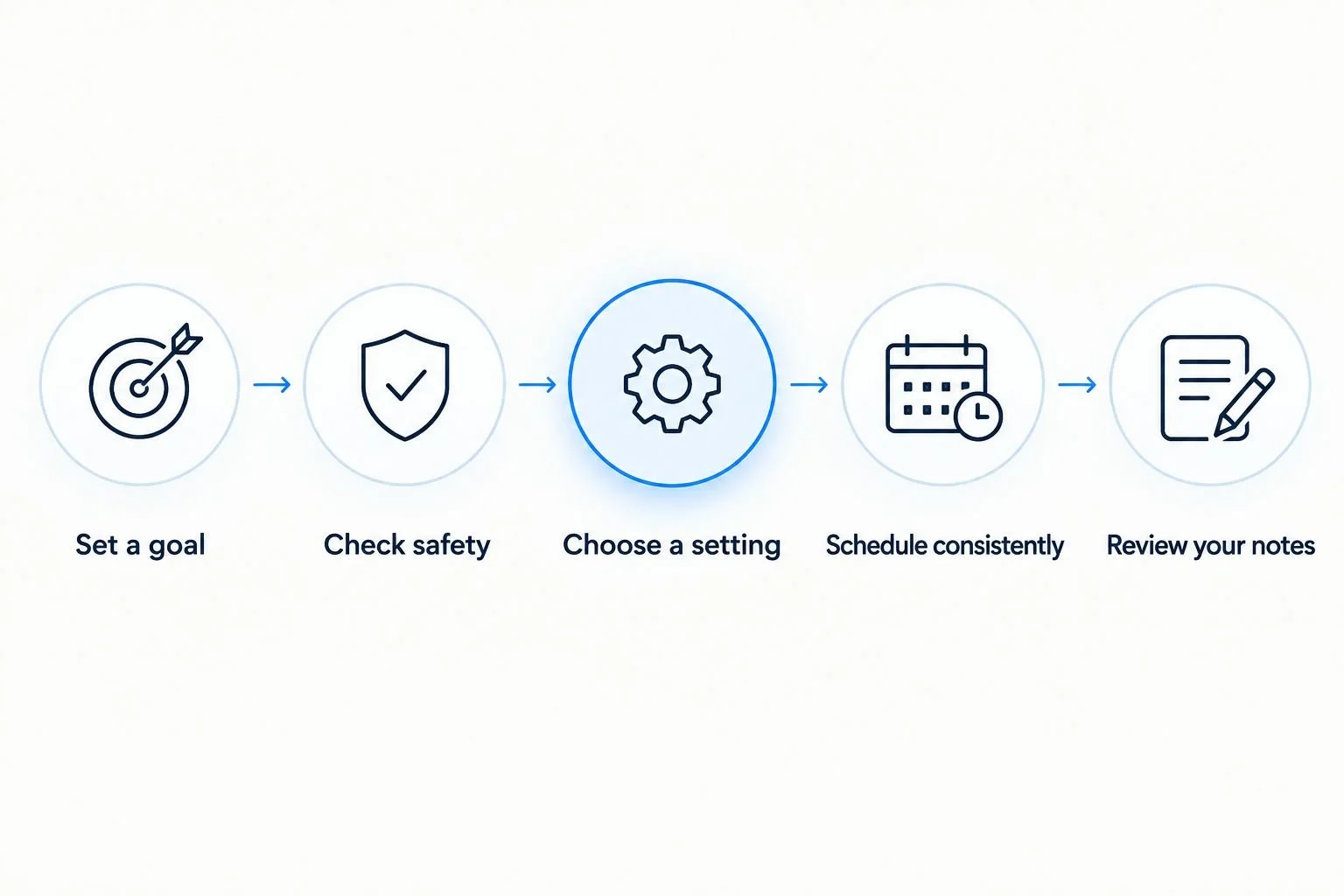
Choose the goal and safety requirements before deciding on a session schedule.
6. Keep skin protection separate from recovery
Golf recovery and outdoor skin protection belong in the same planning conversation, but they solve different problems. A red light session does not replace sunscreen, protective clothing, shade, or advice about a changing skin lesion. Do not use a wellness appointment to justify more unprotected time outdoors.
Discussion of red light therapy for sun damage must keep that distinction clear: interest in light-based skin treatments does not establish protection against ultraviolet exposure during a round. Ask a qualified clinician about sun-damaged skin rather than assuming a general recovery session addresses it.
Make outdoor protection part of your 2026 golf checklist independently of any studio booking. If you have sunburn, irritated skin, or a new skin concern, raise it before a light-based session and follow the relevant professional guidance.
Keep sunscreen and protective clothing in your golf routine.
Plan shade breaks where practical.
Report sunburn or irritation before a session.
Seek assessment for changing or concerning skin lesions.
Reject claims that red light replaces sun protection.
Compare recovery options for golfers
Choose an option by the problem you are trying to solve. These choices are not interchangeable, and none earns a place simply because it sounds more technical. The table separates practical strengths from limitations without assigning unsupported performance benefits.
Sleep, nutrition, and workload planning
Best for: Golfers establishing recovery basics
Practical strength: Fits the daily training routine without adding equipment
Key limitation: Requires consistent choices; does not assess an injury
Bookable studio red light therapy
Best for: Golfers who prefer appointments to owning equipment
Practical strength: Avoids purchasing and maintaining a personal device
Key limitation: Requires scheduling and travel; golf-specific results are not established here
Home red light equipment
Best for: Golfers willing to manage their own setup
Practical strength: Offers control over when the equipment is used
Key limitation: Places responsibility for instructions, positioning, and upkeep on the user
Qualified clinical assessment
Best for: Golfers with persistent, worsening, or function-limiting symptoms
Practical strength: Addresses whether symptoms need evaluation or treatment
Key limitation: Serves a different purpose from a general wellness session
Live Superhuman red light therapy fits the bookable-studio option, not the injury-assessment category. Compare red light therapy studios in Orange County using equipment information, safety procedures, and appointment fit—not claims that every golfer needs the same session.
Before choosing, write down the limitation you are accepting. Home convenience comes with setup responsibility; studio convenience comes with travel. Being explicit about that trade-off prevents an optional recovery tool from becoming an obligation you no longer find useful.
Common mistakes golfers make
Treating swing-related pain as ordinary soreness
Discomfort that changes your swing, grip, walking, or ability to practice deserves attention. Do not keep repeating a painful movement because a recovery appointment is booked afterward. A wellness session cannot tell you whether continuing to play is appropriate.
Using handicap changes as the main result
A lower handicap does not isolate the effect of red light therapy. Keep your recovery observations separate from performance records. If your goal is better golf, continue to address coaching, practice quality, strength, and course management directly.
Assuming more exposure means more benefit
Longer exposure, closer positioning, and additional sessions are not automatic upgrades. Follow equipment-specific instructions instead of improvising. A schedule copied from a different device is not a sound basis for changing your own session.
Adding every recovery service at once
Live Superhuman offers hyperbaric oxygen therapy, red light therapy, PEMF, EWOT, and altitude training sessions. That range does not mean you need to combine them. Choose one clear objective and ask what each service contributes before booking several unfamiliar experiences together.
Letting appointments displace the basics
A late appointment that shortens your sleep defeats sensible recovery planning. Review your actual calendar, not an idealized version of it. In 2026, the right routine is still one you can maintain without sacrificing the foundations of training and recovery.
FAQ
Is red light therapy good for golfers?
Red light therapy is an optional wellness addition for golfers, not an established shortcut to lower scores. Judge it against a specific recovery goal while keeping sleep, nutrition, and sensible training loads in place.
Should I use red light therapy before or after golf?
There is no single timing recommendation that applies to every device and golfer. Follow equipment-specific instructions and appropriate professional guidance, and avoid introducing an unfamiliar session immediately before an important competition.
How long should a golfer's red light therapy session last?
Session length must follow the specific equipment's instructions rather than a generic golf routine. Output, distance, positioning, and intended use differ, so copying another device's exposure time is not a reliable approach.
Can red light therapy treat golfer's elbow?
Do not use a general wellness session as a substitute for assessment of suspected golfer's elbow. Persistent or activity-limiting elbow pain needs qualified clinical advice and an appropriate plan for returning to golf.
Is a studio better than a home red light device?
A studio suits golfers who prefer bookable sessions, while home equipment suits people willing to manage setup and instructions themselves. Neither format establishes better golf results simply because of where the session takes place.
Do I need eye protection during red light therapy?
Follow the eye-protection requirements for the exact device being used. Ask the provider to explain those requirements before exposure, and do not assume that closing your eyes replaces the specified protection.
Does red light therapy protect golfers from sun damage?
Red light therapy does not replace sun protection during golf. Keep sunscreen, protective clothing, and shade in your outdoor routine, and seek qualified advice about sun-damaged or changing skin.
Can I book red light therapy at Live Superhuman?
Live Superhuman offers bookable red light therapy sessions. Ask about equipment instructions, safety requirements, and appointment arrangements before deciding whether a session fits your golf schedule.
One last thing
Write your stopping rule before your first session. Decide what would make the experience worthwhile, what inconvenience you will accept, and which symptoms require assessment instead of another booking. That small decision keeps an optional recovery session tied to your needs rather than turning it into something you continue without questioning.