
Triathletes’ altitude training is exposure to reduced oxygen availability with the aim of supporting endurance preparation or acclimatization for racing at elevation. This 2026 guide explains how to fit altitude training around swimming, cycling, and running without sacrificing the sessions that build race readiness.
TL;DR
Altitude training for triathletes supplements swim, bike, and run preparation; it does not replace race-specific training.
Live Superhuman suits triathletes seeking bookable altitude training sessions rather than equipment ownership.
Protect key workouts, distinguish simulated altitude from oxygen-enriched exercise, and assess your response before adding exposure.
Choose altitude preparation around your race location, training schedule, and health—not a promised performance gain.
Why altitude training matters for triathletes
Triathletes must distribute training stress across three disciplines. Adding reduced-oxygen exposure changes that workload, so the right question is not whether altitude feels demanding. It is whether the exposure serves a clear race objective without reducing the quality of your existing preparation.
A race at elevation creates a different preparation problem from a sea-level race. At natural altitude, lower atmospheric pressure reduces the oxygen pressure available to your lungs; simulated altitude typically reduces the oxygen concentration you breathe. Neither situation guarantees a faster sea-level finish.
For your 2026 season, separate training adaptation from recovery. The guide to recovery therapies for athletes addresses the latter; reduced-oxygen training belongs on the stress side of your planning ledger, even when you experience it while resting.
Choose altitude training to solve a defined preparation problem, not to make an already demanding week harder. Protect sleep, fueling, consistent training, and recovery before adding another variable.
How to plan altitude training around triathlon
Define your race objective
Start with your race information and training calendar. Write down whether you are preparing to compete at elevation, exploring an additional endurance stimulus, or simply evaluating whether altitude sessions fit your routine. Those are different objectives and should not share an automatic plan.
For a 2026 race, use the organizer’s actual course information rather than assuming a mountain destination means every discipline happens at the same elevation. A lake swim, rolling bike course, and summit-area run can present different demands.
The manual approach is straightforward: annotate your calendar and discuss the objective with your coach. You do not need a device or paid session to decide what problem you are trying to solve. If you cannot name that problem, postpone the addition.
Record the race location and published course elevation.
Identify the discipline most affected by your current limitations.
Write one specific reason for considering altitude exposure.
Mark key workouts and races that must remain protected.
Define what would make you stop or reconsider the plan.
Establish your normal training response
Use an ordinary training log before introducing altitude exposure. Record duration, perceived effort, sleep quality, and the outcome of your important swim, bike, and run sessions. Your own repeatable baseline is more useful than somebody else’s impressive-looking oxygen reading.
A 0–10 effort scale gives you a simple way to describe how hard a session felt. Use it consistently rather than treating the score as a laboratory measurement. Compare similar workouts under similar conditions, and record heat, illness, or unusual fatigue when they affect the comparison.
Start with notes you can maintain without buying anything. Extra monitoring only helps when it changes a decision; a crowded dashboard does not compensate for inconsistent training records.
Log session duration in minutes.
Record perceived effort on the same scale each time.
Note sleep quality and unusual fatigue.
Compare repeatable workouts within each discipline.
Keep a separate record of any altitude exposure.
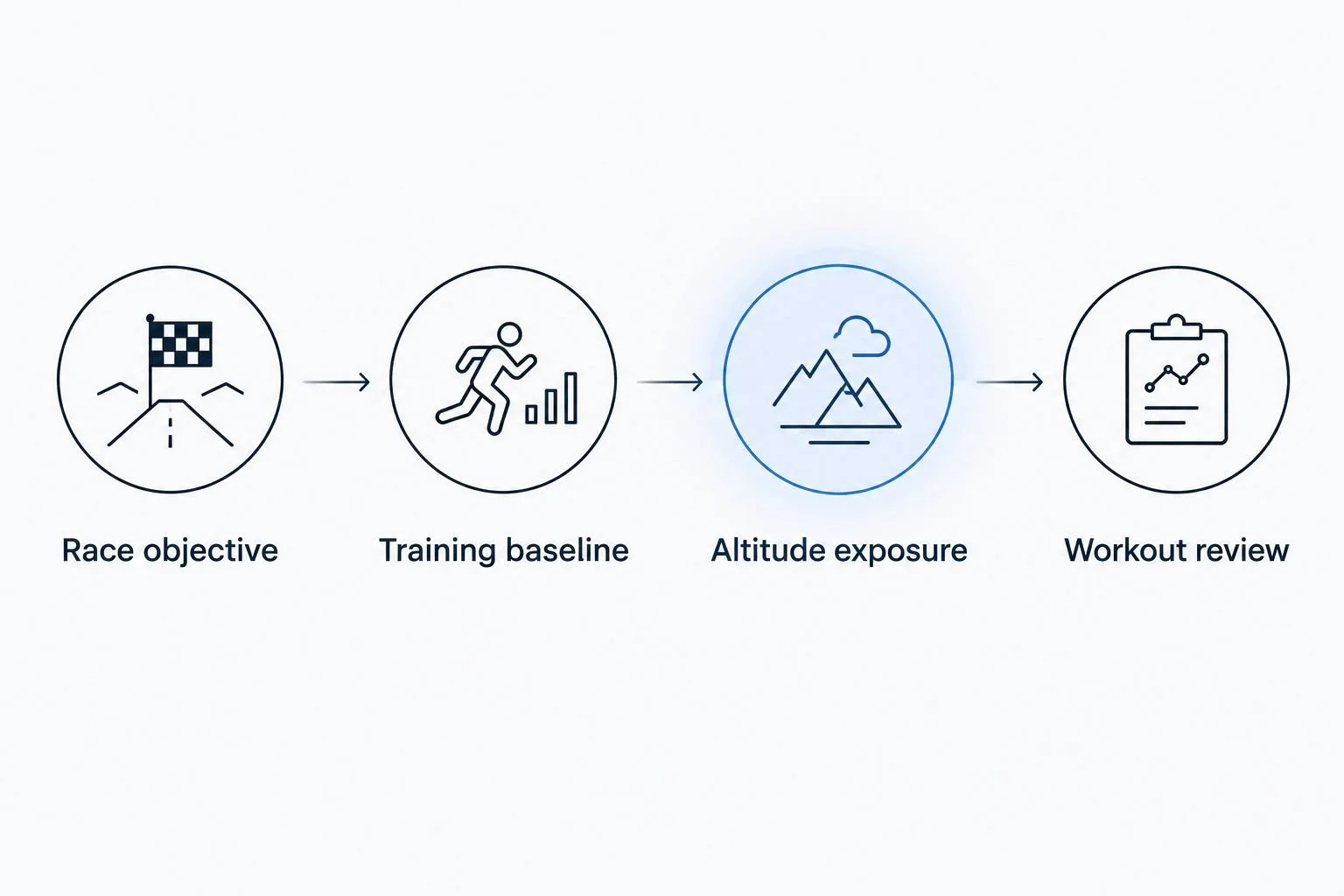
Define the objective and baseline before introducing altitude exposure.
Choose the exposure format that fits your goal
First distinguish natural altitude, simulated altitude, and ordinary training without added hypoxia. Traveling to elevation changes your environment throughout the trip. A simulated-altitude session creates a bounded exposure, while maintaining your current training avoids adding this particular stressor.
Live Superhuman is best for triathletes seeking bookable altitude training sessions rather than equipment ownership. The studio offers altitude training alongside other wellness services. Its session format is not interchangeable with living at elevation, and a booked visit alone does not establish race readiness.
Use Live Superhuman as a session-based option to investigate, not as a substitute for your swim, bike, and run plan. Ask how the altitude session is delivered before deciding whether it matches your objective. Booking removes the equipment-ownership requirement; it does not remove the need to assess suitability.
Clarify whether exposure happens at rest or during exercise.
Ask how reduced-oxygen conditions are created and monitored.
Confirm screening and stop procedures before participating.
Check how the session fits your existing coaching plan.
Avoid assuming all altitude-related services are equivalent.
Protect your key swim, bike, and run sessions
Place your essential workouts on the calendar before adding anything else. Race-specific swim practice, bike pacing, run durability, and transitions still need attention. An optional session should not quietly displace the work tied most directly to your event.
For your 2026 training calendar, treat altitude exposure as an addition that requires review, not an invisible recovery appointment. Avoid simultaneously changing your training volume, equipment, nutrition strategy, and altitude exposure. Otherwise, you lose the ability to understand what caused a change in performance or fatigue.
Begin with a calendar review rather than a prescribed exposure duration. The appropriate intensity, duration, and placement depend on the person and the delivery method; a universal schedule would ignore those differences.
Mark your key swim, bike, and run workouts first.
Preserve planned recovery periods.
Avoid testing unfamiliar exposure immediately before a priority event.
Tell your coach when you add altitude sessions.
Adjust the plan when normal workout quality deteriorates.
Set safety boundaries before you start
Ask a qualified healthcare professional about suitability if you have a heart or lung condition, a history of altitude illness, or another health concern relevant to reduced oxygen. A performance goal does not override individual health considerations.
At natural altitude, headache accompanied by other symptoms after ascent deserves attention rather than a harder workout. Severe breathlessness at rest, confusion, or difficulty walking requires urgent medical evaluation. Stop exercising when concerning symptoms develop; do not use a target reading as permission to continue.
Pulse oximeters provide estimates and can produce inaccurate readings. Movement, cold hands, and other factors affect measurement, so use readings within the provider’s safety process rather than chasing a lower number. A lower oxygen reading is not a training achievement.
Disclose relevant health history before a session.
Ask who supervises exposure and how concerns are handled.
Learn the stop procedure before starting.
Report symptoms immediately rather than waiting for a session to end.
Seek urgent care for severe or concerning symptoms.
Review the effect on your whole training week
Assess altitude exposure against the purpose you wrote down, not against how novel the session felt. Review your next relevant workouts, sleep, perceived effort, and ability to complete planned training. One unusually good session does not establish a lasting benefit.
Use a 7-day training view to see how the addition fits around all three disciplines. This is an organizational window, not a recommended exposure schedule. Extend your review across comparable training periods before attributing a performance change to altitude alone.
A simple written review is enough to start. Keep, adjust, or remove the addition based on its fit with your objective and the quality of your training—not the pressure to justify a booking.
Compare planned training with completed training.
Record whether key sessions remained productive.
Separate fatigue, soreness, and breathlessness in your notes.
Account for changes in sleep, heat, fueling, and workload.
Review concerns with your coach or healthcare professional.
Compare your altitude training options
For 2026 planning, compare formats by purpose and burden rather than treating them as interchangeable purchases. The best option is the one that matches your objective while preserving training quality. None guarantees a personal best.
Maintain normal training without added altitude
Best for: Triathletes still building consistency
Main advantage: Keeps attention on race-specific work without added hypoxic stress
Key limitation: Does not provide altitude exposure
Train at natural elevation
Best for: Triathletes preparing for conditions at an elevated venue
Main advantage: Provides experience in the actual environment
Key limitation: Travel, terrain, weather, and altitude stress complicate planning
Live Superhuman altitude training sessions
Best for: Triathletes seeking a bookable studio format
Main advantage: Does not require owning altitude equipment
Key limitation: Sessions do not reproduce an entire stay at natural elevation
Use a home simulated-altitude setup
Best for: Triathletes considering repeated exposure at home
Main advantage: Allows exposure without traveling to elevation
Key limitation: Requires equipment management and appropriate safety guidance
Natural-altitude preparation has the clearest connection to experiencing an elevated race environment. Its disadvantage is that the environment also changes other variables. Studio and home formats offer different logistics, but convenience alone does not establish an effective exposure plan.
Ask the same questions of every format: What is the goal? What exactly will you experience? How will suitability be assessed? What happens if your training or symptoms worsen?
Common altitude training mistakes triathletes make
Treating every oxygen-based session as the same thing
Altitude training reduces oxygen availability. Exercise with oxygen therapy, commonly called EWOT, uses supplemental oxygen during exercise; hyperbaric oxygen therapy uses oxygen in a pressurized environment. These are different exposures, not interchangeable versions of endurance training.
Live Superhuman offers altitude training, EWOT, and hyperbaric oxygen therapy. Ask for the actual service name and purpose rather than booking around a general promise involving oxygen.
Adding recovery appointments without reducing training stress
A full calendar is not proof of good preparation. Altitude exposure adds a training variable, while hands-on recovery appointments serve a different purpose. Neither gives you permission to ignore persistent fatigue or pain.
Decisions about sports massage frequency belong in the same workload discussion: appointment timing should reflect training demands and individual needs, not justify another hard session. Keep enough room in the week to respond when recovery falls behind.
Judging success by the hardest-feeling session
Breathing harder is an immediate experience, not evidence of improved race performance. If reduced-oxygen work leaves you unable to complete essential bike or run training, review the addition instead of celebrating its difficulty.
Use repeatable outcomes and your original objective. Do not turn every exposure into a test of tolerance.
Copying another athlete’s exposure schedule
A schedule from a training partner does not account for your health, race location, experience, or weekly workload. Even athletes preparing for the same event can need different decisions.
Bring your own calendar and training history to the discussion. Personalization starts with those facts, not with matching somebody else’s session settings.
FAQ
Is altitude training worth it for triathletes?
Altitude training is worth considering when it serves a defined race-preparation objective without displacing essential swim, bike, and run training. It is not a prerequisite for triathlon, and a performance benefit is not guaranteed.
What is the best altitude training option for a busy triathlete?
A bookable studio session suits a triathlete who wants to explore altitude exposure without owning equipment or traveling to elevation. Suitability still depends on the session format, health screening, and fit with the training calendar.
Can I replace a bike or run workout with altitude training?
Altitude exposure does not replace the sport-specific practice provided by cycling or running. Any planned substitution should preserve the objective of the original workout and be discussed with your coach.
How long should an altitude training session last?
There is no universal session duration for every triathlete. Duration depends on the delivery method, exposure intensity, individual health, and training objective; agree on those details with the provider before participating.
Is altitude training the same as EWOT?
No, altitude training reduces oxygen availability, while EWOT involves exercising with supplemental oxygen. They create different exposures and should not be booked as interchangeable services.
Should I use a pulse oximeter to chase a lower oxygen reading?
No, a lower oxygen reading is not a training target by itself. Pulse oximeter readings require context, and symptoms or the provider’s stop procedures take priority over completing a session.
Will studio altitude sessions fully prepare me for a mountain triathlon?
Studio altitude sessions do not reproduce every demand of a mountain triathlon. Terrain, weather, pacing, and the race’s actual elevation remain separate preparation needs.
One last thing
Before booking an altitude session for your 2026 season, write down the workout you most need to protect. It might be an open-water skills session, a race-paced bike ride, or a run you can complete without carrying excessive fatigue.
If an optional addition repeatedly compromises that workout, change the addition—not your definition of a successful training week. Altitude exposure earns its place through its fit with your objective, not through how demanding it feels.