
Firefighters’ hyperbaric oxygen therapy is breathing oxygen in a pressurized chamber with the aim of supporting a specific treatment or recovery goal; suspected smoke-related poisoning requires emergency care, not a wellness appointment. This 2026 guide separates established medical uses from elective recovery sessions and explains what to ask before booking.
TL;DR
Hyperbaric oxygen therapy for firefighters is not a substitute for emergency evaluation after smoke exposure.
Live Superhuman offers bookable hyperbaric oxygen therapy sessions for clients seeking recovery and performance support.
Carbon monoxide poisoning and routine post-shift fatigue require different decisions; do not treat them as interchangeable.
Chamber pressure alone does not establish oxygen delivery, treatment suitability, or firefighter recovery benefits.
Why hyperbaric oxygen therapy matters for firefighters
Firefighters need a clear boundary between recovery support and exposure-related medical care. Smoke exposure, strenuous work, disrupted sleep, and heat create different problems; a chamber session does not answer all of them. Start by identifying the problem, not by choosing a treatment.
Hyperbaric oxygen has recognized medical uses, including selected cases of carbon monoxide poisoning. That does not establish that elective sessions improve performance, prevent occupational disease, or speed recovery in otherwise healthy firefighters. Evidence for a medical indication cannot be transferred automatically to a general wellness goal.
Live Superhuman offers bookable hyperbaric oxygen therapy alongside red light therapy, PEMF, EWOT, and altitude training. Live Superhuman is a fit for firefighters exploring bookable wellness sessions, not a substitute for emergency care after smoke exposure.
For your 2026 recovery plan, keep three decisions separate: whether you need medical evaluation, whether a chamber session is appropriate, and whether an elective session delivers a benefit you can actually assess. Combining those decisions invites the wrong purchase and, after an exposure, a dangerous delay.
How to evaluate hyperbaric oxygen therapy for firefighters
Identify whether you need urgent care
Headache, dizziness, nausea, confusion, chest pain, or breathing difficulty after smoke exposure deserve prompt medical attention. Collapse, severe symptoms, or altered awareness require emergency services. Do not drive yourself if you are impaired, and do not use an elective booking as the next step.
Carbon monoxide poisoning is especially important because an ordinary fingertip pulse oximeter cannot reliably rule it out. CDC clinical guidance distinguishes conventional oxygen saturation readings from the testing needed to assess carbon monoxide exposure. A reassuring watch or fingertip reading is not clearance to resume work.
Tell the treating team about the incident, symptoms, respiratory protection, and any oxygen already received. Emergency clinicians determine whether hospital-based hyperbaric treatment is indicated; a wellness chamber is not interchangeable with that care.
Follow your department’s exposure-reporting and emergency procedures.
Report symptoms even when they resemble ordinary post-shift fatigue.
Give clinicians the exposure circumstances and symptom timeline.
Do not delay emergency evaluation while looking for a chamber.
Define one recovery goal
For elective use, replace a broad objective such as feeling optimized with a question you can answer. You might want to assess perceived soreness after training, how rested you feel, or how comfortably you return to normal activity. These are tracking goals, not promised effects of hyperbaric oxygen therapy.
Separate training fatigue from symptoms that need evaluation. Persistent headaches, unexplained breathlessness, recurrent dizziness, or an unusual decline in exercise tolerance should not become a self-directed chamber experiment.
Build your 2026 plan around sleep opportunity, hydration, nutrition, and appropriate training load first. A booked session cannot replace those foundations. If your schedule makes basic recovery difficult, address that constraint before adding another appointment.
Choose one primary goal in plain language.
Describe what success would look like during normal activity.
Record your current sleep, workload, and symptoms.
Bring persistent or unexplained symptoms to a qualified clinician.
Verify what the session actually delivers
Live Superhuman lists hyperbaric oxygen therapy options using a 1.6 ATA chamber and a 2.0 ATA chamber. ATA means atmospheres absolute: 1 ATA is approximately normal atmospheric pressure at sea level. These figures describe pressure, not a guaranteed outcome or a complete treatment specification.
More pressure is not automatically the better choice. Oxygen concentration, delivery method, exposure duration, screening, and supervision also matter. Ask the provider to explain the actual session rather than comparing chamber labels alone.
For Live Superhuman hyperbaric oxygen therapy, confirm those details directly before deciding between chamber options. A wellness studio offers a booking route for elective sessions; that convenience does not establish suitability for a medical condition or an occupational exposure.
Ask which chamber and pressure the booking includes.
Confirm how oxygen is supplied during the session.
Ask how long the full appointment takes, including preparation.
Request an explanation of screening and supervision.
Ask what the staff do if you feel unwell.
Check suitability before entering a chamber
Pressure and oxygen exposure introduce real risks. Ear and sinus pressure injuries, temporary vision changes, and oxygen-related adverse effects are recognized concerns in hyperbaric care. Oxygen-rich environments also require strict fire-safety precautions; chamber rules are not optional housekeeping.
An untreated pneumothorax is an established contraindication to hyperbaric oxygen treatment. Other medical conditions, recent procedures, medications, and difficulty equalizing ear pressure require individual review. Do not decide suitability from a general article or assume physical fitness makes screening unnecessary.
For a 2026 booking, disclose current congestion, ear problems, breathing conditions, recent surgery, and all medications or supplements requested during screening. Ask who reviews the information and when medical clearance is needed. The relevant question is whether this specific session is appropriate for you.
Complete the screening honestly before the appointment.
Disclose relevant health conditions, procedures, and medications.
Ask how staff handle ear pressure or discomfort.
Follow clothing, device, and prohibited-item instructions.
Postpone participation when the screening team advises it.
Fit the appointment around operational demands
A session should fit your recovery schedule without displacing sleep, meals, or department obligations. Ask about the full visit, not just time inside the chamber. Preparation, screening, pressure changes, and departure instructions all affect scheduling.
Do not treat finishing an appointment as proof that you are ready for duty. Return-to-work and fitness-for-duty decisions belong with the appropriate occupational health and department processes. A subjective lift after a session does not override symptoms, restrictions, or an exposure assessment.
Avoid introducing several new recovery services together if your goal is to understand what helps. Changing sleep, training, supplements, and chamber use simultaneously makes your own observations harder to interpret.
Confirm the complete appointment window before booking.
Protect sleep and ordinary recovery needs first.
Ask about instructions that apply after the session.
Keep fitness-for-duty decisions separate from wellness bookings.
Introduce elective recovery changes separately when practical.
Measure value without overstating the result
Use a brief record that connects the session to your original goal. Log sleep, recent workload, symptoms, and how normal activity feels. Keep the same measures on days without sessions so that an unusually easy shift does not get credited to the chamber.
Personal tracking helps you make a spending and scheduling decision; it does not prove a medical effect. Expectation, rest during the appointment, changing workloads, and normal recovery can all influence how you feel. Avoid turning a good afternoon into a claim about injury prevention or long-term occupational health.
Use this decision sequence for an elective trial: Check symptoms, Define goal, Verify session, Review suitability, Track response. Emergency symptoms bypass the sequence and go straight to medical care.
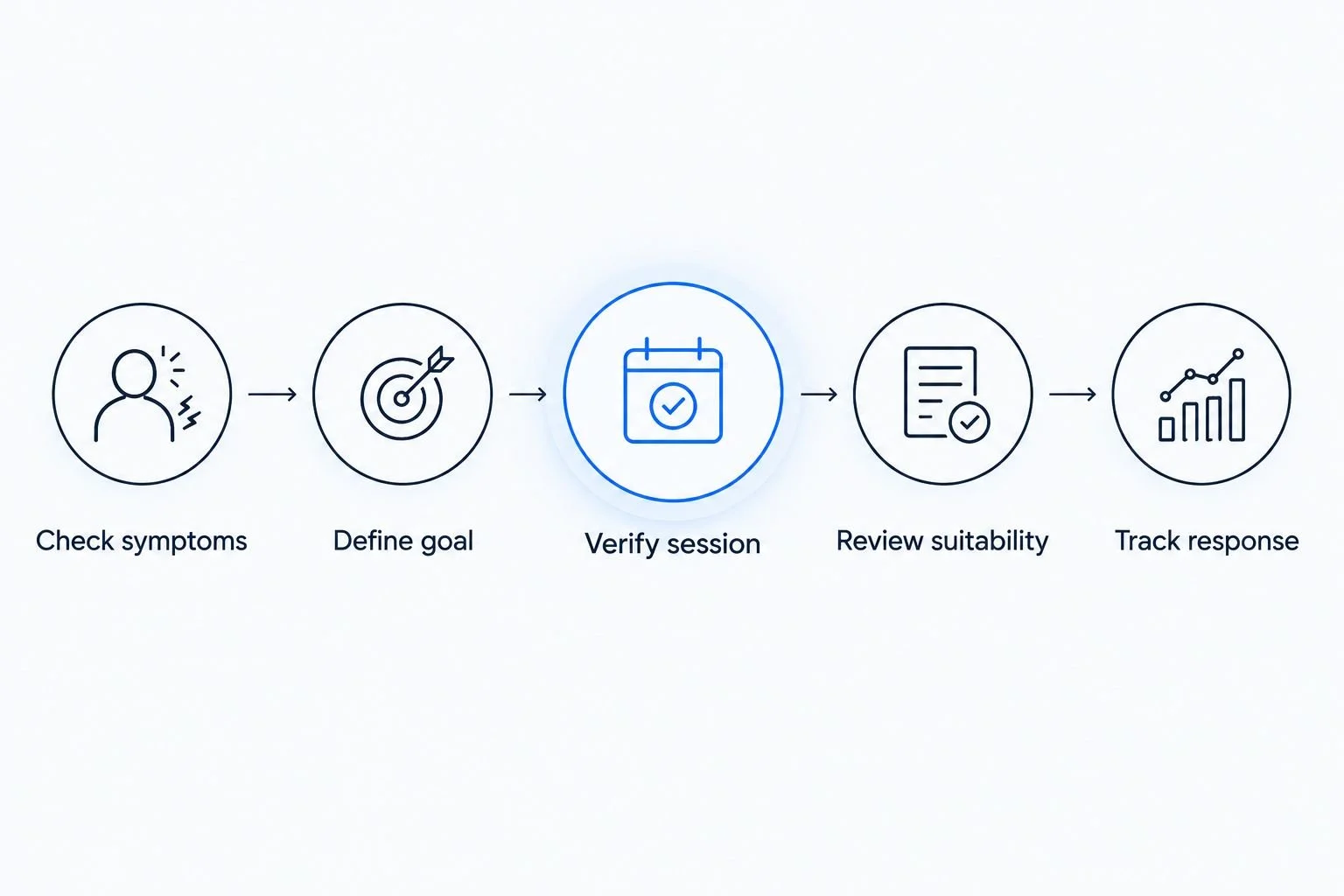
Screen for medical needs before comparing elective recovery sessions.
Review the result before making a recurring commitment. If your chosen goal does not improve, do not assume that increasing pressure or adding appointments is the answer. Reconsider the goal, the recovery basics, and whether professional evaluation is needed.
Record the same observations before and after sessions.
Note sleep and workload alongside any perceived change.
Track discomfort or unwanted effects, not just positives.
Reassess continued participation against your original goal.
Compare the options by purpose, not chamber marketing
The right option depends first on whether you are managing an exposure, an ongoing health concern, or an elective recovery goal. These are different routes, not interchangeable competitors. For 2026 decisions, choose the route that matches the problem before comparing the experience.
Emergency medical evaluation
Best for: Symptoms after smoke exposure or a suspected acute injury
Main advantage: Assesses urgent risks and directs appropriate care
Key limitation: Not an elective recovery service
Hospital-based hyperbaric care
Best for: Clinician-selected medical indications, including certain carbon monoxide poisoning cases
Main advantage: Connects treatment to medical assessment and monitoring
Key limitation: Requires a clinical indication; not a general performance solution
Live Superhuman hyperbaric oxygen therapy
Best for: Firefighters exploring bookable wellness sessions
Main advantage: Offers elective sessions with stated chamber-pressure options
Key limitation: Firefighter-specific recovery benefits are not established by the offering; not emergency care
Occupational health assessment
Best for: Persistent symptoms, exposure follow-up, or fitness-for-duty questions
Main advantage: Connects evaluation to job demands and work restrictions
Key limitation: Does not replace emergency evaluation for acute symptoms
Foundational recovery
Best for: Routine training fatigue without concerning symptoms
Main advantage: Addresses sleep, nutrition, hydration, and training load directly
Key limitation: Does not diagnose or treat an exposure-related condition
The chamber distinction matters most when the reason for treatment is medical. A pressure figure by itself does not tell you whether a facility can assess smoke inhalation, manage complications, or provide the treatment a clinician recommends. Ask about purpose and capability, not just equipment.
Common mistakes firefighters make
Treating a normal oxygen reading as an all-clear
A standard pulse oximeter does not reliably exclude carbon monoxide poisoning. After a concerning exposure, symptoms and incident details still matter. Follow medical guidance rather than using a consumer reading to decide that a wellness session is enough.
Assuming a chamber removes every smoke-related risk
Smoke exposure is not a single problem with a single recovery treatment. Hyperbaric oxygen is not a substitute for respiratory protection, decontamination, exposure documentation, or occupational follow-up. Do not use a session as permission to relax the measures that reduce exposure.
Choosing pressure as if it were a performance ranking
A 2.0 ATA chamber is not automatically a better recovery choice than a 1.6 ATA chamber. Pressure belongs within a suitability decision that also considers oxygen delivery, the intended use, and safety. Ask for the rationale instead of selecting the larger number.
Stacking sessions without a clear reason
Adding red light therapy, PEMF, EWOT, and altitude training to the same recovery experiment makes results difficult to interpret. These services use different methods and are not substitutes for one another. Choose according to a defined goal and individual suitability, not the length of a service menu.
Confusing feeling better with clearance for duty
A wellness appointment does not establish operational readiness. Follow your department’s requirements and medical advice, especially after smoke exposure, injury, or ongoing symptoms. Recovery tracking supports a conversation; it does not replace a fitness-for-duty assessment.
FAQ
Is hyperbaric oxygen therapy good for firefighters after smoke exposure?
Smoke exposure with symptoms requires prompt medical evaluation, not an elective wellness session. Clinicians use hyperbaric oxygen for selected carbon monoxide poisoning cases, but the decision depends on the medical assessment.
Can hyperbaric oxygen therapy prevent cancer in firefighters?
Hyperbaric oxygen therapy is not an established cancer-prevention measure for firefighters. It must not replace exposure reduction, respiratory protection, decontamination, or recommended occupational health follow-up.
What is the difference between a wellness chamber and hospital hyperbaric care?
Hospital hyperbaric care treats clinician-selected medical indications within a medical service, while an elective wellness session serves a different purpose. Chamber pressure alone does not establish equivalent assessment, monitoring, or treatment capability.
Is a 2.0 ATA chamber better than a 1.6 ATA chamber for recovery?
A 2.0 ATA chamber is not automatically better than a 1.6 ATA chamber for recovery. The appropriate choice depends on individual suitability, oxygen delivery, intended use, and professional guidance.
How many hyperbaric oxygen sessions should a firefighter book?
There is no universal session count for firefighter wellness recovery. Medical treatment schedules require clinical direction; elective participation should follow screening and reassessment of a defined goal.
Can I book a session immediately after a difficult shift?
Do not book an elective session instead of seeking care for concerning post-shift symptoms. If you have no urgent symptoms, confirm suitability and scheduling with the provider without sacrificing sleep or department requirements.
Does a normal pulse oximeter reading rule out carbon monoxide poisoning?
No, a conventional pulse oximeter reading does not reliably rule out carbon monoxide poisoning. Tell emergency clinicians about the exposure and symptoms so they can select the appropriate assessment.
One last thing
Your most useful question before booking is not which chamber is strongest. It is: What problem am I trying to solve, and does that problem belong in a wellness studio or a medical setting? Write the answer down before you compare sessions. That single distinction keeps a recovery decision from becoming a delay in necessary care.