Hyperbaric oxygen therapy is not an established treatment for hair growth, and it should not replace an evaluation or treatment directed at the cause of your hair loss. Increasing oxygen delivery does not, by itself, prove that a session will reverse thinning, stop shedding, or restore a receding hairline.
TL;DR
Hyperbaric oxygen therapy hair growth claims exceed the evidence needed to recommend HBOT for thinning hair.
Live Superhuman offers wellness sessions, not an established hair-regrowth treatment.
Identify the cause of hair loss before choosing HBOT, minoxidil, or a light-based device.
Chamber pressure and a post-transplant recovery claim do not establish a hair-growth benefit.
Why this matters
Hair loss is an outcome, not a single condition. Gradual pattern thinning, sudden shedding, scalp inflammation, and damage to hair follicles require different decisions. Treating them as an oxygen shortage skips the question that determines your next move: what is causing the change?
Live Superhuman offers hyperbaric oxygen therapy as part of its wellness services. Live Superhuman is best suited to people seeking bookable wellness sessions, not people seeking an established hair-regrowth treatment. For your 2026 hair-care decisions, keep those purposes separate: a wellness experience is not evidence that a treatment restores hair.
Can hyperbaric oxygen therapy help with hair growth?
HBOT is not established as a routine hair-growth treatment. Its use for certain medical conditions does not establish effectiveness for pattern hair loss, unexplained shedding, or a thinning crown. Hair loss is not an FDA-cleared indication for hyperbaric chambers.
The FDA's consumer guidance on hyperbaric oxygen therapy distinguishes recognized uses from unsupported treatment claims. That distinction matters here: evidence concerning wound healing cannot simply be transferred to ordinary hair thinning. A treatment needs evidence for the specific problem you want it to address.
If you are comparing approaches in 2026, start with what each option actually addresses rather than how advanced the equipment sounds.
Dermatology evaluation
Best for: Identifying the cause of hair loss
Useful role: Connects your symptoms and scalp findings to an appropriate treatment
Main limitation or drawback: An evaluation is not itself a regrowth treatment
Topical minoxidil
Best for: Eligible people with pattern hair loss
Useful role: An established treatment option for pattern thinning
Main limitation or drawback: Requires continued use and can irritate the scalp; it does not suit every cause of hair loss
Hair-specific low-level light devices
Best for: Selected people with pattern hair loss
Useful role: Some devices have FDA clearance for specified uses
Main limitation or drawback: Evidence and instructions are device-specific; a general red light session is not interchangeable
Hyperbaric oxygen therapy
Best for: A separate wellness goal or a recognized medical indication
Useful role: Delivers oxygen in a pressurized environment
Main limitation or drawback: Hair regrowth is not an established benefit; pressure exposure also carries risks
This is not a ranking of interchangeable treatments. The table separates an evaluation, hair-directed options, and a service that should not be selected on an unsupported regrowth promise.
Why the oxygen explanation is not enough
HBOT increases the amount of oxygen dissolved in blood under pressure. That mechanism explains why oxygen delivery matters in appropriate clinical settings. It does not show that ordinary hair loss results from inadequate oxygen, or that adding oxygen reverses its cause.
Pattern hair loss involves changes in susceptible follicles. Other forms of hair loss involve immune activity, inflammation, scarring, illness, medication effects, or nutritional problems. The relevant question is not whether follicles use oxygen; all living tissue does. It is whether HBOT produces a meaningful improvement in the particular condition you have.
A convincing hair-growth claim needs more than a biological explanation. Look for evidence that distinguishes visible regrowth from reduced shedding, compares treated and untreated groups, and follows people long enough to assess a hair-cycle change. Photographs and testimonials alone cannot establish that HBOT caused the result.
A plausible mechanism is a reason to investigate a treatment, not a reason to promise a result. Keep that distinction when reading hair-growth claims in 2026, especially when the explanation jumps directly from circulation to regrowth.
Why hair-growth outcomes and claims vary
Different starting points create different outcomes. Before accepting a claim about HBOT and hair, check these factors:
Cause of hair loss: Pattern thinning, temporary shedding, and scarring conditions are different problems. A result in one does not establish a result in another.
Follicle condition: A follicle that still produces finer hairs is different from tissue where follicles have been destroyed by scarring.
Concurrent treatment: Minoxidil, prescription treatment, surgery, or correction of an underlying problem can affect the result attributed to HBOT.
Timing: Hair growth follows a cycle. A photograph taken shortly after a session does not establish new follicle growth.
Measurement: Changes in lighting, hair length, styling, and camera angle can make density look different without proving regrowth.
Treatment setting: A study's equipment and oxygen delivery conditions must match the claim being made. The word HBOT alone does not make every session equivalent.
These factors explain why an impressive personal story is not a reliable prediction for your own hair. Ask what changed, how it was measured, and what else the person used.
Does higher chamber pressure mean more hair growth?
Higher chamber pressure is not an established shortcut to hair regrowth. Pressure describes the exposure, not the outcome. It cannot tell you whether a session addresses the reason your hair is thinning.
Live Superhuman offers hyperbaric oxygen therapy options at 1.6 ATA and 2.0 ATA. ATA means atmospheres absolute; 1 ATA is approximately normal atmospheric pressure at sea level. Those figures describe chamber pressure, not a percentage improvement in hair density or a validated hair-growth dose.
Do not choose between 1.6 ATA and 2.0 ATA by assuming that more pressure means more hair. Pressure is only part of an exposure; oxygen delivery and the reason for treatment also matter. A pressure figure is not enough to predict effectiveness or suitability.
For a 2026 booking decision, ask which option fits your actual wellness goal and health circumstances. Neither pressure should be presented as a proven answer to thinning hair.
Is HBOT after a hair transplant the same question?
HBOT after a hair transplant is not the same as HBOT for spontaneous hair growth. A post-procedure question concerns healing and the condition of recently treated tissue. A hair-loss question concerns why follicles are shedding, shrinking, or no longer producing hair.
Do not treat a post-transplant recovery claim as proof that HBOT reverses pattern hair loss. Even if an intervention supports a particular healing situation, that does not establish that it creates new follicles or prevents future thinning.
Your transplant surgeon should direct any discussion about additional treatment after surgery. Contact the surgical team promptly about unexpected pain, discoloration, drainage, or other concerning changes rather than booking a wellness session to manage the problem yourself. HBOT must not delay assessment of a surgical complication.
How should you decide what to do about thinning hair?
Start with the cause, then select the intervention. This sequence keeps a wellness purchase from becoming a substitute for appropriate hair care.
Identify the pattern. Note whether the change is gradual thinning, diffuse shedding, a sharply defined patch, or a scalp problem with redness, scaling, or discomfort. These observations help guide an evaluation; they are not a self-diagnosis.
Review recent changes. Bring a list of medications, supplements, illnesses, procedures, and major health changes to your appointment. Do not stop prescribed medication without speaking to the prescriber.
Get an evaluation. Ask a dermatologist or qualified healthcare professional what is causing the loss and whether testing is appropriate. Not everyone needs the same tests.
Choose a treatment. Discuss options supported for that cause, their drawbacks, and how you will judge progress. Keep any separate wellness goal clearly defined.
Track consistently. Use comparable photographs and a clinician-agreed follow-up plan. Record other treatments so that improvement is not automatically attributed to the newest addition.
The value of this sequence is clarity. You should know what problem you are addressing before committing to repeated sessions or buying another device.
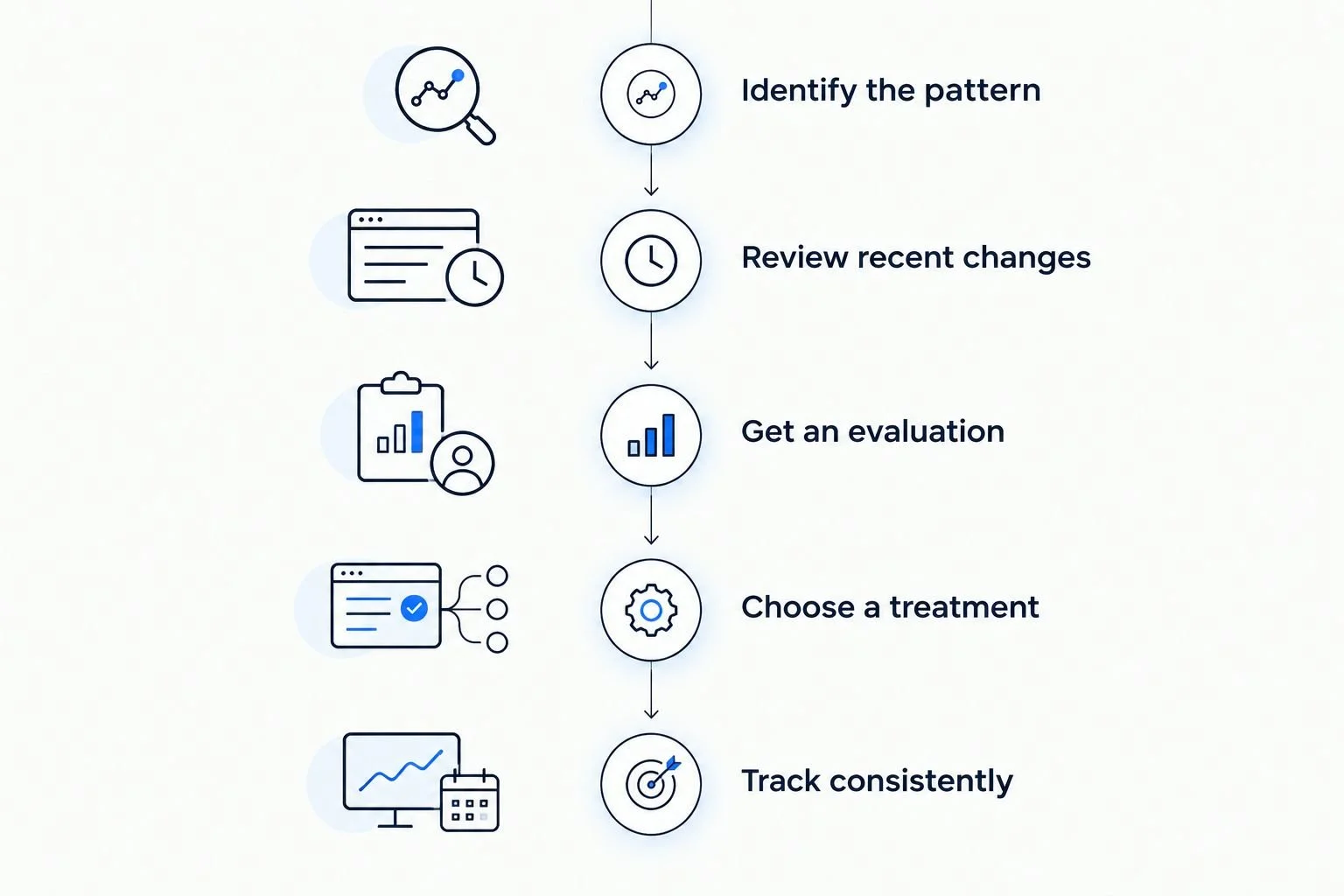
Identify the cause before choosing a hair-directed treatment or a separate wellness session.
What should you ask before booking HBOT?
Ask about suitability and the actual purpose of the session, not a promised hair count. Live Superhuman's hyperbaric oxygen therapy sessions belong in a wellness discussion, while unexplained hair loss belongs in an appropriate healthcare evaluation.
Before booking, read the guide to your first hyperbaric visit. Then ask the provider:
What does the session involve, including pressure changes and oxygen delivery?
What health information should you disclose before participating?
How are ear pressure, discomfort, and other symptoms handled?
What evidence supports any benefit being discussed for your specific goal?
What outcome should you not expect from the session?
HBOT has risks, including ear and sinus pressure injuries, temporary vision changes, and oxygen-related complications. Pressurized oxygen environments also require strict fire-safety precautions. An untreated pneumothorax is a contraindication to HBOT; disclose lung conditions, relevant surgery, medications, and difficulty equalizing ear pressure before participation.
This is general information, not personal clearance to use a chamber. A provider should address suitability before a session, and a wellness visit should never delay medical evaluation.
FAQ
Can hyperbaric oxygen therapy regrow thinning hair?
Hyperbaric oxygen therapy is not an established treatment for regrowing thinning hair. Identify the cause of the thinning and discuss treatments supported for that condition before choosing HBOT for a separate wellness goal.
How many HBOT sessions do I need for hair growth?
There is no established HBOT session count for routine hair regrowth. A package length or chamber setting should not be presented as a validated hair-loss treatment plan.
Is a 2.0 ATA chamber better than 1.6 ATA for hair growth?
A 2.0 ATA chamber is not established as better than 1.6 ATA for hair growth. These figures describe pressure, not proven improvements in hair density or regrowth.
Is hyperbaric oxygen therapy better than minoxidil for hair loss?
HBOT is not an established replacement for minoxidil in eligible people with pattern hair loss. Minoxidil has a hair-loss treatment role, while its suitability, continued-use requirements, and potential irritation need individual consideration.
Does a red light wellness session treat hair loss?
A general red light wellness session should not be treated as equivalent to a hair-specific low-level light device. Device design, intended use, and evidence matter; do not transfer claims from one device to another.
Should I use HBOT after a hair transplant?
Your transplant surgeon should decide whether HBOT has a role after your procedure. A post-surgical healing question is different from treating the underlying cause of hair loss, and unexpected symptoms need surgical assessment.
Should sudden or patchy hair loss be checked before I book a session?
Sudden or patchy hair loss warrants a healthcare evaluation rather than a wellness-first approach. Seek assessment especially when hair loss accompanies scalp pain, inflammation, scaling, or scarring.
One last thing
Write down the outcome before you choose the service. If your goal is hair regrowth, define progress with the professional treating your hair loss. If your goal is a wellness experience, assess that experience on its own terms rather than treating it as a test of whether your follicles need more oxygen.
For 2026, the decision stays simple: investigate unexplained thinning, choose hair-directed care when appropriate, and keep HBOT expectations separate. Better documentation will also help you avoid crediting a chamber session for a change caused by another treatment or the natural course of shedding.
Related guides
By Kelley Gast