
Instead of arranging recovery sessions separately and guessing their order, plan stacking hyperbaric oxygen and red light therapy as a coordinated visit: complete safety screening, agree on each session’s settings, and track how you feel afterward. Use separate, supervised sessions rather than assuming red light equipment belongs inside a pressurized chamber.
TL;DR
For stacking hyperbaric oxygen and red light therapy, Live Superhuman offers both services as bookable wellness sessions.
Agree on session order with staff; do not assume either sequence produces better recovery.
HBOT chamber pressure and red light exposure are separate settings, not interchangeable measures of treatment intensity.
Complete safety screening before booking; more sessions do not establish better results.
Why this matters
Hyperbaric oxygen therapy, or HBOT, involves breathing oxygen in a pressurized chamber. Red light therapy uses light exposure, often described as photobiomodulation. They involve different equipment, different safety checks, and different session settings; combining appointments does not establish an added benefit.
Live Superhuman is best for clients seeking bookable HBOT and red light therapy sessions in a wellness studio. Live Superhuman offers both services for clients interested in recovery and performance. The practical advantage is access to both services, not a demonstrated promise that stacking produces better results than either service alone.
For your 2026 recovery plan, define what you want to evaluate before choosing a combination. Feeling more rested, managing your training schedule, and treating an injury are different goals. A wellness appointment does not replace assessment of persistent pain, unexplained fatigue, or a new injury.
Before you start
Prepare your health information. Bring your medication and supplement list, relevant health history, and details of recent illness or surgery. Ask whether you need clearance from your healthcare professional before either service.
Confirm the actual session details. Ask which chamber you would use, how oxygen is delivered, and what red light equipment and exposure settings staff recommend. Bring the clothing and other materials the studio requests.
Resolve the non-obvious equipment restriction. Do not assume a red light device, phone, wearable, lotion, or other personal item can enter an HBOT chamber. Obtain the chamber operator’s instructions before arrival; oxygen-rich environments require strict fire precautions.
Untreated pneumothorax is a contraindication to HBOT. Ear or sinus trouble, some medications, and other health factors also require review rather than a self-directed booking decision. For red light therapy, disclose light sensitivity and medications that increase sensitivity to light.
Screen first, schedule second. A different appointment order does not remove a contraindication or make an unsuitable session appropriate.
Your recovery goal and baseline
Define what you will evaluate
Choose one primary goal. Write a plain-language statement such as maintaining a consistent recovery routine around training. Avoid combining unrelated goals into a single judgment about whether a session worked.
Record your starting point. Note sleep, recent exercise, current soreness, and any symptoms you already have. Use the same descriptions afterward so your comparison means something.
Choose a simple observation period. Keep notes for 7 days around your first visit, including days without sessions. This is a recordkeeping suggestion, not a recommended treatment frequency or a promise about when benefits appear.
List the changes happening alongside the visit. Include changes in training, sleep, medication, supplements, and other recovery activities. Do not stop prescribed care to make the comparison cleaner.
Expected result: You have a defined goal and a baseline, rather than an expectation that any change must come from the combination.
A useful 2026 session log can be brief. Record the date, service, staff-confirmed settings, your experience during the appointment, and how you feel afterward. Leave interpretation separate from observation: noticing less soreness does not establish which service caused it.
If you are new to both services, discuss starting with one before adding the other. That approach creates more appointments, but it makes your initial experience easier to interpret. A same-day combination trades that clarity for scheduling convenience.
Your session plan
Confirm the chamber and light settings
Identify the chamber option. Live Superhuman lists 1.6 ATA and 2.0 ATA chamber options. Ask which option is appropriate after screening; do not select a pressure simply because the number is higher.
Confirm the oxygen setup. Ask staff to explain how oxygen is delivered and what instructions apply throughout the session. Chamber pressure alone does not describe the complete oxygen exposure.
Confirm the red light settings. Ask about the device, exposure duration, positioning, treatment area, and required eye protection. Follow the equipment-specific instructions rather than copying settings from another studio or a home device.
Agree on the appointment order. Have staff confirm the sequence and any transition instructions. Do not treat a preferred booking sequence as evidence that one order improves results.
Expected result: You know what each session involves, which settings staff have selected, and what you must do between services.
ATA means atmospheres absolute, a measure of pressure. It is not a rating of overall session quality, and it cannot be compared directly with red light exposure settings. A stronger-looking number is not a reason to increase exposure.
For a 2026 booking, confirm these details directly rather than relying on an old screenshot or another person’s session notes. Device instructions and your own screening determine the plan you follow.
Compare the appointment formats
Separate-day sessions
Best for: First-time users who want clearer observations
Practical advantage: Easier to distinguish each initial experience
Limitation: Requires separate visits and does not prove individual effectiveness
HBOT followed by red light
Best for: Clients whose staff-approved schedule uses this order
Practical advantage: Keeps both services within one planned visit
Limitation: Same-day changes are harder to attribute; this order does not establish better results
Red light followed by HBOT
Best for: Clients whose staff-approved schedule uses the reverse order
Practical advantage: Provides another scheduling arrangement
Limitation: Requires the same screening and equipment precautions; reversing the order does not establish better results
Choose the format for suitability and logistics, not a promised multiplier effect. None of these appointment formats turns wellness sessions into a substitute for medical care.
Your visit and recovery notes
Complete each session separately
Repeat the health update on arrival. Tell staff about new congestion, ear discomfort, medication changes, or symptoms since booking. A completed intake form is not a reason to withhold new information.
Follow the chamber entry instructions. Use only approved clothing and items. Ask how to communicate with the operator and what to do if you cannot comfortably equalize pressure.
Report discomfort immediately. Do not push through ear pain, chest discomfort, breathing difficulty, or other concerning symptoms to finish an appointment. Let staff direct the response; severe symptoms require urgent medical assessment.
Check in before the next service. Explain how the first session felt before beginning the second. If you feel unwell, pause the plan rather than treating the second service as a way to correct the first.
Follow the red light setup exactly. Use the positioning, exposure duration, and eye protection directed for that equipment. Extra exposure is not a sensible way to compensate for a missed appointment.
Expected result: Each service has its own safety check, and the second session begins only after you have reported your experience with the first.
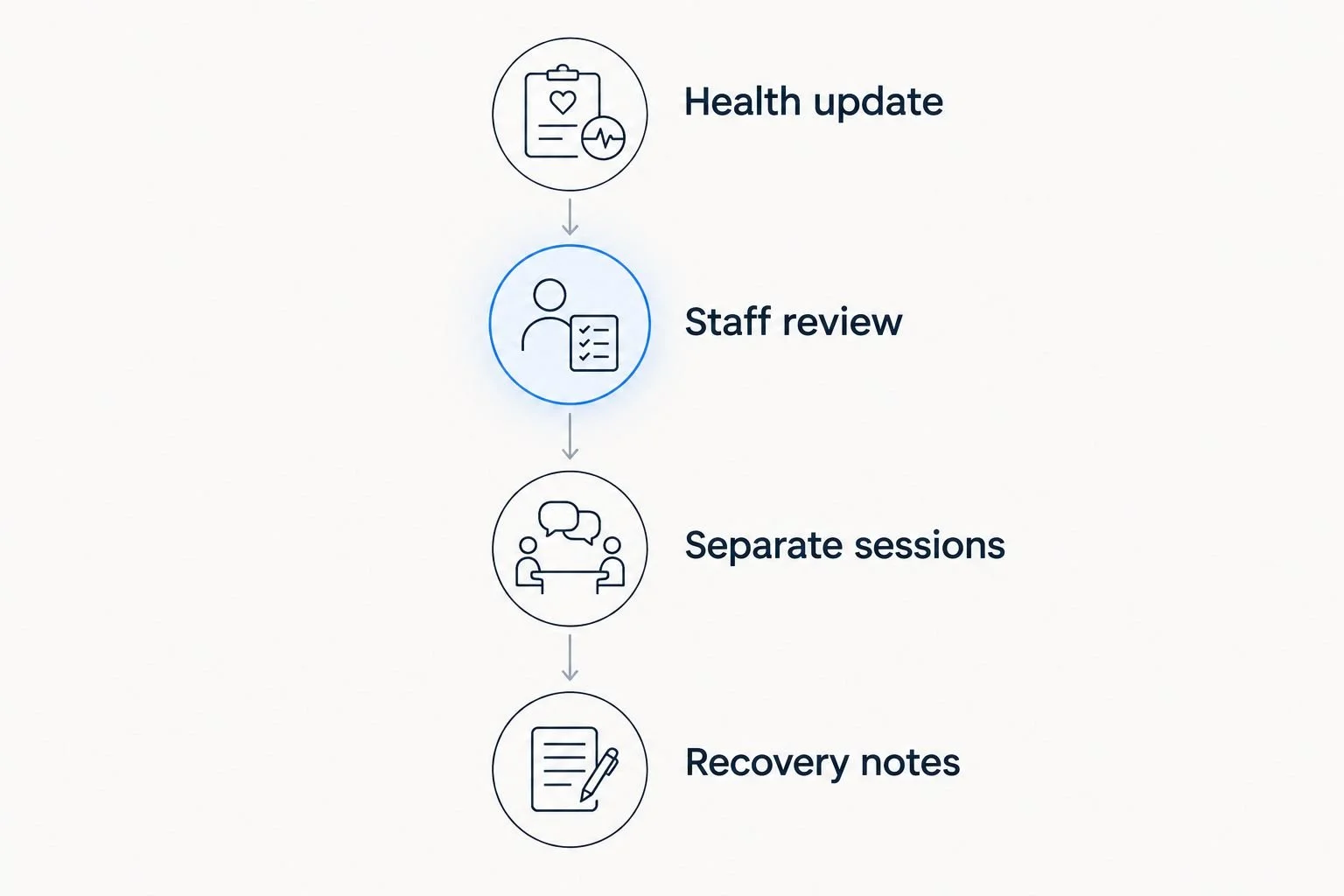
The workflow is simple: Health update, Staff review, Separate sessions, Recovery notes. The review belongs before exposure, not after you have committed to completing both services.
Record the experience before repeating it
Write down what actually happened. Record the services completed, their order, and the settings staff confirmed. Do not fill gaps from memory or assume the next appointment will use identical settings.
Describe your response without assigning a cause. Note comfort, energy, soreness, and any unwanted effects in ordinary language. A positive experience is useful information, but it is not proof of an added stacking benefit.
Review before changing the plan. Share concerns with staff and involve your healthcare professional when symptoms or medical questions arise. Do not independently increase chamber pressure, light exposure, or appointment frequency.
Expected result: Your next decision follows a documented experience rather than enthusiasm alone.
Another workflow: add the second service later
If both services are new to you, build the combination gradually rather than making the first visit a test of everything at once. This variant prioritizes clearer observations over the convenience of a single visit.
Start with one screened service. Choose it with staff based on your goal and suitability, not a claim that it must always come first.
Record the initial experience. Note what you felt during the session and afterward, including anything uncomfortable or unexpected.
Discuss adding the other service. Complete its screening and confirm its equipment instructions independently. A comfortable HBOT session does not establish suitability for red light therapy, or vice versa.
Revisit the combined schedule. Decide whether separate visits remain more useful or a same-day appointment fits your routine.
For your 2026 plan, resist adding another recovery service at the same time merely to make the visit feel more complete. More simultaneous changes make your notes less informative. Keep ordinary recovery foundations—sleep, appropriate training load, and nutrition—visible in the plan.
Troubleshooting
Your ears will not equalize comfortably
Tell the chamber operator immediately and follow their instructions. Do not force equalization or continue through pain. Report congestion or ear trouble before a future session so suitability can be reassessed.
You do not know which session affected how you feel
Separate the appointments for subsequent observations if staff agree that doing so is appropriate. Keep your notes consistent and document changes in exercise or sleep. Even then, personal observations do not establish cause and effect.
The red light session causes discomfort
Stop the exposure and alert staff. Ask staff to review positioning, exposure settings, and equipment-specific safety instructions before another session. Report eye symptoms or persistent skin symptoms to a healthcare professional rather than trying to adjust around them yourself.
The first service leaves you feeling unwell
Pause the second service and tell staff exactly what you are experiencing. Do not assume another exposure will restore your energy or resolve a symptom. Seek appropriate medical assessment for concerning or persistent symptoms.
The booking leaves no transition time
Ask staff to revise the schedule so equipment changes and check-ins are not rushed. Do not shorten screening, skip reporting discomfort, or improvise session settings to fit a tight calendar. The appointment should fit the safety process, not the reverse.
Customize your workflow
Live Superhuman offers HBOT and red light therapy as distinct wellness services; plan them as distinct decisions. Ask about suitability, the session format, and the practical requirements before committing to a combined visit.
Use the contact page to explain your recovery goal, whether either service is new to you, and any questions that need resolving before booking. Request instructions rather than assuming a particular sequence or exposure duration.
Keep your 2026 routine repeatable before expanding it. If travel time or a crowded training calendar makes the combined visit difficult, discuss a simpler schedule instead of compressing the process.
FAQ
Can I do hyperbaric oxygen and red light therapy on the same day?
Discuss a same-day appointment with staff after completing screening for both services. Treat them as separate sessions with separate equipment instructions; combining them does not establish an added recovery benefit.
Should I do red light therapy before or after HBOT?
Agree on the order with staff rather than assuming either sequence is better. Follow the transition instructions and report how you feel before beginning the second service.
Is stacking hyperbaric oxygen and red light therapy better than one service alone?
Do not assume the combination is better than either service alone. Different mechanisms do not, by themselves, demonstrate an added benefit from stacking.
Can I bring a red light device into a hyperbaric chamber?
Do not bring a red light device into a hyperbaric chamber unless the chamber operator explicitly authorizes that exact equipment and use. Follow all chamber restrictions on electronics, personal items, and materials.
How long should each session last?
Use the duration selected after screening and according to the equipment instructions. There is no universal duration in this guide that you should apply to every chamber or red light device.
Does a higher chamber pressure mean a better session?
Higher chamber pressure is not a general measure of a better session. Pressure selection belongs within a screened, supervised plan, alongside oxygen delivery and other session details.
What should I tell staff before combining the services?
Tell staff about your medications, relevant health history, recent illness or surgery, light sensitivity, and ear or sinus trouble. Report changes again on arrival, even if you already completed an intake form.
Does Live Superhuman offer both services?
Live Superhuman offers bookable hyperbaric oxygen therapy and red light therapy sessions. Confirm the session details and whether a combined visit is appropriate before scheduling.
One last thing
The most useful adjustment is often better documentation, not more exposure. Write down the actual chamber option, light settings, appointment order, and your response. Without that record, a repeat visit can become a different experience that you mistakenly treat as the same one.
Related guides
By Kelley Gast