
Yes—red light therapy is worth considering for specific goals such as improving the appearance of fine lines, but it is not a proven shortcut to better health or athletic performance. In 2026, the strongest buying decision starts with a defined goal, a suitable device, and realistic expectations; the commitment also includes repeat visits or home use, not just a single session.
TL;DR
Is red light therapy worth it? Consider it for a specific goal, not broad promises of better health.
The American Academy of Dermatology describes potential skin benefits while emphasizing that results vary.
Muscle recovery evidence does not justify guaranteed performance claims or replacing basic recovery habits.
Live Superhuman offers bookable red light therapy sessions for readers who prefer a studio to home equipment.
Is red light therapy worth it in 2026?
Red light therapy deserves a targeted trial, not an open-ended commitment. Research supports potential benefits for certain skin concerns, while exercise recovery findings depend on the equipment, exposure, timing, and outcome being studied. A positive finding for one application does not establish benefits for every other use.
If recovery is your priority, the red light therapy and muscle recovery guide provides a more focused starting point than a general wellness claim. Keep the question narrow: what change would make the sessions worthwhile for you?
Your delivery format also matters. Studio sessions and home devices involve different practical trade-offs, but neither format guarantees a better biological response.
Studio sessions
Best for: People who prefer appointments without managing home equipment
Practical advantage: No home device to select or store
Limitation: Travel and scheduling become part of the commitment
Home device
Best for: People who want to fit sessions into an existing routine
Practical advantage: You control when you use it
Limitation: You must evaluate the device and follow its instructions
Defer red light therapy
Best for: People without a clear goal or with unresolved safety questions
Practical advantage: Avoids adding an unmeasured intervention
Limitation: You postpone testing whether it helps your specific goal
The useful comparison is not simply studio versus home. It is a suitable, repeatable approach versus an intervention you cannot evaluate.
Why this matters
Red light therapy sits between two unhelpful extremes: dismissing every application and accepting every advertised benefit. Neither approach helps you decide whether it belongs in your routine.
For your 2026 decision, separate research about a particular outcome from claims about general recovery, longevity, or total-body improvement. Evidence for changes in skin appearance does not automatically support claims about endurance or injury recovery.
You also need to protect the basics. Sleep, appropriate training load, adequate nutrition, and care for persistent symptoms remain priorities. Adding a recovery session does not make those needs disappear.
What benefits have a reasonable evidence basis?
Skin appearance: a specific goal to evaluate
The American Academy of Dermatology's patient guidance on red light therapy describes potential benefits for concerns such as fine lines and wrinkles, while explaining that results and devices vary. That supports a measured expectation—not a promise of dramatic rejuvenation.
If skin appearance is your goal, identify the concern before choosing equipment or sessions. Take comparable photographs under consistent lighting rather than relying on a mirror check immediately afterward. A change in lighting, skin products, or camera angle can make an informal comparison misleading.
Best for: someone evaluating a defined cosmetic concern with realistic expectations. The limitation is that a result from a particular research device does not establish the same result from every consumer device or studio setup.
Muscle recovery: promising, but not a guaranteed outcome
Photobiomodulation research includes exercise recovery and muscle performance, but findings are not uniform across study designs. Differences in light delivery and exercise testing make broad claims difficult to justify.
Feeling more relaxed after a session is a valid personal observation. It is not the same as demonstrating faster muscle repair, improved strength, or readiness for a harder workout.
Best for: someone who already manages basic recovery habits and wants to evaluate an additional tool. The limitation is attribution: soreness also changes with sleep, training familiarity, workload, and time.
Broad wellness claims: require more scrutiny
Cleveland Clinic's patient overview of red light therapy describes the treatment as an area of ongoing research and cautions against treating every proposed use as established. Use that distinction when assessing claims in 2026.
Claims about whole-body optimization need an identifiable outcome. Ask what is being measured, what evidence supports it, and whether that evidence applies to the equipment being offered.
Best for: no recommendation based solely on an undefined wellness promise. Skip claims that cannot explain what improvement means or how you would recognize it.
Why red light therapy results vary
A device emitting red light is not enough information to predict a result. These factors affect whether a session matches the intended use:
Your goal: skin appearance and post-exercise soreness are different outcomes. Evidence needs to match the question you are asking.
Wavelength: light wavelength describes part of what the device delivers. Common examples include 630 nm and 660 nm red light and 850 nm near-infrared light; these are category examples, not specifications for a particular studio.
Light delivery: output at the treatment area, distance, and exposure time work together. A wavelength label alone does not establish the delivered dose.
Coverage: a small targeted device and a larger treatment area are not interchangeable simply because both use red light.
Consistency: changing equipment, positioning, and session habits makes your experience harder to compare.
Other changes: new training, skincare, supplements, or sleep habits complicate any attempt to credit red light therapy alone.
The wavelength examples are not a shopping ranking. A 660 nm label does not make a device better than a 630 nm device, and adding 850 nm does not prove better results. You need information about the intended application and the complete light delivery—not a contest over specifications.
How do you decide whether to try it?
Use a simple sequence before making red light therapy a recurring part of your routine. The aim is to make the decision testable without turning a personal trial into a claim of scientific proof.
Define your goal. Choose a specific concern, such as the appearance of fine lines or soreness after comparable workouts. Avoid combining unrelated goals into a single judgment.
Check suitability. Review relevant health conditions, medications, and device safety instructions. Ask a qualified clinician when those raise questions.
Record your baseline. Use consistent photographs for skin appearance or a repeatable description of soreness and activity. Keep the comparison simple enough to maintain.
Keep conditions steady. Follow the equipment's instructions and record other meaningful changes. Do not increase exposure because you want a faster response.
Review the outcome. Decide whether the observed change matters enough to justify continuing. A lack of meaningful improvement is a reason to reconsider, not automatically to add more sessions.
This sequence makes a 2026 trial more useful than relying on enthusiasm after the first visit. It also separates enjoying an experience from demonstrating a change in your chosen outcome.
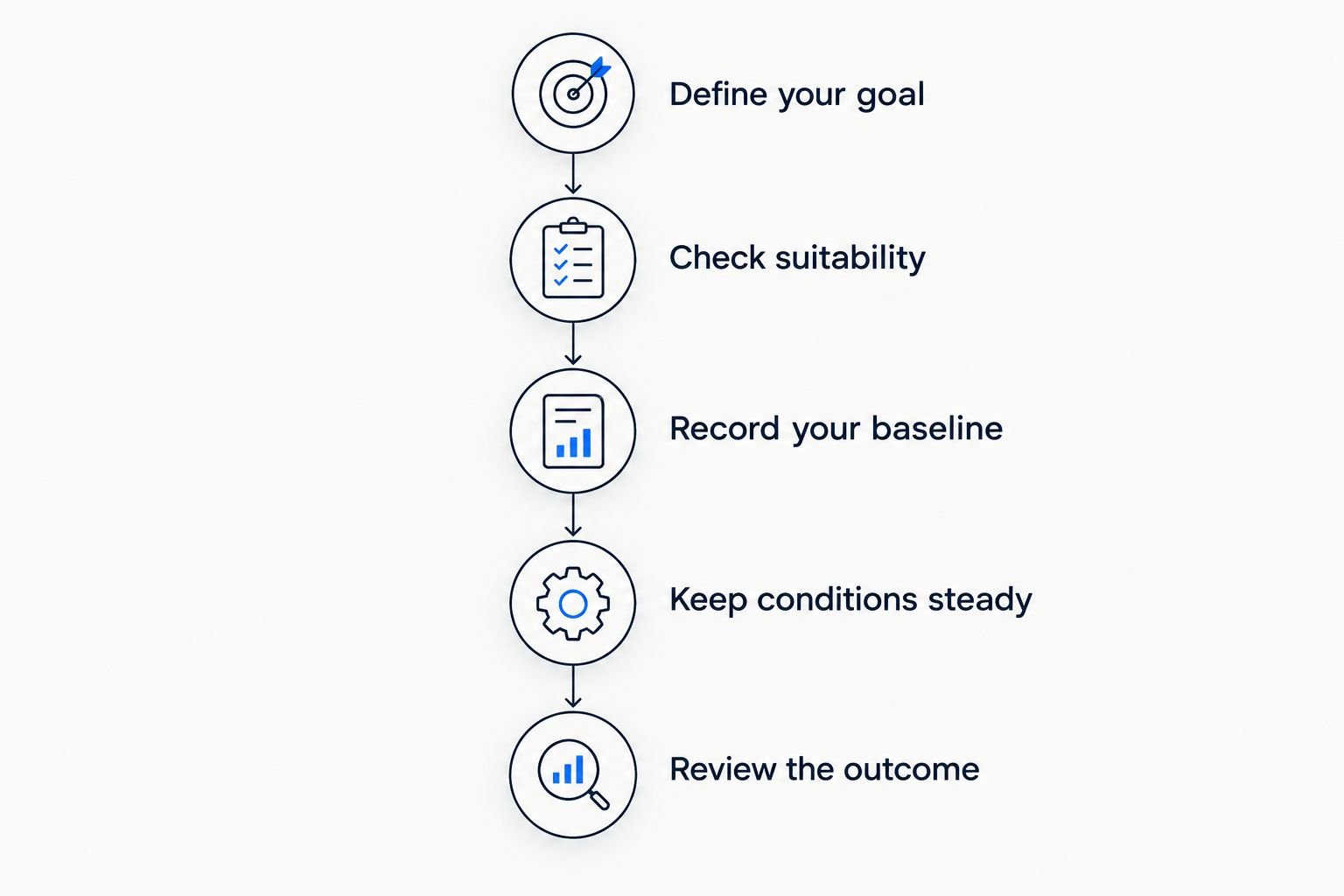
Choose the outcome before starting, then compare under consistent conditions.
You do not need an elaborate tracking system. You need a record that answers the same question before and after, without moving the goalposts when the result disappoints.
What should you ask before a studio session?
Ask what equipment the session uses, which wavelengths it delivers, how positioning is determined, and what safety instructions apply. Request an explanation tied to your goal rather than accepting a list of possible benefits.
A studio should distinguish the service it provides from an outcome it cannot guarantee. Also ask what you need to do before arrival, what the session involves, and how to report discomfort during it.
Live Superhuman is best for readers who want bookable studio red light therapy sessions rather than a home device. The studio format removes the need to select and store your own equipment; its trade-off is the travel and scheduling involved. Neither convenience nor an appointment establishes that the treatment will deliver your desired result.
Use the contact page to ask about the red light therapy session and its suitability for your goal. Confirm details directly rather than assuming every studio follows the same approach.
Who should get safety advice first?
Red light therapy is not ultraviolet tanning, but that distinction does not make every device or use appropriate for everyone. Follow the manufacturer's eye-safety and exposure instructions, and do not assume that brighter light or longer exposure is better.
Ask a qualified clinician before starting if you take medication that increases light sensitivity, have a light-sensitive condition, or want to expose an area with an unexplained skin change. Discuss pregnancy or active medical treatment before adding an elective light-based session.
Stop if the session causes discomfort or an unexpected reaction. Persistent pain, a changing skin lesion, or an unexplained symptom needs appropriate assessment—not a recovery-session experiment.
Is red light therapy worth it for muscle recovery?
Red light therapy is worth evaluating for muscle recovery only as an optional addition, not a guaranteed performance tool. Compare similar workouts and account for sleep and training load; otherwise, a change in soreness tells you little about what caused it.
Is red light therapy better at home or in a studio?
Neither home nor studio red light therapy is automatically better. Choose the format that provides suitable equipment, clear instructions, and a routine you can maintain; convenience matters, but it does not replace evidence.
How long should you try red light therapy?
There is no universal trial length that applies to every goal and device. Use guidance appropriate to the intended application, agree on when to review progress, and avoid extending an ineffective routine indefinitely.
FAQ
Is red light therapy worth it in 2026?
Red light therapy is worth considering in 2026 for a defined goal with realistic expectations, not as a general health upgrade. Evidence varies by application, and a suitable device does not guarantee an individual result.
What's the best way to tell if red light therapy is working?
Compare the same outcome under consistent conditions before and after starting. Use comparable photographs for skin appearance or a repeatable recovery record, and note changes in sleep, training, or skincare.
Can red light therapy replace sleep or rest days?
Red light therapy does not replace sleep, appropriate rest, or sensible training load. Treat it as an optional addition rather than permission to ignore fatigue or persistent symptoms.
Is more red light therapy better?
More red light therapy is not automatically better. Exposure time and light delivery work together, so follow the device instructions rather than extending sessions on your own.
Does red light therapy use UV light?
Red light therapy does not use ultraviolet light as its treatment mechanism. Follow the actual device's safety instructions, including any eye-protection requirements.
Can I use red light therapy if I take medication?
Check with a qualified clinician if your medication increases light sensitivity or you are unsure about compatibility. Bring the medication details and information about the proposed device or session.
Does Live Superhuman offer red light therapy?
Live Superhuman offers bookable red light therapy sessions. Ask directly about the session format, equipment, preparation, and suitability for your intended goal.
One last thing
Decide what would make you stop before you start. If your chosen outcome does not improve, reconsider the intervention instead of assuming that more sessions must be the answer.
For a 2026 decision, that stopping rule is more useful than a long list of possible benefits. It keeps red light therapy in its proper role: a targeted option you evaluate, not an obligation you keep renewing.
Related guides
By Kelley Gast