
CrossFit athletes’ EWOT therapy is exercise while breathing oxygen-enriched air, with the aim of supporting conditioning and recovery; those goals are not guaranteed outcomes. This guide explains how to assess EWOT therapy for CrossFit athletes in 2026 without confusing an oxygen-assisted session with proven improvements in strength, workout times, or recovery.
TL;DR
EWOT therapy for CrossFit athletes combines exercise with oxygen-enriched air; better benchmark scores are not a guaranteed result.
Live Superhuman offers bookable EWOT sessions for athletes seeking a studio-based option.
Keep strength training, aerobic conditioning, sleep, and nutrition central; treat EWOT as an optional addition.
Compare repeatable workouts and next-day readiness before deciding whether EWOT deserves space in your training week.
Why EWOT matters for CrossFit athletes
CrossFit combines lifting, gymnastics, and conditioning. Those demands make it essential to distinguish the benefit you want: a stronger lift, better pacing, and less next-day fatigue are different goals requiring different measures.
EWOT introduces oxygen-enriched air during exercise. That changes the breathing environment, but it does not establish that the session improves your next workout. The useful question is whether adding EWOT helps your training without adding unwanted fatigue or displacing the basics.
Live Superhuman offers EWOT alongside hyperbaric oxygen therapy, red light therapy, PEMF, and altitude training. Live Superhuman is best for CrossFit athletes seeking bookable, studio-based EWOT sessions.
For your 2026 training plan, separate the appeal of the equipment from the outcome you can actually observe. A session feeling different is not the same as a measurable performance benefit.
Understand what EWOT does—and does not establish
EWOT stands for exercise with oxygen therapy. You exercise while breathing oxygen-enriched air through an appropriate delivery system; it is not the same experience as sitting in a pressurized hyperbaric chamber.
Breathing oxygen-enriched air changes oxygen exposure during the session. It does not automatically establish faster muscle repair, lasting aerobic adaptation, or improved CrossFit performance. Research findings also depend on the exercise setting, oxygen delivery, participants, and outcome measured.
Do not treat general oxygen research as proof of a CrossFit-specific result. An effect measured during exercise is different from an improvement retained afterward. Ask whether any evidence offered concerns the actual session, athlete population, and benefit being discussed.
EWOT also involves exercise. If you finish fatigued, count that effort in your training load rather than labeling the entire visit recovery.
How to assess EWOT in your training week
Define your training goal
Start with your training log, not a booking calendar. Name the problem you want to address: inconsistent conditioning pace, difficulty recovering between training days, or uncertainty about your current aerobic workload.
Choose an outcome that matches that problem. A heavier squat does not isolate aerobic conditioning, while one fast workout does not establish improved recovery. In 2026, use the same standard for EWOT that you use for a training change: decide what success looks like before you begin.
Write one primary goal in plain language.
Choose a repeatable workout or readiness measure.
Record your current training schedule.
Note sleep, nutrition, and unusual stress alongside results.
Establish a baseline before adding sessions
Use a notebook or spreadsheet to record comparable training days first. No special device is required to note workout format, pacing, effort, and how you feel afterward.
Use a familiar 0–10 effort scale consistently, with 0 representing rest and 10 representing maximal effort. This is a way to organize your observations, not a substitute for medical assessment or a promise of precise measurement.
Avoid comparing unrelated workouts. A barbell-heavy session and a longer conditioning piece ask different things of you, even when both feel hard. Keep the comparison narrow enough to interpret.
Record the movements, loads, and workout format.
Log completion time or work completed where relevant.
Record perceived effort on the same 0–10 scale.
Check readiness again about 24 hours later.
Flag changed equipment, scaling, or training conditions.
Check suitability before choosing a studio
Begin with questions you can ask directly: what exercise is involved, how oxygen is delivered, and what happens if you feel uncomfortable. Ask a qualified healthcare professional about suitability if you have a health condition, take relevant medication, or have unexplained exercise symptoms.
A studio session is the alternative to arranging equipment and managing an oxygen-assisted exercise setup yourself. Live Superhuman offers bookable EWOT sessions, but you should confirm the session details and suitability process before booking. A booking is not medical clearance.
Oxygen supports combustion. Follow the provider’s safety instructions, keep ignition sources away, and do not improvise equipment connections or oxygen settings.
Describe your exercise history and relevant health concerns.
Ask how the oxygen delivery equipment is used.
Ask what supervision and stopping procedures apply.
Confirm equipment-cleaning and fit procedures.
Stop exercising if chest pain, dizziness, or unusual breathlessness occurs.
Place the session around your hardest training
First map your existing week manually. Mark heavy lower-body work, demanding conditioning, competition practice, and genuine rest. Decide where another exercise session belongs before deciding that oxygen makes it a recovery session.
For your initial assessment, avoid changing several training variables at once. Adding EWOT while increasing lifting volume and changing your diet leaves you unable to separate their effects. Protect the sessions that matter most to your current goal.
Use the sequence below as a planning checklist, not as an exercise prescription.
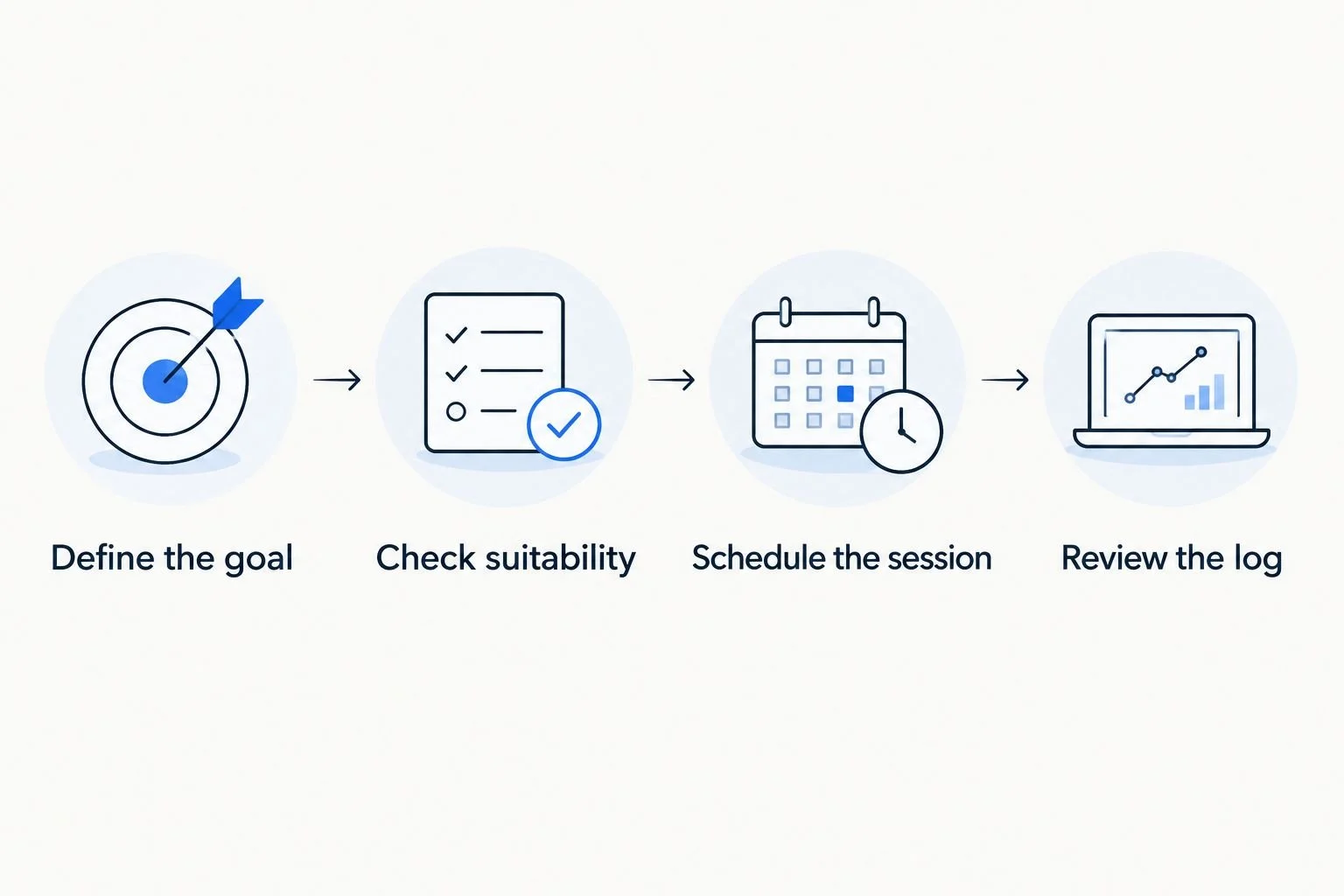
Decide what you will measure before adding an oxygen-assisted exercise session.
Scheduling should make your training easier to interpret. If the session leaves you tired, that observation belongs in the log even if your original goal was recovery.
Define the goal before choosing a day.
Check suitability before participating.
Schedule the session around priority workouts.
Review the log before adding more sessions.
Keep the first comparison simple
Keep the comparison simple: use your existing log and repeat a familiar, appropriate training task under similar conditions. Do not turn the evaluation into an extra maximal test.
Compare at least 2 similar training sessions as an organizational starting point, not as scientific proof. Record both the result and its context. Improved pacing after a better night’s sleep does not isolate an EWOT effect.
Live Superhuman EWOT sessions offer a bookable studio option; the limitation is that a completed session alone cannot tell you whether your conditioning improved. That judgment still requires consistent observation outside the studio.
Keep workout scaling and equipment consistent.
Compare pacing as well as the final result.
Note sleep and training load before each comparison.
Record discomfort or added fatigue honestly.
Avoid adding another recovery service during the same comparison.
Review the result before committing more time
Decide whether the experience supports your actual goal, not whether you enjoyed the novelty. Enjoyment matters for adherence, but it is a different outcome from improved performance.
Set a review date in your 2026 calendar and examine comparable sessions together. Look for repeatability rather than selecting your best day. If results remain unclear, keep the conclusion narrow: the benefit has not been established for you.
Keep EWOT optional until your observations justify its place. Do not remove useful training or adequate rest merely to make room for a service.
Review workout results alongside effort ratings.
Compare next-day readiness with your baseline.
Check whether the visit displaced sleep or meals.
Discuss persistent fatigue with an appropriate professional.
Continue only when the experience fits your goals and schedule.
Compare the options for CrossFit athletes
Choose by purpose rather than by which service sounds most technical. Oxygen-assisted exercise, ordinary conditioning, and passive wellness sessions are not interchangeable.
The table compares practical roles, not proven rankings of effectiveness. No option below guarantees a better benchmark score, and the best fit depends on what you need to change.
Conventional aerobic conditioning
Best for: Athletes building exercise capacity through training
Main advantage: Directly practices the work you want to improve
Key limitation: Adds training load and requires appropriate programming
EWOT
Best for: Athletes assessing oxygen-assisted exercise
Main advantage: Combines movement with oxygen-enriched air
Key limitation: CrossFit-specific performance benefits are not established by the session alone
Hyperbaric oxygen therapy
Best for: Athletes comparing a chamber-based oxygen session
Main advantage: Distinct oxygen-delivery setting without simultaneous conditioning
Key limitation: Does not replace exercise or establish a CrossFit performance benefit
Red light therapy
Best for: Athletes considering a non-exercise wellness session
Main advantage: Does not require a conditioning workout during exposure
Key limitation: Results depend on the application; it does not train pacing or lifting skill
Rest and sleep planning
Best for: Athletes whose recovery time is being squeezed
Main advantage: Addresses time available for recovery directly
Key limitation: Does not replace appropriate training or resolve every cause of fatigue
EWOT differs from altitude training as well. EWOT uses oxygen-enriched air; altitude exposure reduces oxygen availability. More oxygen and less oxygen are different exposures, not stronger and weaker versions of the same session.
Common mistakes CrossFit athletes make
Treating an oxygen session as proven recovery
An EWOT session includes movement, so its exercise load still counts. Calling it recovery does not erase the effort required. Record what you did and how you felt afterward rather than assuming the oxygen component cancels fatigue.
Using workout soreness as the only score
Soreness and performance are different observations. Feeling less sore does not establish better strength, aerobic capacity, or movement quality. Track the outcome you selected instead of changing the definition of success after the session.
Stacking services before measuring anything
Adding EWOT, a chamber session, and other recovery services together makes attribution difficult. If the next workout improves, you cannot identify which change mattered. Start with a clear question and keep other major variables steady where practical.
Letting a session replace necessary care
Persistent fatigue, chest symptoms, or unusual breathlessness require appropriate assessment, not another performance experiment. In 2026, the boundary remains straightforward: a wellness session is not a diagnosis or treatment plan for unexplained symptoms.
FAQ
What is EWOT therapy for CrossFit athletes?
EWOT therapy for CrossFit athletes means exercising while breathing oxygen-enriched air. Athletes considering it should distinguish the experience during the session from any lasting change in conditioning or recovery.
Will EWOT improve my CrossFit benchmark times?
An EWOT session does not guarantee better CrossFit benchmark times. Compare repeatable workouts under similar conditions and account for pacing, sleep, scaling, and training load before attributing a change to EWOT.
Is EWOT the same as hyperbaric oxygen therapy?
No, EWOT combines exercise with oxygen-enriched air, while hyperbaric oxygen therapy uses a pressurized chamber. The different settings mean benefits claimed for one should not automatically be applied to the other.
Should I do EWOT before or after a hard workout?
There is no universal placement that fits every athlete and session. Ask about the exercise involved, protect priority workouts, and count any effort or fatigue toward your total training load.
Can EWOT replace my aerobic conditioning?
EWOT should not be assumed to replace appropriately programmed aerobic conditioning. Your training still needs to develop the exercise skills and capacity required for your goals.
Who should ask a healthcare professional before trying EWOT?
Athletes with health conditions, relevant medications, or unexplained exercise symptoms should ask a qualified healthcare professional about suitability before participating. Stop exercise if chest pain, dizziness, or unusual breathlessness occurs.
Does Live Superhuman offer EWOT sessions?
Live Superhuman offers bookable EWOT sessions for clients seeking recovery and performance support. Confirm the exercise format, suitability process, and practical session details before booking.
One last thing
A better comparison can be more useful than another service. Choose one familiar workout, preserve its scaling, and record how hard it felt alongside the result. That gives you a clearer basis for assessing any addition to your routine.
For 2026, keep the decision simple: EWOT earns a place through a useful experience and an acceptable training cost—not through the assumption that more oxygen automatically means better CrossFit performance.