There is no established number of hyperbaric oxygen therapy sessions that everyone needs for wellness, recovery, or performance in 2026. For a diagnosed medical condition, a qualified clinician determines the treatment count; for general wellness, a session package is not evidence that you need that many visits. Choose the reason for treatment before choosing the number of sessions.
TL;DR
How many hyperbaric oxygen therapy sessions do you need? There is no universal wellness total.
Live Superhuman offers bookable HBOT wellness sessions; medical treatment counts require a clinician’s assessment.
Chamber pressure, session length, and visit frequency are different variables—not interchangeable measures of treatment.
Set a specific goal and review point before committing to repeat hyperbaric oxygen therapy sessions.
Why this matters
A fixed session count sounds useful because it makes scheduling simple. But it leaves out the question that matters: what result are you trying to achieve, and what evidence supports using HBOT for that purpose?
In 2026, keep wellness decisions separate from treatment prescribed for a medical condition. Feeling refreshed after a visit, tolerating the chamber comfortably, and receiving treatment for a recognized medical indication are different outcomes. They should not share an automatic booking schedule.
If you are new to the experience, read about your first hyperbaric visit before deciding on repeat appointments. Understanding what a visit involves helps you ask better questions; it does not establish how many visits will benefit you.
How many hyperbaric oxygen therapy sessions do you need?
For general wellness, there is no established session total that applies to everyone. For medical treatment, the count depends on the condition and the prescribing clinician’s assessment. Neither an advertised package nor another person’s experience establishes your individual need.
General wellness or recovery interest
Best for: People exploring a wellness experience
How to decide the count: Define the goal, complete safety screening, and agree on a review point
Benefit of this approach: Keeps bookings tied to a stated purpose
Limitation: Does not establish that HBOT will improve recovery or performance
Treatment for a diagnosed condition
Best for: Patients referred for medical evaluation
How to decide the count: Follow the treating clinician’s condition-specific plan
Benefit of this approach: Connects treatment decisions to medical assessment
Limitation: A wellness booking cannot replace that assessment
Continuing after previous sessions
Best for: People reconsidering repeat visits
How to decide the count: Review the original goal, response, and any problems before continuing
Benefit of this approach: Creates an opportunity to stop an unhelpful routine
Limitation: Personal impressions alone cannot prove treatment effectiveness
The table separates decisions, not competing packages. A longer course is not automatically better, and a shorter course is not automatically sufficient. The correct question is whether the proposed count has a clear justification for your situation.
Set the purpose before the schedule
Write down what you want from HBOT in plain language. Wanting a relaxing experience is different from wanting faster recovery between workouts, and both differ from seeking treatment for an injury or illness.
Be equally clear about what would make you reconsider. If your only reason for continuing is that you already bought appointments, the package—not your goal—is directing the decision.
Wellness sessions: no established total
For wellness-focused HBOT, avoid treating a preset series as a proven requirement. A provider should explain the reason for recommending repeat visits, what benefit is being discussed, and where uncertainty remains.
Best for: people exploring a wellness service who understand that an experience is not a guaranteed performance result. The practical advantage is that you can discuss your goals before committing to a recurring schedule; the limitation is that there is no universal wellness count to promise the result you want.
An introductory visit can help you understand the chamber experience and your comfort with it. It cannot establish that you need an extended course, and a pleasant visit does not prove that a specific recovery outcome occurred.
Before booking more, ask:
What specific goal is the proposed schedule intended to address?
What evidence supports HBOT for that goal?
Why is this number of visits being recommended?
When will the recommendation be reviewed?
What would be a reason to stop or seek medical advice?
You do not need a complicated tracking system to ask these questions. You need an answer that connects the recommended appointments to your actual purpose.
Medical treatment: clinician-directed count
For a diagnosed condition, the treating clinician determines the session count and reassesses treatment as appropriate. Do not substitute a wellness studio’s suggested schedule for medical care or alter prescribed treatment because a general article describes a different number.
Best for: patients whose medical team has identified a reason to consider hyperbaric treatment. The advantage is condition-specific assessment; the limitation is that the schedule cannot be responsibly determined from your recovery goal or calendar alone.
The FDA distinguishes cleared medical uses of hyperbaric oxygen therapy from uses promoted without established safety and effectiveness. That distinction matters more than how many appointments a provider sells.
Tell your clinician about any wellness sessions you are considering alongside medical treatment. If you have new symptoms, an unresolved injury, or a concern about an existing condition, seek an appropriate assessment rather than increasing your HBOT visits yourself.
Why the recommended session count varies
A useful recommendation explains its reasoning. These factors belong in the discussion before you settle on a schedule:
Your purpose: a wellness experience and treatment for a diagnosed condition require different decision-making.
The supporting evidence: findings for a particular medical use do not automatically apply to general performance goals.
The actual treatment conditions: chamber pressure, oxygen delivery, and session duration matter when interpreting a recommendation.
Your health history: safety screening comes before deciding whether repeat exposure is appropriate.
Your response: discomfort or a new health concern requires review, not automatic continuation.
The reassessment plan: agree on when to review the reason for continuing rather than leaving the schedule open-ended.
Your available time matters for planning, but it does not establish a beneficial treatment count. Likewise, choosing a larger package does not turn an uncertain wellness claim into an established outcome.
Does higher pressure mean you need fewer visits?
Higher chamber pressure does not establish that you need fewer sessions. Pressure and session count describe different parts of an exposure, and there is no simple exchange rate between them.
For reference, 1 ATA represents approximately sea-level atmospheric pressure. Live Superhuman lists a 1.6 ATA chamber and a 2.0 ATA chamber option. Those figures identify pressure options, not a proven difference in the number of wellness visits you need.
When comparing options in 2026, ask about the complete session rather than choosing by the pressure figure alone. Confirm the oxygen-delivery method, planned duration, screening requirements, and reason that option is being suggested for you.
Do not interpret a higher pressure number as a stronger promise. A pressure specification alone cannot tell you whether HBOT suits your goal, whether you should proceed, or how many appointments are appropriate.
How should you decide whether to book more?
Use a decision sequence that makes room for reassessment. The aim is not to calculate a medical treatment count yourself; it is to avoid letting repeat bookings become automatic.
Define the goal. State whether you are seeking a wellness experience, a recovery-related benefit, or medical treatment. Do not group these together under a vague promise to feel better.
Check suitability. Discuss your health history and any current concerns before entering a chamber. Ask who handles screening and who to contact if a concern needs medical assessment.
Confirm details. Ask about pressure, oxygen delivery, session duration, and what happens if you become uncomfortable. Make sure the explanation describes the actual session you would receive.
Set a review. Agree on what you will discuss before booking further visits. Include both your original goal and any discomfort or practical difficulty.
Reassess bookings. Continue only after reconsidering the reason for doing so. An unchanged goal is not, by itself, evidence that additional sessions will help.
This sequence keeps your 2026 booking decisions tied to a purpose rather than a recurring calendar reminder. It also gives you a clear place to raise questions before extending your commitment.
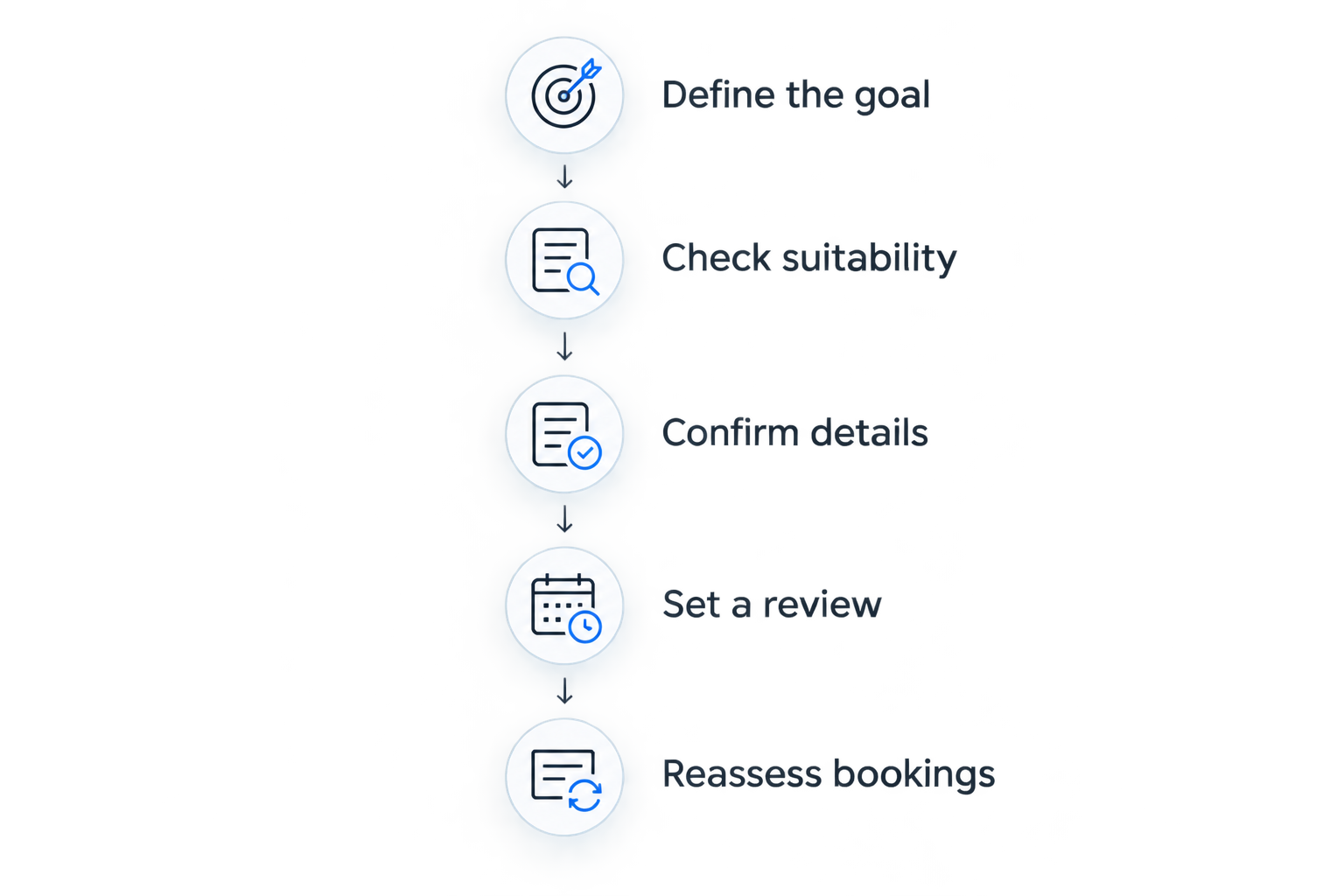
Review the reason for continuing before making repeat bookings automatic.
Session count also differs from visit frequency. Deciding how often to attend does not answer how long you should continue; the guide to how often to do hyperbaric oxygen therapy for recovery addresses that separate planning question.
What should you track between sessions?
Track the outcome you actually care about, not just attendance. For a wellness goal, a simple record of how you felt, your training demands, sleep, and any discomfort gives you something concrete to discuss at the review.
Keep expectations separate from observations. Writing that you felt less tired is an observation; concluding that HBOT caused faster recovery is a different claim. Changes in training, rest, or other services make that conclusion harder to support.
Do not use a personal journal to judge treatment of a medical condition. Your treating clinician should decide which assessments matter and how those findings affect the treatment schedule.
A useful record supports a conversation; it does not prove effectiveness. If you cannot explain what you are monitoring, clarify the goal before adding more appointments.
Where does Live Superhuman fit?
Live Superhuman is best suited to people seeking bookable HBOT wellness sessions rather than a substitute for prescribed medical care. The studio offers hyperbaric oxygen therapy for clients interested in recovery and performance.
The benefit of considering a bookable wellness session is that you can ask about the experience in relation to your goals. The boundary is equally important: a studio offering does not establish a medical need, guarantee an outcome, or determine a treatment course for a diagnosed condition.
Bring your questions about chamber options, session details, screening, and repeat bookings before you commit. Keep medical decisions with an appropriately qualified clinician.
Ask about your HBOT visit
Discuss session details and your questions before deciding on repeat bookings.
FAQ
How many hyperbaric oxygen therapy sessions do you need for recovery?
There is no established universal session count for general recovery or performance. Define your goal, discuss suitability, and ask what evidence supports the proposed schedule before committing to repeat visits.
Is one hyperbaric oxygen therapy session enough?
A single session does not establish that you have received enough treatment for a medical condition or achieved a wellness goal. An introductory visit can help you understand the experience, but it cannot prove a lasting recovery benefit.
Should I book a package before trying HBOT?
A package is a purchasing arrangement, not evidence of how many sessions you need. Ask why that number is recommended, when you will reassess, and what would justify continuing.
Does a 2.0 ATA chamber mean I need fewer visits?
A 2.0 ATA chamber does not establish that you need fewer visits. Pressure, oxygen delivery, session duration, and the reason for treatment must be considered together.
Can I stop a prescribed course when I feel better?
Do not change a prescribed course without discussing it with your treating clinician. Feeling better does not independently establish that the treatment goal has been met.
Can Live Superhuman tell me my wellness session count?
Live Superhuman can discuss its bookable wellness sessions, but there is no universal evidence-based wellness count to promise. Treatment decisions for a diagnosed condition belong with a qualified clinician.
What if my ears hurt during a chamber session?
Tell the operator immediately if your ears hurt during a chamber session. Pressure changes can injure the ears, so do not push through pain to complete a visit or meet a session target.
One last thing
Ask for the reason to stop, not just the reason to start. A useful discussion explains when the recommendation will be reviewed and what would make further visits inappropriate or unhelpful.
For your 2026 plan, put that review on the calendar before making repeat bookings automatic. A clearly stated goal and a willingness to reassess are more useful than collecting sessions without knowing what they are meant to accomplish.
Related guides
By Kelley Gast