
There is no established weekly hyperbaric oxygen therapy schedule for general workout recovery. Choose session frequency with a qualified healthcare professional based on your health, recovery goal, and the actual chamber settings—not a blanket daily or weekly recommendation. More sessions do not automatically mean better recovery, and a wellness schedule should not replace evaluation of an injury or persistent symptoms.
TL;DR
How often should you do hyperbaric oxygen therapy? General workout recovery has no established weekly schedule.
Live Superhuman offers wellness-focused hyperbaric oxygen therapy; session frequency requires an individual decision.
Chamber pressure, oxygen delivery, and session duration matter alongside frequency.
Do not copy a medical treatment schedule for athletic recovery or increase visits to push through persistent symptoms.
How often should you do hyperbaric oxygen therapy?
For general athletic recovery, there is no established number of HBOT sessions per week that everyone should follow. A schedule used for a diagnosed condition does not establish an effective schedule for post-workout soreness, performance optimization, or everyday fatigue.
Start by separating your goal from the appointment calendar. Wanting to feel ready for your next training session is different from receiving treatment for a specific medical condition. Those situations require different decisions, even when both involve a hyperbaric chamber.
The hyperbaric oxygen therapy recovery workflow addresses the recovery context. Use that context to frame your questions rather than treating a published schedule as a personal prescription.
Wellness-focused HBOT discussion
Best for: People exploring support for their recovery routine
Main advantage: Lets you discuss your goal before choosing visits
Main limitation: Does not establish that a particular frequency improves workout recovery
Clinician-directed HBOT treatment
Best for: People with a condition being evaluated for medical treatment
Main advantage: Connects scheduling to a specific medical purpose
Main limitation: Cannot be copied directly into a general fitness routine
Reassessment before more sessions
Best for: People with persistent symptoms or unclear results
Main advantage: Creates a decision point instead of automatic repetition
Main limitation: Requires investigating the problem rather than simply adding appointments
Why this matters
In 2026, a calendar filled with recovery appointments is still not evidence that your recovery is improving. Frequency describes exposure; it does not prove benefit.
Pressure, oxygen concentration, exposure time, and the reason for treatment all affect what a session involves. Counting visits while ignoring those details makes comparisons misleading. Two people reporting the same number of visits can be describing different exposures.
Treat frequency as a decision to justify, not a target to hit. Sleep, adequate nutrition, and an appropriate training load remain fundamental parts of recovery; scheduling another chamber visit does not remove those needs.
Decide what you want the sessions to change
Before discussing frequency, name the outcome you want to improve. “Better recovery” is too broad to evaluate without explaining what it means in your routine.
A clearer goal might be returning to your usual training comfortably, experiencing less post-exercise soreness, or feeling less fatigued between sessions. These are goals to discuss and observe—not promised effects of HBOT.
Use this decision sequence:
Define your goal. Explain what feels different from your normal recovery and what you want to change.
Review your health. Discuss relevant conditions, medications, previous chamber experiences, and current symptoms with an appropriate healthcare professional.
Confirm session details. Ask about pressure, oxygen delivery, duration, supervision, and the process for communicating discomfort.
Track your response. Record your training, recovery experience, and any unwanted effects without assuming that every change comes from HBOT.
Reassess frequency. Decide whether continuing makes sense rather than renewing the same schedule automatically.
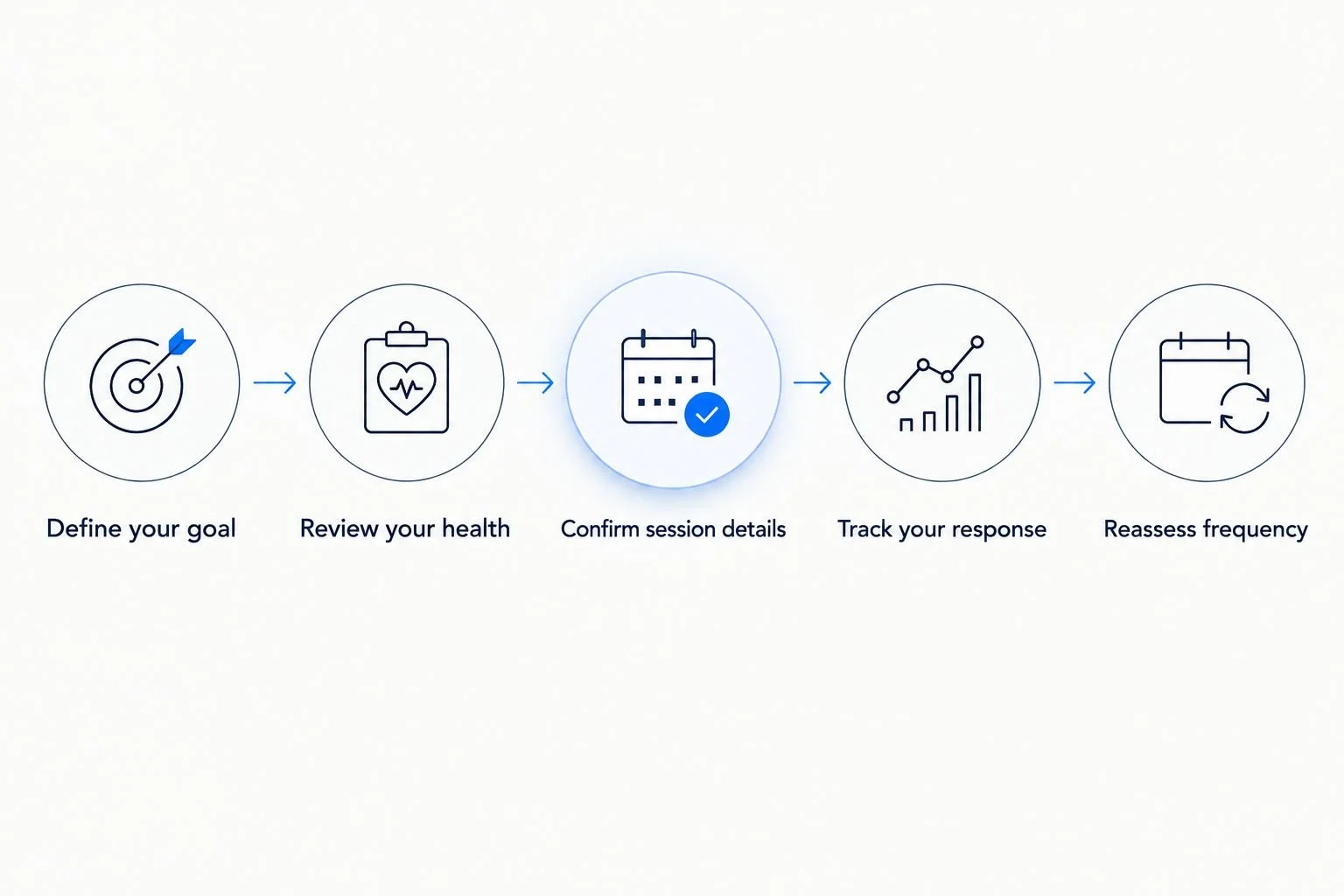
Choose frequency after clarifying your goal, health considerations, and session details.
This sequence puts the decision in the right order. A recommendation that starts with an appointment count before discussing your health and goal leaves important questions unanswered.
Chamber pressure is not a weekly schedule
ATA means atmospheres absolute, a measure of total pressure. Normal atmospheric pressure at sea level is approximately 1 ATA; a chamber setting describes pressure, not the number of sessions you need.
Live Superhuman offers a first-visit experience with a 1.6 ATA chamber and a 2.0 ATA chamber option. Those figures identify pressure settings. They do not establish interchangeable sessions or prove that the higher-pressure option produces better athletic recovery.
1.6 ATA
What the number tells you: The stated chamber pressure
Best for: Discussing the 1.6 ATA experience with the provider
What still needs clarification: Oxygen delivery, duration, suitability, and frequency
2.0 ATA
What the number tells you: A higher stated chamber pressure
Best for: Discussing the 2.0 ATA option with the provider
What still needs clarification: Oxygen delivery, duration, suitability, and frequency
1.6 ATA: confirm the complete session
A 1.6 ATA setting alone is not enough information to choose a recovery schedule. Ask how oxygen is delivered and how the appointment is structured, including compression and decompression.
The useful comparison is the complete session, not pressure in isolation. Do not assume that attending more often compensates for differences in pressure or oxygen delivery.
2.0 ATA: higher pressure is not a frequency recommendation
A 2.0 ATA setting does not tell you to attend more often or less often. It is a separate exposure detail that belongs in the suitability discussion.
Avoid choosing a chamber solely because its number is higher. Your goal is an appropriate session, not the largest pressure figure on a booking page.
Why HBOT frequency varies
A useful 2026 scheduling discussion addresses these factors before settling on repeat visits:
Purpose of use. General fitness recovery and treatment of a diagnosed condition are different contexts; schedules should not transfer between them automatically.
Health considerations. Relevant medical history and medications affect whether HBOT is appropriate and what needs review before you begin.
Actual exposure. Chamber pressure, oxygen delivery, and duration describe more than a visit count alone.
Session tolerance. Ear discomfort, difficulty equalizing pressure, or other unwanted effects require attention rather than a more aggressive schedule.
Recovery context. Training load, sleep, nutrition, illness, and other recovery activities affect how you interpret changes.
Reason to continue. Repeat appointments need a clear purpose and a point for reassessment, not just an available slot on your calendar.
These factors explain why a generic recommendation can sound precise without answering your actual question. An exact weekly count is not useful when its purpose and supporting rationale are unclear.
Should you do hyperbaric oxygen therapy every day?
Daily HBOT is not an established default for general workout recovery. Frequent treatment schedules used in medical care are tied to specific conditions and clinical decisions, not simply to a desire to recover faster.
If someone recommends daily sessions, ask what evidence supports that frequency for your particular goal and session setup. Also ask what would trigger a pause or a reassessment.
In 2026, the practical distinction remains the same: an intensive schedule is a treatment decision, not a shortcut you can borrow from someone else's experience. Do not increase frequency because a teammate or online testimonial describes a different situation.
Is weekly HBOT enough for recovery?
A weekly session is not a validated universal minimum or maintenance schedule for athletic recovery. Convenience can help you keep appointments, but convenience does not establish effectiveness.
If you are considering a recurring visit, ask what outcome you are evaluating and how you will decide whether to continue. A standing appointment without a decision point makes it easy to confuse consistency with progress.
It is also reasonable to question the underlying problem. Repeatedly feeling unable to recover from normal training calls for a review of training demands and health, not an automatic commitment to additional wellness sessions.
Keep HBOT separate from EWOT
HBOT and exercise with oxygen therapy, or EWOT, are not interchangeable ways to count oxygen sessions. HBOT involves increased ambient pressure; EWOT combines exercise with supplemental oxygen without that same pressurized-chamber setting.
Questions about oxygen therapy masks concern the oxygen-delivery interface used during activities such as EWOT, not the ambient pressure used in HBOT. A mask discussion therefore cannot establish how often you should enter a hyperbaric chamber.
This distinction matters when comparing recovery routines in 2026. An account of someone's oxygen-assisted workout does not provide a chamber schedule, and a chamber schedule does not explain how to structure an oxygen-assisted workout.
Compare like with like before copying frequency. Identify the modality, the exposure details, and the goal before deciding whether another person's routine is relevant to yours.
Track recovery without claiming more than you know
A recovery log helps organize observations. It cannot, by itself, prove that HBOT caused an improvement.
Record what happened around each visit: the training you completed, sleep quality, soreness, fatigue, and any discomfort during or after the session. Keep the descriptions consistent enough that you can compare them without rewriting the meaning each time.
Also record changes to the rest of your routine. If you reduce training intensity, improve sleep, and add several recovery services together, you cannot confidently assign the result to one intervention.
For a 2026 recovery plan, choose observations that relate directly to your goal. Feeling relaxed after an appointment is a valid experience, but it is not the same finding as restored exercise capacity or recovery from an injury.
Your log should support questions such as:
Is the original problem improving, unchanged, or worsening?
Have training demands or sleep changed at the same time?
Am I tolerating the sessions comfortably?
Is there a clear reason to continue at this frequency?
Bring those observations into the reassessment. Do not use the log to justify pushing through symptoms or escalating chamber exposure on your own.
Know when to pause the scheduling conversation
Persistent pain, unexplained fatigue, or declining exercise tolerance deserves appropriate evaluation. Do not assume these are routine recovery problems simply because they started during a training block.
Pressure changes can cause ear or sinus discomfort, and HBOT has risks that require suitability screening. A history of lung problems, current congestion, or difficulty equalizing pressure belongs in the pre-session discussion. An untreated pneumothorax is a contraindication to HBOT.
Tell the session provider immediately if you experience discomfort or feel unwell. Seek urgent medical attention for symptoms such as chest pain or significant breathing difficulty rather than waiting for the next wellness appointment.
The useful decision is sometimes to pause. More visits are not an appropriate response to a problem that has not been assessed.
Where a wellness studio fits
Live Superhuman is best for people seeking bookable wellness-focused hyperbaric oxygen therapy sessions, not a self-prescribed medical treatment schedule. The studio's recovery-and-performance focus describes the setting; it does not establish a guaranteed outcome or a universal frequency.
The advantage is a service you can discuss in the context of your wellness routine. The limitation is equally important: wellness access does not replace clinical assessment or establish that a particular visit count will improve your recovery.
Use the contact page to ask about the actual session details and what information to bring before booking. If your goal involves an injury or a diagnosed condition, involve the healthcare professional responsible for that care.
FAQ
How often should you do hyperbaric oxygen therapy for workout recovery?
There is no established weekly HBOT schedule for general workout recovery. Discuss your goal, health, and the complete session setup with a qualified healthcare professional before choosing repeat visits.
Can I do hyperbaric oxygen therapy every day?
Daily HBOT is not an established default for general workout recovery. Frequent medical treatment schedules should not be copied into a wellness routine without an appropriate clinical reason.
Is one hyperbaric session a week enough?
A weekly session is not a validated universal minimum for athletic recovery. Choose a schedule with a clear purpose and a point for reassessment rather than assuming weekly attendance is necessary.
Does a 2.0 ATA chamber mean I need fewer sessions?
A 2.0 ATA pressure setting does not establish that you need fewer sessions. Pressure must be considered alongside oxygen delivery, duration, suitability, and the reason for use.
Can I replace sleep and rest days with HBOT?
No, HBOT should not replace adequate sleep, nutrition, or appropriate training recovery. Adding chamber visits does not resolve the demands of an unsustainable training schedule.
Does Live Superhuman offer hyperbaric oxygen therapy?
Live Superhuman offers bookable hyperbaric oxygen therapy sessions in a wellness studio. Ask about session details and suitability before deciding on repeat visits.
Should I keep doing HBOT if I feel ear pain?
Tell the session provider immediately if you feel ear pain or have trouble equalizing pressure. Do not push through discomfort or increase frequency to compensate for an interrupted session.
One last thing
Before booking repeat visits, ask what would make you stop or change the schedule. A useful recovery plan includes a reassessment decision, not just a start date.
If nobody can explain what you are evaluating, adding appointments will not make the answer clearer. Define the goal first, then decide whether HBOT belongs in the plan.
Related guides
By Kelley Gast