Cyclists’ EWOT therapy is exercise with supplemental oxygen, used with the aim of supporting cycling performance and recovery goals. This 2026 guide explains how to assess its place alongside your rides without confusing a different breathing environment with proven gains on the bike.
TL;DR
EWOT therapy for cyclists combines exercise with supplemental oxygen; judge its value against repeatable cycling outcomes.
Live Superhuman offers bookable EWOT sessions for cyclists exploring studio-based exercise with oxygen therapy.
Keep ordinary cycling, recovery habits, and EWOT distinct when assessing changes in endurance or perceived effort.
Confirm session details and personal suitability before adding oxygen-supported exercise to your training calendar.
Why EWOT matters for cyclists
Cyclists need to distinguish an interesting session from a useful training decision. An oxygen-supported workout still occupies space in your schedule, and its value depends on what you want to accomplish, how hard you exercise, and what happens to your regular riding afterward.
EWOT means exercise with oxygen therapy. Unlike passive recovery services, EWOT includes exercise, so you should account for its workload rather than automatically treating the appointment as rest. The inside an EWOT session guide addresses the session experience separately from the question of cycling performance.
For your 2026 training plan, evaluate EWOT as an optional addition—not a replacement for consistent riding. A session that feels easier while breathing supplemental oxygen does not, by itself, demonstrate better performance when you return to ordinary air.
Cycling also gives you practical ways to assess change: power, heart rate, perceived effort, and performance on a familiar route. Use those measures to frame a specific question instead of relying on a general feeling that you are optimizing recovery.
How to assess EWOT alongside your cycling
Define your cycling goal before booking
Start with your existing ride notes. Identify the problem you want to investigate before choosing a session: difficulty completing planned training, inconsistent recovery between rides, or a desire to explore a different exercise environment.
Keep the goal separate from the proposed solution. Wanting stronger climbing performance does not establish that supplemental oxygen is the missing ingredient, and feeling tired after a demanding week does not identify the cause.
Write your goal beside your 2026 event calendar. If an appointment competes with essential training, sleep, or recovery time, resolve that conflict before adding another activity. The calendar should explain where the session fits, not simply show that an appointment slot is open.
Choose an outcome you can observe outside the studio. For a cyclist, maintaining familiar power at a comparable effort is more relevant than an impressive sensation during an unfamiliar session.
Name the cycling outcome you want to evaluate.
Identify the ride or test that reflects that outcome.
Record what currently limits that ride.
Note upcoming events and demanding training days.
Decide what result would justify continuing.
Establish a baseline with ordinary riding
Use your current bike computer, training diary, or paper notebook before adding another tracking tool. Record the details you already understand consistently; a complicated dashboard will not repair an inconsistent comparison.
Power measures external cycling output, while heart rate and perceived effort describe different aspects of your response. None tells the whole story alone. Compare similar efforts and include context such as heat, sleep, fueling, and accumulated fatigue.
Avoid testing yourself to exhaustion merely to create a baseline. A familiar, repeatable ride is easier to compare than an exceptional effort completed under unusual conditions. Keep the route, equipment, and intended effort as consistent as practical.
This baseline also protects you from crediting EWOT for unrelated changes. A lighter training week, improved sleep, or a different pacing strategy belongs in the record because each changes the comparison you are making.
Record ride duration in minutes.
Record power in watts when available.
Record heart rate in beats per minute when available.
Describe perceived effort using the same scale each time.
Note sleep, fueling, weather, and recent training.
Confirm suitability and session details
Start by writing down your health questions and asking what the appointment involves. Supplemental oxygen is not a reason to ignore symptoms, bypass medical advice, or assume that harder exercise is appropriate for you.
Ask a qualified healthcare professional about suitability if you have a heart or lung condition, use prescribed oxygen, or experience unexplained exercise symptoms. Chest pain, fainting, or severe breathlessness require medical assessment, not an experiment with a wellness session.
Live Superhuman is best for cyclists seeking bookable, studio-based EWOT sessions. Its role here is access to a session; you still need to confirm the exercise format, breathing equipment, workload, and suitability rather than infer those details from the service name.
Live Superhuman offers EWOT alongside hyperbaric oxygen therapy, red light therapy, PEMF, and altitude training. Those are different services, not interchangeable descriptions of the same experience. Ask which service matches the question you are actually trying to answer.
Explain your cycling goal and current training load.
Ask what exercise equipment the session uses.
Confirm how supplemental oxygen is delivered.
Ask how workload and comfort are monitored.
Clarify when to stop and how to request assistance.
Place the session without disrupting key rides
Use your existing training calendar first. Mark demanding rides, easier days, and events before deciding where an unfamiliar exercise session belongs. Do not label EWOT as recovery solely because your goal is to feel recovered.
Your first priority is understanding the workload. Ask whether the intended exercise is easy, moderate, or demanding for you, and discuss that answer with your coach if you have one. An appointment described in wellness language still needs a clear place in an athletic schedule.
Avoid introducing several unfamiliar services together when your goal is evaluation. Combining EWOT, a new interval schedule, and other recovery sessions creates a comparison you cannot interpret cleanly.
The decision sequence is simple: define the purpose, preserve the training priorities, then review your response. You are fitting an optional session around cycling—not rebuilding the entire week around an untested assumption.
Protect the rides that serve your main goal.
Clarify the intended exercise intensity before attending.
Keep unrelated training changes limited during evaluation.
Record the session as exercise in your diary.
Review how you feel before the next planned ride.
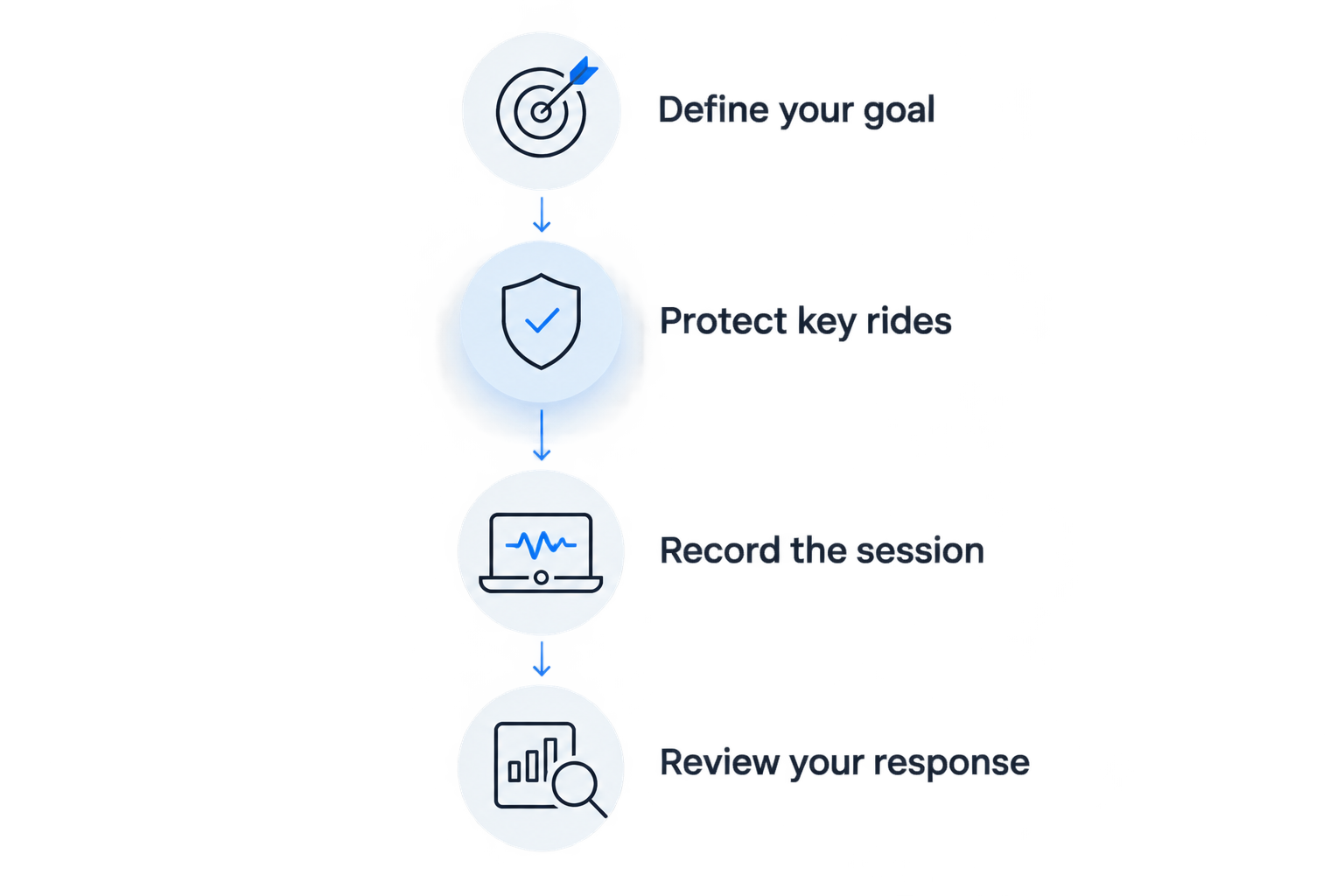
Fit the session around your cycling priorities, then assess the response.
Measure cycling outcomes outside the session
Return to the baseline you established. Compare familiar riding under reasonably similar conditions rather than judging success by the mask, equipment, or sensation of breathing supplemental oxygen.
Separate immediate experience from lasting change. Feeling comfortable during EWOT answers a comfort question; completing a comparable outdoor ride at your intended effort answers a cycling question. Neither observation needs to become a claim about every cyclist.
In your 2026 training log, record what changed and what stayed the same. If you changed your bike fit, reduced training, or started sleeping better, retain that context. A clear record is more useful than a confident explanation unsupported by the comparison.
Be particularly careful with estimated VO2 max. A device estimate and a directly measured exercise test are different measurements; compare like with like, and ask an appropriately qualified professional to interpret testing when needed.
Repeat a familiar ride rather than inventing a new test.
Compare power, heart rate, and perceived effort together.
Note whether conditions were genuinely comparable.
Separate session comfort from later cycling performance.
Record competing explanations for any improvement.
Review the setup before deciding to continue
Use your notes to decide whether the experience fits your goal and schedule. Continuing should be a deliberate choice based on suitability, tolerability, and a useful place in your routine—not a reaction to technical terminology.
Equipment details matter when comparing exercise sessions. An EWOT exercise bike setup links oxygen delivery with the exercise station, so ask how both work together rather than judging the experience from the oxygen source alone. Confirm the actual arrangement with the provider; the service name does not specify every component.
Keep the decision narrow. You do not need to decide whether every oxygen-related wellness service is worthwhile. Decide whether this exercise session serves your stated cycling objective without displacing something more important.
If the experience does not fit, stopping is a valid outcome. If you continue, retain the same comparison habits instead of allowing familiarity to replace measurement.
Review comfort and any symptoms from the session.
Compare the experience with your original goal.
Check whether appointments disrupt priority training.
Ask unresolved equipment and supervision questions.
Decide whether to continue, pause, or seek further advice.
Compare the options for your cycling goal
Choose by purpose, not by how technical the service sounds. Ordinary cycling offers the most direct connection to bike-specific practice. EWOT changes the breathing environment during exercise, while other studio services involve different activities and conditions.
The table separates those options without assuming that any appointment produces a particular performance result. “Best for” describes the task each option fits, not a guaranteed outcome.
Ordinary cycling
Best for: Cyclists prioritizing bike-specific practice
Practical advantage: Directly matches the activity you want to improve
Key limitation: Does not include supplemental oxygen delivery
Live Superhuman EWOT sessions
Best for: Cyclists exploring studio-based exercise with supplemental oxygen
Practical advantage: Provides a bookable EWOT option
Key limitation: Session experience alone does not establish better outdoor performance
Hyperbaric oxygen therapy
Best for: People specifically seeking a pressurized chamber session
Practical advantage: Uses a distinct pressure-based setting
Key limitation: Is not a cycling workout or interchangeable with EWOT
Altitude training
Best for: Cyclists specifically exploring reduced-oxygen exposure
Practical advantage: Addresses a different oxygen environment
Key limitation: Should not be treated as equivalent to supplemental-oxygen exercise
Ordinary air contains about 21% oxygen. EWOT adds supplemental oxygen during exercise; altitude exposure involves reduced oxygen availability. Those distinctions matter more than grouping everything under oxygen training.
Live Superhuman also lists 1.6 ATA and 2.0 ATA chamber options for hyperbaric sessions. Those pressure figures describe chamber options—not EWOT intensity, cycling workload, or a reason to choose one service over another. Keep pressure, oxygen delivery, and exercise intensity separate when comparing services.
Common mistakes cyclists make with EWOT
Treating an easier session as proof of adaptation
A different breathing environment changes the conditions of the workout. Do not compare how an EWOT session feels with an outdoor ride and immediately call the difference improved fitness. Assess the cycling outcome under comparable ordinary riding conditions.
Adding exercise to an already overloaded week
A cyclist seeking recovery can still accumulate more work through an exercise-based appointment. Record EWOT alongside the rest of your activity, and protect rest rather than assuming the session cancels out fatigue.
Confusing oxygen support with altitude preparation
Supplemental oxygen and reduced-oxygen exposure are different concepts. If your goal is riding at elevation, ask questions specifically about altitude demands instead of assuming an EWOT session answers them.
Buying into a result before defining success
A vague goal makes every good day look like confirmation. Write the outcome first, preserve your baseline, and decide what would make the session useful before interpreting your next ride.
FAQ
What is EWOT therapy for cyclists?
EWOT therapy for cyclists is exercise performed while breathing supplemental oxygen. Cyclists considering it should distinguish the session experience from measurable changes in ordinary cycling performance.
Will EWOT improve my cycling VO2 max?
An EWOT session does not establish that your cycling VO2 max has improved. Evaluate any claimed change with comparable testing rather than relying on session sensations or unlike device estimates.
Is EWOT the same as altitude training?
No, EWOT and altitude training use different oxygen environments. EWOT adds supplemental oxygen during exercise, while altitude exposure involves reduced oxygen availability.
Should I replace a recovery ride with EWOT?
Do not automatically replace a recovery ride with EWOT. First confirm the session workload and consider how it fits your existing training and recovery needs.
How often should a cyclist do EWOT?
Choose a schedule only after clarifying your goal, suitability, and the session workload. A fixed frequency does not account for differences in cycling load, health, or personal response.
What should I track when evaluating EWOT?
Track comparable cycling performance, perceived effort, and recovery context. Include power and heart rate when available, along with sleep, fueling, weather, and recent training.
Does Live Superhuman offer EWOT sessions?
Yes, Live Superhuman offers bookable EWOT sessions. Confirm the current exercise format, equipment, and suitability directly before arranging a visit.
One last thing
Your next ordinary ride is a better evaluation setting than your strongest impression inside the studio. Before an EWOT appointment, write down the specific cycling question you want answered and the comparable ride you will use to assess it.
For your 2026 season, keep that question small enough to answer honestly. A clear decision about one optional session is more valuable than attributing every change in performance to a new service.
Related guides
By Kelley Gast