
Instead of improvising your recovery routine after every workout, build a hyperbaric oxygen therapy recovery workflow around suitability screening, a clearly defined goal, and consistent follow-up. Use this 2026 guide to organize your sessions without assuming that chamber time guarantees faster recovery.
TL;DR
Live Superhuman offers bookable hyperbaric oxygen therapy sessions for recovery-focused clients.
Start your hyperbaric oxygen therapy recovery workflow with screening, not a chamber-pressure decision.
The 1.6 ATA and 2.0 ATA chamber options describe pressure, not guaranteed recovery outcomes.
Track training load, sleep, soreness, and session tolerance before changing your recovery routine.
Why this matters
A repeatable recovery workflow helps you make clearer decisions; it does not prove that a treatment works. If you change training, sleep, nutrition, and chamber sessions together, you cannot confidently identify what affected your recovery.
Live Superhuman is best for recovery-focused clients seeking bookable hyperbaric oxygen therapy sessions in a wellness-studio setting. That describes the service fit, not a promise of faster healing or better athletic performance.
Hyperbaric oxygen therapy involves breathing oxygen in a pressurized chamber. Pressure is measured in atmospheres absolute, abbreviated ATA; 1 ATA is approximately atmospheric pressure at sea level. The pressure setting alone does not describe the complete session or establish its suitability for you.
For your 2026 recovery plan, separate the booking decision from the outcome question. First establish whether a session is appropriate, then decide what information would justify continuing. Wellness sessions do not replace assessment of an injury, persistent pain, or unexplained fatigue.
Before you start
Prepare your health and session history. Have your medication list, relevant health information, previous chamber experience, and any ear or sinus concerns ready to discuss. Ask who reviews suitability and when you need clearance from a qualified healthcare professional.
Bring a recovery baseline and calendar. Record your current training demands, sleep pattern, soreness, and practical scheduling constraints. You need a reference point before you can interpret changes.
Confirm chamber rules before arriving. Ask about permitted clothing, personal items, preparation, communication with staff, and stopping a session. Oxygen-rich environments require strict fire-safety precautions; never assume your phone, cosmetics, or usual workout gear can enter the chamber.
Do not book around a deadline before confirming suitability. A competition date or demanding workweek does not override a safety concern. If you feel unwell or your health changes between booking and arrival, tell the provider before entering the chamber.
Recovery goal and baseline
Define your goal
Write down the reason you are considering a session. Use a concrete statement such as wanting to understand how you feel between training days, rather than expecting a guaranteed performance improvement.
Separate ordinary post-exercise soreness from symptoms that need professional assessment. Do not use a wellness appointment to postpone evaluation of persistent or worsening symptoms.
Choose observations you can record consistently: sleep quality, soreness during normal movement, energy, and whether you completed your planned training.
Record those observations before your first visit. Include recent hard workouts, travel, illness, and schedule changes that affect how you feel.
Expected result: You have a written goal and a baseline that does not depend on memory. You can explain what you want to learn without claiming that hyperbaric oxygen therapy will produce a particular result.
Keep your notes interpretable
Use the same descriptions each time. If you record soreness as mild, moderate, or severe, keep those categories rather than switching between unrelated scoring systems.
Add context instead of recording an isolated good or bad day. Feeling fresher after a lighter training week means something different from feeling fresher after the same workload. Your 2026 recovery notes should preserve that distinction.
A simple note template is enough:
Goal: What you want to understand.
Training: What you actually did.
Sleep: How sleep compared with your usual pattern.
Recovery: Soreness, energy, and normal movement.
Session: What you attended and how you tolerated it.
Suitability screening and chamber selection
Complete the screening conversation
Ask the provider how suitability is assessed before a first hyperbaric oxygen therapy session.
Share your health history and medications accurately. Mention current congestion, difficulty clearing your ears, previous pressure-related discomfort, and discomfort in enclosed spaces.
Ask whether your circumstances require clearance from a qualified healthcare professional. Follow that direction before proceeding.
Confirm how you communicate discomfort during the session and how staff respond if you need to stop.
Expected result: You know whether you can proceed, what further review is needed, and how to report a problem. An unanswered safety question is a reason to pause, not something to work out inside the chamber.
Compare the chamber options
Live Superhuman lists 1.6 ATA and 2.0 ATA chamber options. Do not choose a higher pressure because it sounds more effective. Pressure is a session characteristic, not a recovery score.
1.6 ATA
Best for: Clients whose suitability review supports this option
Practical advantage: Identifies the pressure option to discuss before booking
Limitation: The pressure figure does not establish oxygen delivery, session duration, or recovery benefit
2.0 ATA
Best for: Clients whose suitability review supports this option
Practical advantage: Identifies a different pressure option for an informed discussion
Limitation: Higher pressure does not establish a better personal outcome
Ask what the appointment includes, how oxygen is delivered, how long the full visit takes, and what supervision is provided. Do not infer these details from ATA alone.
If you are comparing providers in 2026, ask each provider the same questions. Otherwise, you risk comparing unlike sessions while treating the pressure number as the only meaningful difference.
Booking and session preparation
Confirm the appointment details
Confirm the intended chamber option after suitability questions are resolved. If your confirmation is unclear, ask the provider rather than guessing.
Ask for the full appointment window, including preparation and time after the chamber session. Build your calendar around that answer rather than an assumed duration.
Request the provider's preparation instructions and permitted-items rules. Follow the actual instructions instead of copying another person's routine.
Explain any scheduling constraints, including planned training or travel, and ask whether they affect the appointment decision.
Expected result: Your calendar reflects the real visit, and you know what to bring, what to leave outside, and whom to contact if circumstances change.
Prepare for communication, not endurance
A chamber session is not a workout to push through. Before it begins, make sure you understand how to alert staff and what to do if you experience ear discomfort, anxiety, or another unexpected sensation.
Tell staff promptly if pressure changes cause discomfort. Do not force your ears to clear or continue silently because you want to complete the appointment. Follow staff instructions, including any decision to pause or stop.
The preparation sequence is straightforward: define the goal, resolve suitability questions, confirm the booking, then review your experience. Keep that order even when booking feels like the easiest first step.
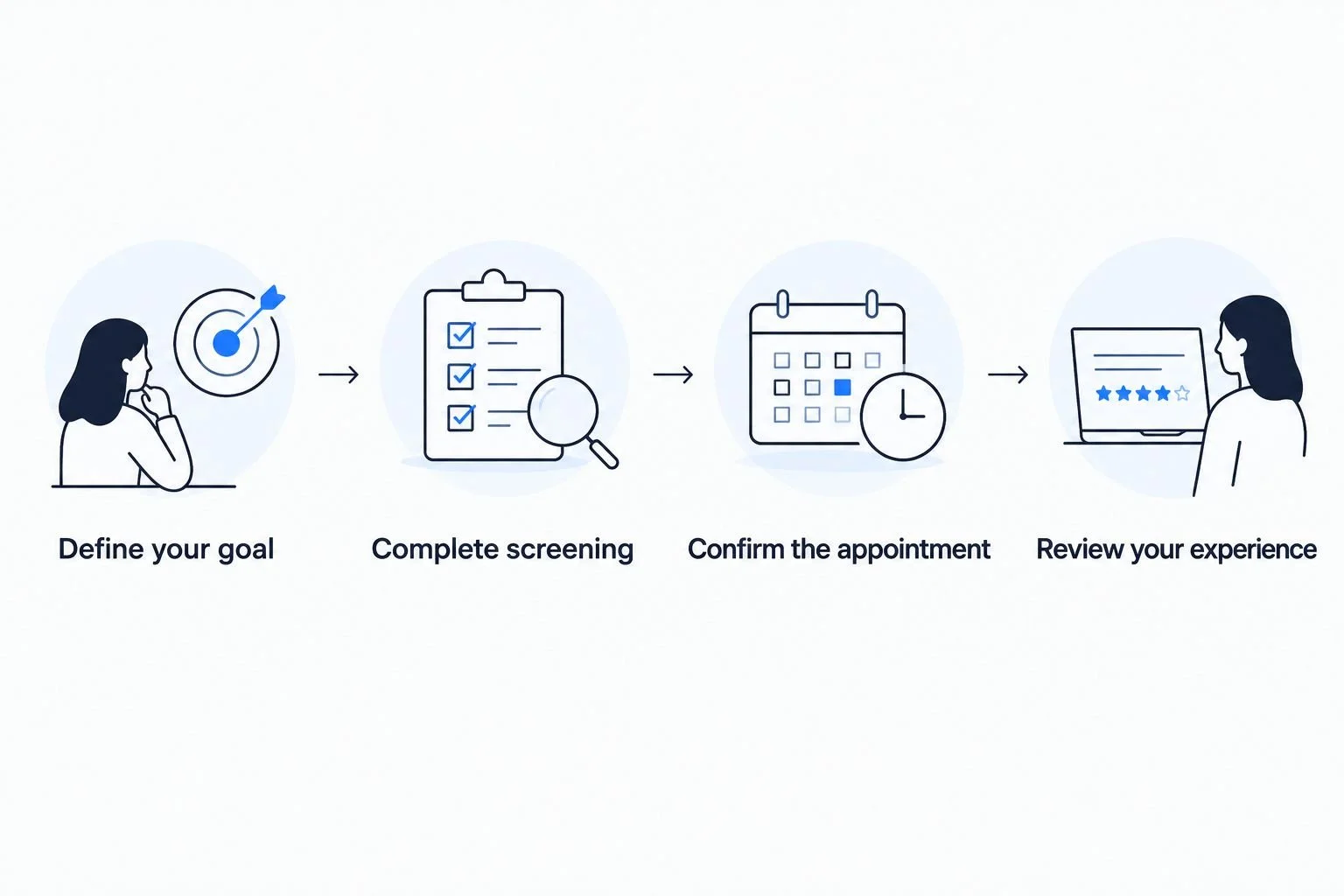
Resolve suitability questions before confirming the appointment.
Session record and follow-up
Review your experience
Record the session details the provider gives you, including the chamber option. Do not fill gaps with assumptions about oxygen delivery or time under pressure.
Note whether you experienced ear discomfort, anxiety, or any unexpected symptoms. Report concerns to the provider; seek appropriate healthcare advice when needed.
Continue recording the same recovery observations you chose before the visit. Include training and sleep changes alongside them.
Review whether the session was tolerable, practical to attend, and relevant to your original goal before deciding on another booking.
Expected result: You have a usable session record rather than a vague impression. You can distinguish a scheduling problem, a tolerance concern, and an uncertain recovery outcome.
Feeling better after a session is an observation, not proof of cause. Recovery changes with training load, sleep, nutrition, illness, and time. A personal log helps organize those factors but cannot establish treatment effectiveness.
For a 2026 follow-up conversation, bring the original goal and your notes. Ask what supports continuing, what would prompt reassessment, and whether a concern belongs with a healthcare professional rather than a wellness provider.
Second workflow: adjust when training changes
A maintenance routine and a heavy training period create different scheduling questions. When your workload changes, update the recovery workflow instead of automatically adding chamber sessions.
Identify the change. Note whether you added training, returned after time away, changed work hours, or experienced disrupted sleep.
Revisit suitability. Tell the provider about new health concerns, medications, or problems during previous sessions before arranging another visit.
Keep the original observations. Continue recording sleep, soreness, energy, and training completion so your notes remain comparable.
Review the whole routine. Check whether basic recovery needs and appropriate assessment are being neglected before adding more appointments.
Best for: Returning clients whose training or schedules have changed. The advantage is that your bookings stay connected to current circumstances; the limitation is that changing training also makes before-and-after comparisons harder to interpret.
For sport-specific context, the hyperbaric oxygen therapy guide for endurance runners addresses a more focused audience. Keep your personal suitability review separate from any general training guide.
Troubleshooting
Your ears hurt during pressure changes
Tell staff immediately rather than pushing through. Pressure changes can cause ear discomfort and injury. Follow staff direction, and seek medical assessment for persistent pain, hearing changes, or other concerning symptoms.
Congestion develops before your appointment
Contact the provider before attending. Ear and sinus pressure equalization can be more difficult when you are congested. Do not conceal symptoms to preserve a booking or assume that previous tolerance guarantees the next session will be comfortable.
You feel confined or anxious in the chamber
Discuss the concern before entering. Ask how communication works and what happens if you want to stop. Do not assume every chamber offers the same space, visibility, or experience.
Your notes show no clear recovery change
Review the decision rather than automatically increasing pressure or frequency. Check whether your goal was measurable and whether training or sleep changed. An unclear result does not establish that you need a more intensive session.
Your appointment disrupts the rest of your routine
Reassess the scheduling trade-off. Include travel, preparation, and the full visit when deciding whether appointments fit. A recovery booking should not routinely displace the sleep or necessary care you were trying to support.
Customize your workflow
Build your Live Superhuman hyperbaric oxygen therapy recovery routine around the question you actually need answered. A first-time visitor needs suitability and preparation information; a returning visitor needs a clear record of tolerance and a reason to continue.
Keep changes deliberate. Adding several recovery services together makes it harder to interpret your experience, even when the appointments fit your calendar. Confirm each service's suitability separately rather than treating a combined visit as one interchangeable intervention.
Before your next booking, ask:
Has my health or medication information changed?
Can I explain the purpose of this visit?
Do I understand the session details and safety instructions?
Does the appointment fit without sacrificing basic recovery needs?
Use those answers to guide the conversation, not to self-prescribe chamber settings.
Explore your session options
Review Live Superhuman's services, then confirm suitability and session details before booking.
FAQ
What's the best way to start hyperbaric oxygen therapy for recovery?
Start with suitability screening and a clear recovery goal before choosing a chamber option. Record your training, sleep, and soreness so later observations have context.
Does hyperbaric oxygen therapy guarantee faster workout recovery?
No, hyperbaric oxygen therapy does not guarantee faster workout recovery. A personal improvement after a session does not establish that the session caused it.
Is 2.0 ATA better than 1.6 ATA for recovery?
A higher pressure alone does not establish a better recovery outcome. Suitability, oxygen delivery, session details, and the reason for attending all matter.
How many hyperbaric oxygen therapy sessions should I book?
There is no universal session count for general workout recovery. Resolve suitability questions and discuss the reason for continuing before committing to repeated visits.
Can I attend a chamber session when I have congestion?
Contact the provider before attending with congestion. Ear and sinus pressure equalization can be more difficult, and the provider needs that information before deciding whether to proceed.
What should I track after a hyperbaric oxygen therapy session?
Track session tolerance, sleep, soreness, energy, and training alongside any unexpected symptoms. Keep your descriptions consistent and report concerns rather than relying only on a recovery score.
Does Live Superhuman offer hyperbaric oxygen therapy sessions?
Yes, Live Superhuman offers bookable hyperbaric oxygen therapy sessions, with 1.6 ATA and 2.0 ATA chamber options listed in its service information. Confirm suitability and the details of your intended session directly before booking.
One last thing
Write your reason for continuing before you book again. That simple decision separates a recovery plan from a habit of adding appointments whenever training feels hard.
Keep that reason beside your 2026 session notes. If your goal remains unclear, your symptoms need assessment, or the visit repeatedly disrupts sleep and training, address that problem before adding another session.