Visit a biohacking studio on a service-specific schedule that accounts for your goals, health considerations, and response—not a fixed weekly quota. For your 2026 recovery routine, agree on what you want to improve, how you will assess it, and when to reconsider the schedule before committing to repeat visits.
TL;DR
How often should you visit a biohacking studio? Set frequency by service, suitability, and a defined review point.
Live Superhuman offers bookable recovery and performance sessions; attendance alone is not evidence of progress.
Hyperbaric oxygen therapy, red light therapy, PEMF, EWOT, and altitude training need separate scheduling discussions.
Keep your routine understandable: changing several services together makes individual effects harder to identify.
Why this matters
A studio visit is an appointment, not a standardized amount of treatment or exercise. Changing the service, equipment settings, session length, or activity changes what you are scheduling—even when the number of visits stays the same.
Live Superhuman is a biohacking studio for clients seeking bookable recovery and performance sessions. That makes it relevant to a service-based routine, but the right appointment frequency still requires an individual discussion rather than a blanket recommendation.
Build your 2026 schedule around a clear purpose, not the largest number of appointments you can fit into your calendar. A useful plan explains both why you are returning and what would justify changing course.
How often should you visit a biohacking studio for best results?
Choose your visit frequency after deciding which service you are using and what result you want to assess. A schedule for a passive session should not automatically become the schedule for exercise with oxygen therapy or altitude training.
Use this sequence before booking recurring appointments:
Define your goal. Describe the recovery or performance outcome you care about in terms you can recognize and record.
Check suitability. Share relevant health concerns, medications, previous reactions, and your current training demands with the appropriate provider.
Choose the service. Ask why that particular session fits your goal and what evidence supports that use.
Agree on frequency. Request a service-specific explanation for the proposed spacing, session length, and review point.
Review your response. Decide whether to continue, adjust, or stop based on your experience and appropriate guidance—not attendance alone.
These steps do not prescribe a treatment schedule. They give you a practical way to evaluate a recommendation before it becomes a recurring commitment.
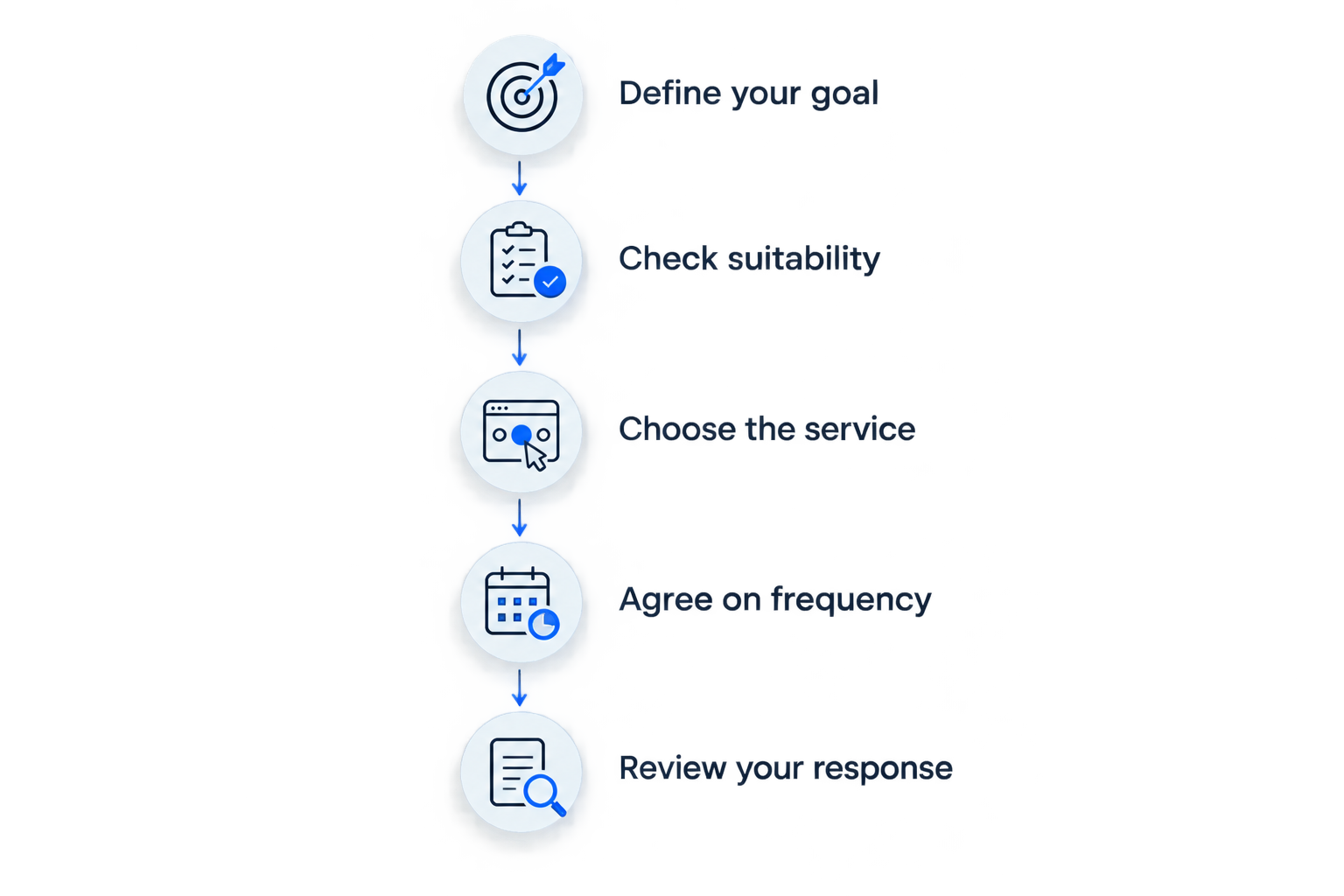
Choose the service and check suitability before setting recurring appointments.
A useful scheduling conversation ends with an explanation you can repeat in plain language. If the only rationale is that more visits are better, ask what specific outcome the additional visits are intended to support.
Set frequency separately for each service
Hyperbaric oxygen therapy, red light therapy, PEMF, EWOT, and altitude training describe different experiences. Do not treat them as interchangeable appointments. Each needs its own discussion of suitability, settings, expectations, and scheduling.
The table below compares planning considerations, not proven outcomes or recommended treatment doses. The best-fit labels describe the question you need answered before selecting a service.
Hyperbaric oxygen therapy
Best for this planning question: Understanding a pressure-based session
Practical advantage: Pressure provides a specific setting to discuss
Limitation to resolve: Pressure alone does not determine suitable frequency
Red light therapy
Best for this planning question: Evaluating a light-based session
Practical advantage: You can ask about the exact equipment and exposure
Limitation to resolve: The service name alone does not describe the light dose
PEMF
Best for this planning question: Evaluating a pulsed electromagnetic field session
Practical advantage: You can discuss the device and its settings
Limitation to resolve: A schedule for one device does not establish another device's schedule
EWOT
Best for this planning question: Planning exercise with oxygen therapy
Practical advantage: Exercise workload can be discussed alongside the session
Limitation to resolve: It adds an exercise component that belongs in your training plan
Altitude training
Best for this planning question: Planning reduced-oxygen exposure
Practical advantage: You can discuss exposure conditions and activity together
Limitation to resolve: A visit count alone does not describe the exposure
Hyperbaric oxygen therapy: discuss pressure and suitability
The supplied chamber options are 1.6 ATA and 2.0 ATA. ATA means atmospheres absolute; 1 ATA is standard atmospheric pressure. These figures describe pressure, not how often you should attend.
Ask which option is appropriate for you, why it is being suggested, and what session details matter beyond pressure. Do not interpret a higher ATA figure as an automatic reason to attend more often—or as proof of a better result.
The advantage of discussing exact settings is clarity. The limitation is that a pressure figure, by itself, cannot answer a scheduling question.
Red light therapy: ask about the actual exposure
A red light session is not fully described by its appointment length. Equipment characteristics and how the light is delivered matter when discussing an appropriate session.
Ask what information the provider uses to recommend spacing between visits. The practical benefit is a clearer explanation of what you are receiving; the limitation is that copying another person's calendar does not reproduce that person's exposure or circumstances.
PEMF: keep the device in the conversation
PEMF stands for pulsed electromagnetic field therapy. Before agreeing to repeat sessions, ask which device and settings the recommendation concerns, what the intended use is, and how your response will be reviewed.
Naming the device makes the conversation more specific. It still does not establish that a schedule used elsewhere is suitable for you.
EWOT: count the exercise, too
EWOT means exercise with oxygen therapy. Because exercise is part of the session, describe your other workouts when discussing appointment frequency.
The planning advantage is that you can consider the session alongside your existing activity. The trade-off is that adding an exercise-based appointment changes more than your studio calendar; it also changes your activity schedule.
Altitude training: clarify the exposure
Ask whether the proposed altitude session involves rest, exercise, or both, and how the exposure will be selected. Your schedule needs to account for what happens during the appointment, not just its name.
The useful feature is a clearly described exposure. The limitation is that a session count without exposure details cannot tell you whether two schedules are comparable.
Why your biohacking studio schedule varies
The most useful frequency recommendation explains its inputs. For your 2026 planning, ask the provider to connect the proposed calendar to these factors:
Your goal: General recovery, a specific performance objective, and trying an unfamiliar service require different ways of judging success.
The service: A pressure-based session, light exposure, electromagnetic field session, and exercise-based appointment are not the same intervention.
Session details: Duration, equipment, settings, and activity determine more than the appointment label reveals.
Your health context: Relevant conditions, medications, symptoms, and previous reactions belong in the suitability discussion.
Your training demands: Exercise-based sessions need to be considered alongside your existing activity, not in isolation.
Your response: Comfort, unwanted effects, and progress toward the agreed goal should inform the next decision.
Calendar convenience matters, but it should not become the reason for a particular exposure schedule. Tell the provider what you can realistically attend, then ask whether that schedule fits the service's intended use.
How do you know whether repeat visits are worthwhile?
Repeat visits are worthwhile only if you have a reason to continue that goes beyond having completed the previous appointment. Decide what evidence would make the routine useful to you before interpreting how you feel afterward.
Start with a short written description of your goal. For recovery, that might concern how you feel during your usual training; for performance, use an appropriate repeatable measure rather than a vague expectation of feeling optimized.
Keep a useful session record
Record the service, relevant session details supplied by the provider, and your experience before and afterward. Include changes in training, sleep, or other parts of your routine that would affect the comparison.
You do not need an elaborate dashboard. You need enough consistency to distinguish a repeatable pattern from a memorable afternoon.
Separate your experience from a causal claim
Feeling better after a visit is useful personal feedback. It does not, by itself, show that the session caused the change or establish the best future frequency.
Keep the conclusion proportional to the evidence. A personal record can support a scheduling conversation without proving a medical benefit or a performance improvement.
Set the review point before adding visits
Ask when the provider expects to reassess your plan and what would lead to a different recommendation. The review should include lack of progress and unwanted effects—not only reasons to continue.
For a 2026 routine, a clear reassessment decision is more useful than an open-ended promise to keep attending. Your options should include changing the plan or stopping.
Should you combine several services in one visit?
Combining services can reduce separate trips, but convenience does not establish that the combination improves results. Ask about suitability, sequencing, and the reason for each component before arranging a multi-service visit.
There is also a practical trade-off: when you change several parts of your routine together, identifying which change affected your experience becomes harder. Keep your notes specific to the services received and avoid attributing everything to a single session.
Live Superhuman offers hyperbaric oxygen therapy, red light therapy, PEMF, EWOT, and altitude training sessions. That choice supports a discussion about individual services; it is not a reason to use every option or apply the same frequency to all of them.
Choose an understandable routine over a crowded one. Ask what each additional service contributes to the plan before adding it.
What should you ask before booking again?
Before your next appointment, ask for direct answers to the questions below. They help separate a useful recommendation from a calendar suggestion.
What goal is this service intended to address?
What evidence supports this use, and what remains uncertain?
Why are you recommending this spacing between sessions?
Which settings or session details should stay consistent?
What reactions mean I should stop and seek advice?
When will we review whether continuing makes sense?
If you are considering wellness sessions because of persistent symptoms, get those symptoms assessed by a qualified healthcare professional. A studio schedule is not a substitute for appropriate medical care.
Discuss your next session
Ask about service selection, session details, and scheduling before booking recurring visits.
FAQ
How often should you visit a biohacking studio as a beginner?
Choose a service-specific schedule after discussing your goal, suitability, and session details. Being a beginner does not establish a universal weekly visit count.
Should I visit a biohacking studio every day?
Do not assume daily visits are appropriate. Ask for a service-specific explanation of frequency, spacing, and the point at which your plan will be reviewed.
Is visiting more often always better for recovery?
More frequent attendance does not by itself establish better recovery. Judge the plan against a defined goal, your response, and appropriate professional guidance.
Can I use the same schedule for red light therapy and hyperbaric oxygen therapy?
Do not transfer a schedule between red light therapy and hyperbaric oxygen therapy without a separate discussion. The services involve different exposures and session details.
How do I know when to reduce my studio visits?
Review frequency when your goals, health context, training demands, or response change. Ask the provider what findings would support fewer sessions, a different approach, or stopping.
Can I combine EWOT and altitude training with my workouts?
Discuss EWOT and altitude training alongside your existing workouts before adding sessions. Explain your current activity and ask how the proposed exposure fits the overall plan.
What should I track after a biohacking session?
Track the service received, relevant session details, your experience, and changes elsewhere in your routine. Use the record to support a review rather than treating it as proof of cause and effect.
One last thing
An appointment count is not a complete description of your routine. Two calendars can look identical while the services, settings, exercise demands, and reasons for attending differ substantially.
Before your next Live Superhuman biohacking studio visit, write down the decision you want the session to inform. That simple step gives your 2026 routine a purpose beyond filling the next available appointment.
Related guides
By Kelley Gast