
Instead of fitting oxygen-based sessions around workouts at random, build your EWOT and altitude training combination around separate exposures, consistent training, and a shared session log. Start with each service individually; combining them does not establish that you will gain more endurance than from either service alone.
TL;DR
An EWOT and altitude training combination needs separate starting points, not an assumption that opposite oxygen exposures cancel out.
Live Superhuman offers bookable EWOT and altitude training sessions for clients pursuing recovery and performance goals.
Keep endurance training consistent while assessing oxygen-based sessions; changing everything together makes results difficult to interpret.
Use symptoms, workload, and staff guidance together; a pulse oximeter reading is not permission to continue.
Why this matters
EWOT means exercise with oxygen therapy: exercise performed while breathing supplemental oxygen. Altitude training involves reduced oxygen availability, either at actual altitude or through a simulated environment. These are different exposures, not interchangeable versions of the same workout.
Live Superhuman is best for readers seeking bookable EWOT and altitude training sessions. Live Superhuman offers both services, but their presence on the same service list does not establish an ideal sequence or a guaranteed endurance benefit.
For your 2026 training plan, make the distinction practical: identify what each session is supposed to add before scheduling both. Your regular endurance work remains the reference point. Feeling different immediately after a session is not the same as demonstrating improved performance.
Before you start
Bring your training context. Have your current workout schedule, target event or activity, recent training notes, and relevant health information ready. Ask a qualified healthcare professional whether either exposure is appropriate if you have a health condition or concerns about exercising with altered oxygen availability.
Confirm the actual session format. Ask whether altitude training involves exercise or passive exposure, how staff monitor participants, and how they determine individual settings. Do not assume that every altitude service uses the same method.
Resolve the hidden scheduling problem first. A combined visit can introduce exercise fatigue as well as an oxygen-related exposure. Identify which part counts toward your training load before placing it beside a hard workout.
You do not need access to equipment controls to follow this workflow. Equipment settings belong with appropriately trained staff; your job is to communicate, document, and avoid adding unplanned work.
Choose the role of each session
Use this comparison to separate the purposes and limits of the options. These are planning distinctions, not claims that one approach produces better endurance results.
EWOT assessed separately
Best for: Understanding your response to exercise with supplemental oxygen
Practical advantage: Keeps the exercise-and-oxygen exposure identifiable
Limitation: Exercise intensity still affects fatigue and makes comparisons harder if it changes
Altitude training assessed separately
Best for: Understanding your response to reduced oxygen availability
Practical advantage: Makes the altitude exposure easier to distinguish from other additions
Limitation: Reduced oxygen availability can make a familiar workload feel harder
Both services in a training plan
Best for: Readers with a clear reason to assess both
Practical advantage: Gives each service a defined place in your schedule
Limitation: Adds scheduling and interpretation complexity; superiority is not established by combining them
Choose the simplest plan that answers your training question. Adding a second service is not progress if you cannot explain what you expect to learn from it.
Goal and baseline configuration
Define your comparison
Write one training question. For example: can you maintain a familiar endurance workload without increasing perceived effort? Avoid a vague objective such as feeling optimized.
Select a repeatable workout. Use an existing session rather than adding a new fitness test. Keep the route, equipment, and conditions as comparable as practical.
Create your log fields. Label them Session type, Workload, Duration, Effort, Symptoms, and Next workout. These are labels for your own notes, not names of studio software controls.
Record perceived effort consistently. A 0–10 effort scale gives you a repeatable way to describe how demanding the exercise felt. Treat it as subjective context, not a measurement of oxygen delivery.
Expected result: you have a specific question and a familiar workout against which to compare your experience.
For a 2026 training log, also record factors that change the interpretation: poor sleep, illness, travel, heat, and an unusually demanding workout. A better pace on a cooler day does not isolate the effect of an oxygen-based session.
Avoid turning this into a daily score-chasing exercise. Look for comparable observations, and keep ordinary training records even when the session feels unremarkable. Selectively logging good days creates an unreliable picture.
EWOT session configuration
Establish a separate starting point
Explain your current workload. Tell staff what you trained recently and what comes next. A session should not become an unexpected hard workout because the exercise component went uncounted.
Confirm the exercise task. Ask what activity you will perform, how intensity is selected, and how you should communicate discomfort. Do not copy another person's settings.
Follow the staff-directed setup. Let staff explain the oxygen delivery equipment and its use. Do not alter oxygen settings or equipment connections yourself.
Record the exercise component. Note the activity, duration, and workload information you actually have. Record symptoms and perceived effort without inventing missing measurements.
Check the next planned workout. Document whether you completed it as intended, changed it, or skipped it. That context matters more than an immediate impression alone.
Expected result: you can describe an EWOT session separately from altitude exposure and account for its exercise demand.
Your 2026 EWOT notes should distinguish a session's purpose from its outcome. “Used supplemental oxygen during exercise” describes the exposure. “Improved endurance” requires a meaningful performance comparison; it is not something the equipment itself confirms.
Altitude session configuration
Establish a separate altitude exposure
Confirm the format. Ask whether you will exercise or remain at rest, and whether the service uses actual altitude or simulated reduced oxygen availability. The phrase altitude training does not answer those questions by itself.
Share your EWOT experience. Report what you did and how you felt, including any symptoms. Do not present a comfortable EWOT session as evidence that altitude exposure will also feel comfortable.
Ask for the stopping instructions. Know how to signal staff, how the exposure ends, and what symptoms require immediate attention before starting.
Use the assigned workload. Do not increase effort simply to reproduce your normal pace or power. Reduced oxygen availability changes the demands of exercise.
Document the exposure separately. Create 1 log entry per session rather than merging EWOT and altitude notes into a single impression.
Expected result: you know which altitude format you used and can separate its effects on effort and fatigue from the EWOT session.
Keep the distinction between wellness sessions and event preparation clear. A studio exposure does not, by itself, establish readiness for a mountain event or replace planning for actual altitude conditions.
The workflow follows a simple sequence: Define goal, Record baseline, Assess separately, and Review response. Move to the review only when the separate sessions are documented clearly enough to compare.
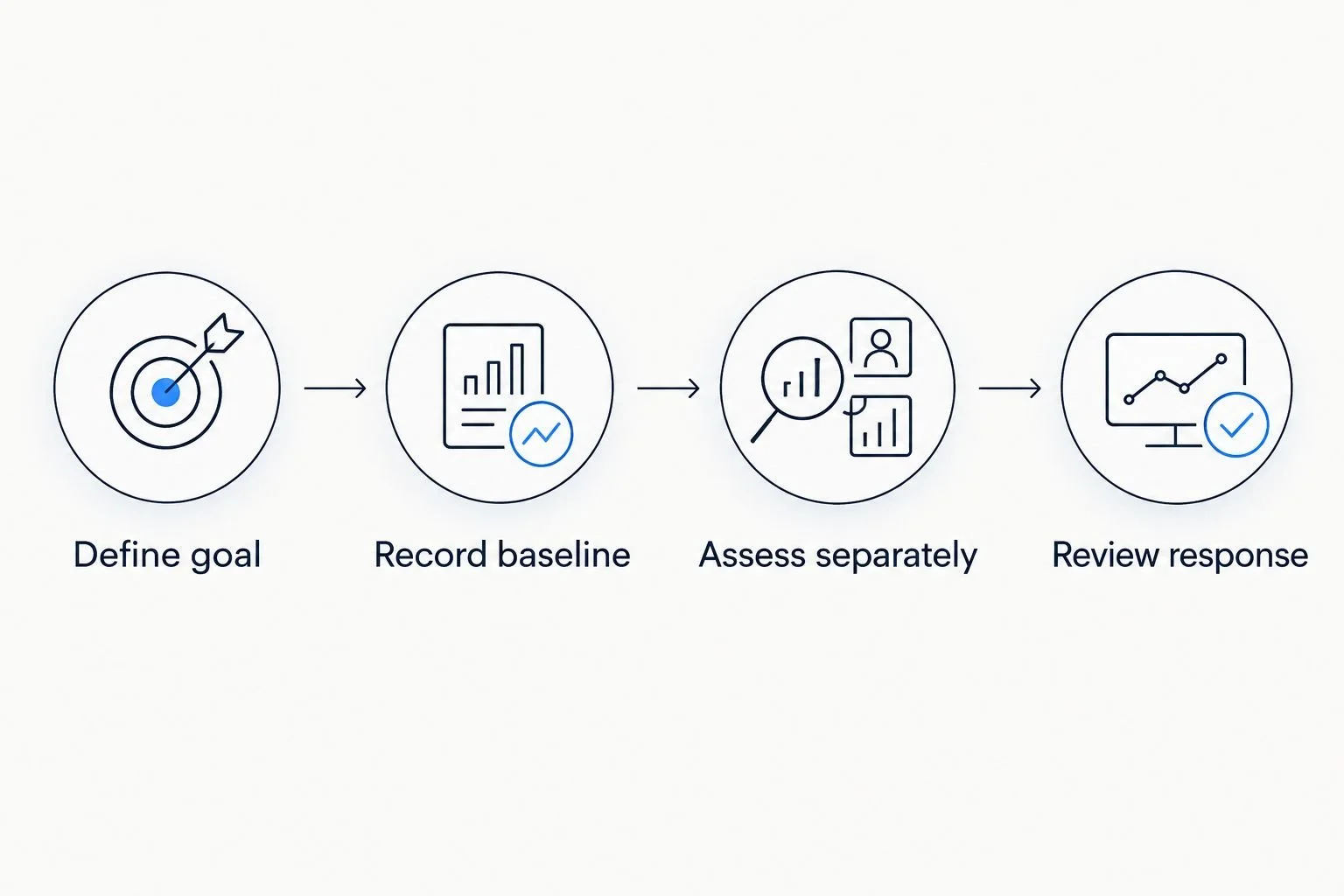
Separate starting points make a combined training plan easier to evaluate.
Schedule and review configuration
Put both services into the training calendar
Protect your priority workouts. Mark the sessions that matter most for your sport before adding studio visits. Do not crowd the calendar merely because appointments fit.
Assign each service a purpose. Write the reason beside each appointment. If both entries have the same vague purpose, simplify the plan before adding more sessions.
Confirm spacing with staff. Base the discussion on your workload, session format, health considerations, and response. There is no universal interval supplied by the service names alone.
Change 1 variable per review. For example, keep your familiar workout unchanged while assessing a scheduling change. Do not simultaneously alter training intensity, session order, and exposure settings.
Review the next workout, not just the visit. Compare completion, effort, symptoms, and recovery notes. A combined plan that repeatedly disrupts your priority training needs reassessment.
Expected result: every appointment has a purpose, and you can identify what changed when your training response changes.
For your 2026 review, keep conclusions proportionate to the evidence. A personal log can reveal scheduling problems and patterns in your experience. It cannot establish that a combined approach caused a physiological adaptation.
Second variant: when your training load changes
The adjacent workflow is not automatically doing both services on the same day. It is updating the plan when your endurance training changes.
Best for: athletes moving into a harder training phase, approaching an event, or returning after a disrupted schedule. The advantage is a plan that reflects current workload; the limitation is that changing training demands makes session effects harder to isolate.
Start by updating your training calendar. Then tell staff what changed before repeating the previous arrangement. A schedule that fitted an easier week does not automatically fit a week with demanding intervals or longer endurance work.
For an event-focused block in 2026, avoid introducing unfamiliar exposures simply to make preparation feel more complete. Familiarity with your response is more useful than a last-minute addition whose effect on fatigue you cannot anticipate.
If you are considering a same-day visit, ask staff to explain the rationale, order, monitoring, and stopping criteria. Do not assume that EWOT reverses an altitude exposure or that opposite oxygen conditions make the combination safer. Keep separate notes for each component even when both occur during one visit.
Monitoring without chasing a reading
Pulse oximetry estimates peripheral oxygen saturation; it does not measure endurance fitness or certify that an exposure is safe. Movement, cold hands, poor circulation, and sensor placement can affect readings.
The choice of pulse oximeters for altitude training matters because exercise creates measurement challenges: a device that cannot obtain a stable signal gives you less interpretable feedback. Device choice still does not replace staff supervision or an individualized response plan.
Ask staff how they check signal quality and interpret readings alongside symptoms and workload. Do not borrow a saturation target from another athlete or use a reassuring number to dismiss feeling unwell.
Stop exercising and alert staff if symptoms develop. Chest pain, fainting, severe breathlessness, or confusion require urgent medical attention, not an adjustment intended to finish the session. Do not restart simply because a display changes.
Troubleshooting
Your usual workload suddenly feels much harder
Reduce or stop the effort and tell staff. Reduced oxygen availability can increase the demands of a familiar task; forcing your usual pace defeats the purpose of a controlled session. Record what happened before deciding whether the schedule or workload needs changing.
The oxygen reading jumps around
Stop moving while staff check the sensor, hand position, and signal quality. Do not interpret an unstable display as a training result or repeatedly adjust exposure to chase it. Symptoms still take priority.
You cannot tell which service affected your next workout
Return to separate assessment rather than adding more combined visits. Keep your regular workout comparable and document each exposure independently. If sleep, illness, or training load also changed, do not assign the outcome to one service.
Studio visits keep displacing endurance workouts
Simplify the schedule and protect your sport-specific work. Optional sessions should not repeatedly replace the training you intended to complete. Discuss fewer additions rather than trying to recover the missed work through extra intensity.
Customize your workflow
Bring the same short log to each conversation with Live Superhuman about EWOT and altitude training. Ask what the session is intended to accomplish, how its exercise demand fits your week, and what would trigger a change.
If altitude exposure is your main question, the IHHT-to-altitude acclimatization workflow addresses a related planning topic. Do not treat different oxygen-exposure formats as interchangeable merely because their names appear together.
Keep future additions deliberate. Another wellness service introduces another variable; it does not automatically make the plan more effective.
FAQ
What's the best way to combine EWOT and altitude training?
Start by assessing each separately, then discuss scheduling around your existing endurance training. Keep a consistent log and avoid assuming that combining the services produces greater gains.
Should I do EWOT before or after altitude training?
There is no universal order established by the service names alone. Ask staff to explain the rationale for the sequence based on the actual session format and your individual circumstances.
Can I do EWOT and altitude training on the same day?
A same-day arrangement needs an individualized assessment of workload, exposure, monitoring, and recovery. Separate starting points make your response easier to interpret before considering that arrangement.
Does combining EWOT and altitude training guarantee a higher VO2 max?
No, combining EWOT and altitude training does not guarantee a higher VO2 max. A session log or a better-feeling workout does not establish a change in maximal oxygen uptake.
Do I need a pulse oximeter for altitude training?
Ask the provider how oxygen saturation is monitored during the specific session. A personal device does not replace supervision, reliable signal interpretation, or attention to symptoms.
How often should I schedule EWOT and altitude sessions?
Frequency should reflect your health considerations, session format, training load, and response. Do not copy a fixed schedule from another athlete or increase visits solely because the first exposure felt comfortable.
Does Live Superhuman offer both EWOT and altitude training?
Live Superhuman offers bookable EWOT and altitude training sessions. Confirm the session format and discuss how each fits your training before arranging a combined plan.
One last thing
Decide what would make you simplify the plan before adding anything. If sessions repeatedly disrupt priority workouts or produce symptoms, more complexity is not the answer. A clear stopping or reassessment decision makes your training log useful rather than merely detailed.
Related guides
By Kelley Gast