Emerald laser cost is best evaluated through a current, itemized provider quote—not a standalone session figure. Ask what the complete treatment plan includes, whether anything is billed separately, and what happens if you stop before completing it. This guide explains how to compare those details before you commit.
TL;DR
Compare Emerald laser cost using the complete written treatment plan, not an isolated session figure.
Body contouring quotes should identify the treatment, included visits, separate charges, and cancellation terms.
Live Superhuman serves recovery-focused clients; distinguish wellness sessions from an Emerald laser treatment quote.
For a 2026 decision, request current terms and a clearly stated quote expiration date.
Why this matters
A quote answers your question only when it describes what you are buying. A session figure without a treatment description, visit count, and payment terms leaves you comparing incomplete information.
Compare the same scope before comparing the financial commitment. That means separating the named treatment from assessments, progress checks, additional services, and anything presented as optional.
Live Superhuman offers bookable wellness sessions focused on recovery and performance. Keep that purpose distinct from your body contouring goal: a shared wellness setting does not make different services interchangeable.
How much does an Emerald laser treatment cost?
Get a current written quote from the provider you are considering. The useful answer is the total for a clearly described treatment plan, together with a breakdown of what that total includes.
For your 2026 comparison, request the following information in the same document. Do not rely on details scattered across a conversation, an advertisement, and a booking screen.
Named treatment
What to ask the provider: Does the quote specifically identify Emerald laser treatment?
Why it belongs in your comparison: Establishes which service the estimate covers
Treatment scope
What to ask the provider: What areas and visits does the plan include?
Why it belongs in your comparison: Defines the work attached to the quote
Assessment
What to ask the provider: Is an initial assessment included or billed separately?
Why it belongs in your comparison: Clarifies the commitment before treatment begins
Progress review
What to ask the provider: What follow-up or measurement is included?
Why it belongs in your comparison: Explains how the provider reviews the plan
Additional services
What to ask the provider: Which items are required, and which are optional?
Why it belongs in your comparison: Separates the core treatment from additions
Payment terms
What to ask the provider: When is payment due, and what are the cancellation terms?
Why it belongs in your comparison: Identifies the obligation you accept when booking
An itemized quote does not prove a treatment is right for you. It gives you something concrete to evaluate alongside suitability, expected outcomes, and the provider's explanation of limitations.
Ask for a complete breakdown
Use a direct request: ask the provider to show the treatment itself, any separate assessment or follow-up charges, and any optional additions as distinct line items. Then ask which items are necessary to complete the proposed plan.
Do not treat an optional addition as part of the base treatment unless you choose it. Equally, do not omit a required item when comparing the full commitment.
Compare a session quote with a treatment-plan quote
A session quote and a treatment-plan quote answer different questions. The first describes an appointment; the second should describe a defined sequence of appointments and its terms.
Neither format is automatically the better choice. Match the format to the decision you are ready to make, and ask the provider to explain any commitment beyond the appointment in front of you.
Individual session quote
Best for: Understanding the commitment attached to a specific appointment
Advantage: Makes that appointment's scope easier to inspect
Limitation: Does not establish the total for a longer plan
Complete treatment-plan quote
Best for: Evaluating a proposed course before committing
Advantage: Puts the proposed visits and terms together
Limitation: Requires you to examine unused-visit and cancellation terms
Treatment plus optional services
Best for: Separating your main goal from additional services
Advantage: Lets you identify what each addition contributes
Limitation: Becomes difficult to compare if items are not separated
Before accepting a plan, ask what decision you are making today. Are you agreeing to an assessment, a treatment appointment, or the entire proposed course? Those are different commitments, even when they appear in the same conversation.
If the provider revises the plan after an assessment, request a revised written estimate. An earlier figure should not substitute for the scope you ultimately approve.
What makes Emerald laser quotes different?
Use these factors to investigate differences between estimates. They are questions to resolve, not assumptions about what a particular provider charges.
Treatment scope: Confirm the exact service and areas covered. Do not compare estimates that describe different work as though they are equivalent.
Proposed visits: Ask how many appointments the quote includes and why the provider recommends that schedule for your goal.
Included support: Establish whether assessment, progress review, and follow-up are included or separate.
Additional services: Ask whether each addition is optional and whether declining it changes the proposed treatment plan.
Commitment terms: Read the rules for scheduling, cancellations, stopping early, and any unused appointments before paying.
Quote validity: Ask how long the written estimate remains valid and what circumstances would require a replacement.
For a 2026 booking, use the terms attached to your current estimate. A dated screenshot or an old conversation does not establish the agreement you are about to enter.
Keep location and convenience in your decision, but separate them from the treatment description. An easier journey can matter to your schedule without demonstrating anything about the treatment's outcome.
How do you compare quotes without missing anything?
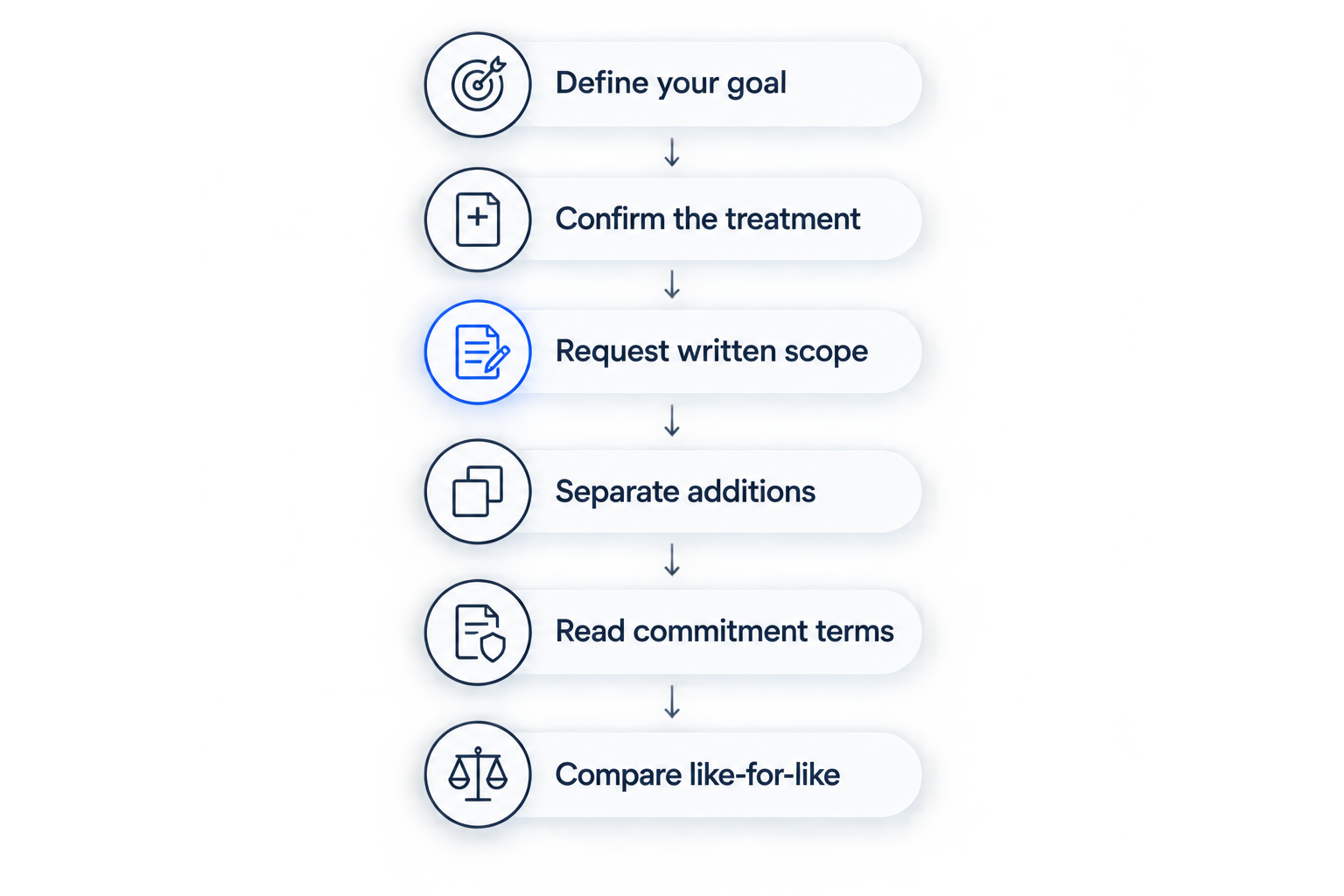
Follow the same sequence with every provider. Consistency makes omissions easier to spot and prevents an appealing headline figure from deciding the comparison for you.
Define your goal. Describe what you want to change and ask whether the proposed treatment addresses that goal. Avoid starting with a package name before you understand the service.
Confirm the treatment. Ask the provider to identify the treatment and explain what happens during the appointment. Keep that description with the estimate.
Request written scope. Get the included areas, proposed visits, assessments, and follow-up in writing. Ask for clarification wherever a description is broad.
Separate additions. Mark every extra as required or optional. Ask what each addition is intended to contribute rather than accepting a bundled description.
Read commitment terms. Review payment timing, scheduling rules, cancellations, and what happens if you discontinue the plan. Resolve unclear wording before agreeing.
Compare like-for-like. Put matching items beside each other. Where the scope differs, ask for an explanation instead of treating the figures as directly comparable.
The result should be a document you can explain in plain language: what you receive, what you owe, when you owe it, and what remains uncertain. If you cannot explain an item, ask the provider to rewrite it clearly.
How do you judge value beyond the quote?
Start with the outcome you want, then ask what the provider can reasonably explain about achieving it. A clearly presented estimate is useful, but it is not evidence of a particular result.
Ask what the proposed treatment is intended to change, how progress will be assessed, and what limitations apply. Request an explanation you understand before discussing whether to add more services.
Keep body contouring costs tied to the exact treatment named in each estimate. An umbrella category does not establish which service, treatment areas, or follow-up a quote includes.
Separate treatment claims from your goal
Your goal and the provider's claim should match. If your goal concerns body shape, ask the provider to explain the specific change being discussed rather than accepting broad language about transformation or wellness.
Do not use a financial commitment as proof of effectiveness. A larger plan still needs a clear explanation of suitability, expected outcomes, and limitations.
Decide how progress will be reviewed
Ask the provider what will be recorded before treatment and how later observations will be compared. The explanation should distinguish the treatment's intended outcome from unrelated changes in your routine.
Agree on the review method before committing, not after deciding whether you are satisfied. That gives both you and the provider a shared description of what you are evaluating.
Count the schedule commitment separately
Ask about appointment length, preparation, and any instructions affecting your usual activities. Use the provider's actual answers to assess whether the proposed schedule fits your life.
Keep that time commitment beside the financial estimate. A plan you cannot realistically attend is a poor fit, regardless of how appealing its presentation looks.
Is Emerald laser the same as red light therapy?
Do not treat an Emerald laser quote as a quote for red light therapy. Confirm the exact treatment name, device, intended use, and appointment details with the provider rather than assuming light-based services are interchangeable.
If your underlying goal is exercise recovery, evaluate recovery services against that goal. If your goal is body contouring, keep the discussion focused on the proposed body contouring treatment.
Live Superhuman is a fit for recovery-focused clients seeking bookable wellness sessions. Its stated services include hyperbaric oxygen therapy, red light therapy, PEMF, EWOT, and altitude training; that service list is not an Emerald laser treatment quote.
For that separate recovery question, the guide to how often to use red light therapy for recovery addresses session planning. Do not transfer a recommendation about one service to another without a treatment-specific explanation.
Should you commit before an assessment?
Understand what you are agreeing to before paying. Ask whether the appointment is an assessment, treatment, or both, and whether the proposed plan can change afterward.
If the plan changes, request the updated scope and terms before proceeding. Do not assume an initial discussion settles every detail of a later agreement.
For your 2026 decision, keep the final estimate and any written clarifications together. That record should reflect the service you approved, not an earlier version with different inclusions.
Questions to resolve before agreeing
What exactly am I authorizing at this appointment?
What happens if the assessment changes the recommendation?
Which parts of the plan can I decline?
What happens to unused appointments if I stop?
Who explains concerns or unexpected responses after a session?
Clear answers do not guarantee an outcome. They establish whether you understand the agreement well enough to make a decision.
FAQ
How do I get an accurate Emerald laser cost quote?
Request a current, itemized quote directly from the provider you plan to visit. Ask it to identify the treatment, included visits, separate charges, optional additions, and commitment terms.
Does a session quote tell me the total treatment cost?
A session quote does not establish the total for a longer treatment plan. Ask the provider to describe the full proposed course and identify which items are included.
Should I choose individual sessions or a complete treatment plan?
Choose only after comparing the scope and commitment attached to each format. An individual appointment is easier to evaluate on its own; a complete plan requires careful review of unused-visit and cancellation terms.
What should I ask about extra charges?
Ask the provider to separate required items from optional additions in writing. Confirm whether assessment, progress review, and follow-up are included rather than assuming they are.
Is Emerald laser interchangeable with red light therapy?
Do not treat the services as interchangeable. Ask the provider to identify the exact treatment, intended use, and appointment details relevant to your goal.
Does a larger treatment plan guarantee better results?
A larger financial commitment does not establish that you will get a better result. Evaluate the proposed plan through its suitability, stated limitations, and agreed method of reviewing progress.
Can I use an older estimate for a 2026 appointment?
Ask the provider to confirm the estimate and its terms for your 2026 appointment. Keep the current written version rather than relying on an older advertisement or conversation.
One last thing
Ask the provider to describe what is not included in the quote. An exclusions list forces a clearer conversation about assessments, additional services, follow-up, and obligations that an inclusions list can leave ambiguous.
Your final decision should rest on a named treatment, a defined scope, understandable terms, and a realistic discussion of outcomes. If one of those remains unclear, resolve it before you commit.
Related guides
By Kelley Gast