
Instead of manually comparing disconnected scan printouts, keep your InBody results and hyperbaric oxygen therapy sessions in one dated log. An InBody scan tracks body-composition estimates; it does not measure oxygen delivery or prove that HBOT caused a change.
TL;DR
InBody scan hyperbaric oxygen therapy progress tracking shows body-composition trends, not proof that HBOT works.
Live Superhuman offers hyperbaric oxygen therapy for clients seeking recovery and performance support.
Repeat scans under comparable conditions, using the same device and preparation instructions.
Record training, nutrition, hydration, and session dates before interpreting changes.
Why this matters
InBody uses bioelectrical impedance to estimate body composition. Fluid balance affects the measurement, so a different result does not automatically mean you gained muscle or lost fat. Nor does it establish a response to hyperbaric oxygen therapy.
Live Superhuman offers hyperbaric oxygen therapy sessions alongside other wellness services. Live Superhuman is best for clients seeking bookable wellness sessions focused on recovery and performance. Body-composition tracking adds context to those goals, but it cannot validate a treatment effect.
For your 2026 tracking plan, separate three questions: What changed on the scan? What changed in your daily performance? What else changed during that period? Keeping those questions separate prevents an encouraging result from becoming an unsupported explanation.
Before you start
Arrange scan access separately. Confirm where you will receive your InBody scan, which device you will use, and whether you can obtain the result sheet. Do not assume a wellness session includes body-composition testing.
Get preparation and safety instructions. Follow the scan operator’s current guidance about meals, exercise, hydration, bathroom use, and device suitability. Ask your healthcare professional about HBOT suitability; a body-composition scan is not medical clearance.
Avoid the hidden comparison trap. Use the same device and comparable conditions each time. Changing scanners, scanning after a workout, or arriving with a different hydration status complicates interpretation before you even open the report.
Have a spreadsheet or notebook ready, plus your scan reports and session dates. You do not need an automatic connection between an InBody account and a booking system. This guide uses a manual log with labels you create yourself, not an unverified software integration.
Baseline record
Create your tracking sheet
Create a sheet named 2026 Recovery Tracking. Keep the original reports in a separate folder so you can check any entry against its source.
Add columns labelled Scan Date, Device, Weight, Skeletal Muscle Mass, Body Fat Percentage, and Preparation Notes. Copy only measurements that actually appear on your report.
Add HBOT Session Date, Session Details, Training Notes, Sleep Notes, and Goal Notes. Keep the session record separate from scan measurements rather than treating each visit as a new body-composition result.
Record units exactly as supplied. Do not mix pounds and kilograms in the same column, and distinguish a percentage from a percentage-point change.
Expected result: Your sheet separates measured estimates, session history, and personal observations. A reader can identify the source of every entry without guessing.
Avoid filling blank cells with zero. A missing measurement and a measured zero mean different things. Leave unavailable fields blank and explain the gap in Preparation Notes when necessary.
Establish a comparable baseline
Choose a normal day rather than a deliberately unusual training or eating day. Follow the operator’s preparation instructions instead of trying to produce a more flattering result.
Record the device and scan time. Note whether the preparation matched the instructions, including any departures you already know about.
Save the complete report. Enter its values without rounding away detail or replacing an unexpected result with an estimate.
Write a specific recovery or performance goal. For example, record how you feel during a familiar training session rather than using an undefined goal such as feeling optimized.
Expected result: Your baseline describes both the scan result and the conditions that produced it. You have a reference point, not a declaration of success or failure.
If you already started HBOT, label the first available scan honestly. It is your tracking baseline, not a pre-session baseline. That distinction belongs in the record wherever you later compare results.
Session log and repeat scans
Record what actually happened
Enter each completed HBOT visit under HBOT Session Date. Record session details only when the provider supplies them; do not reconstruct settings from memory.
Add concise Training Notes. Include a change in workout volume, a return from time off, or an unusually demanding session when relevant.
Use Sleep Notes and Goal Notes for observations, not explanations. Write that you felt less tired during a familiar activity, not that the chamber increased your muscle mass.
Record other meaningful changes, including a new eating pattern or another recovery service. A combined routine is still trackable, but it makes attribution harder.
Expected result: Your log shows the context surrounding a change instead of crediting the most memorable appointment.
Live Superhuman offers hyperbaric oxygen therapy, red light therapy, PEMF, EWOT, and altitude training. If you use several services, name each one in your notes. Do not group distinct sessions under a single recovery label and then attribute the combined experience to HBOT alone.
Set a repeatable review schedule
Choose a scan interval with your operator or qualified professional. As a planning example, a 4-week review window gives you a defined period to document; it is not an established HBOT response timeline.
Review your log every 7 days to catch missing entries. This is an administrative check, not a requirement to scan weekly.
Aim for 2 comparable scans before describing a change between measurements. More observations provide additional context, but no scan count proves that HBOT caused an outcome.
Repeat the operator’s preparation instructions and use the same device. Note any differences before you read the new result.
Expected result: Your 2026 review calendar has an agreed measurement interval, regular record checks, and a clear rule for flagging inconsistent conditions.
The sequence is simple: baseline first, session documentation next, comparable repeat scan after that, interpretation last. Do not reverse it by deciding the session worked and searching the report for supporting numbers.
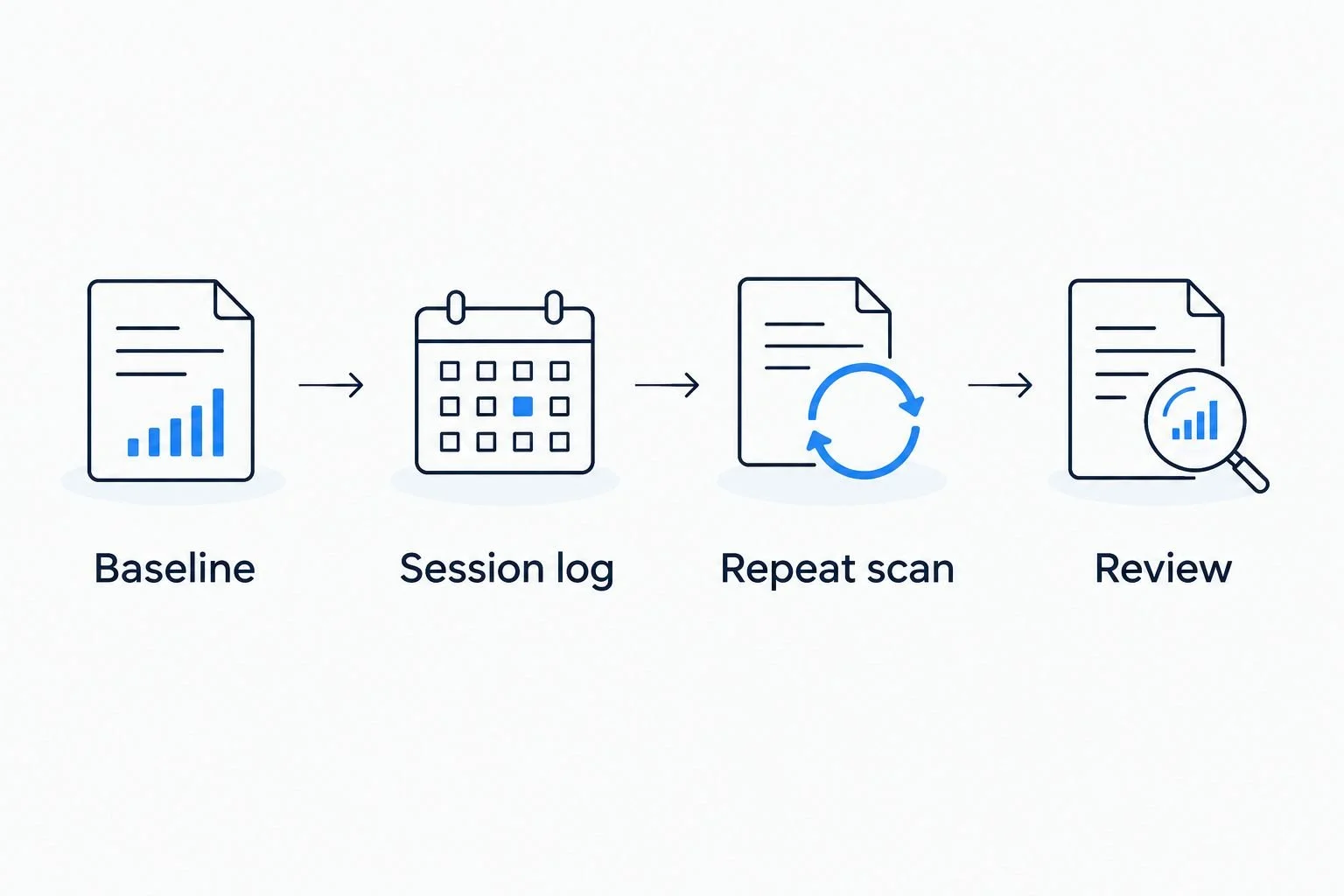
Interpret the repeat scan only after checking the conditions and session record.
Progress review
Compare measurements without assigning a cause
Check Preparation Notes before comparing values. Flag a scan taken under substantially different conditions rather than presenting it as directly equivalent.
Compare matching measurements and units. Keep body weight, skeletal muscle mass estimates, and body fat percentage in separate columns.
Read the pattern alongside your training and daily observations. A scan and a performance note answer different questions; neither should silently replace the other.
Write a short summary with two parts: the observed change and the interpretation limit. For example: the report shows a higher muscle-mass estimate, but preparation differed and the cause is unknown.
Expected result: Your summary says what the record supports without turning a correlation into a treatment claim.
For your 2026 review, use complementary records rather than searching for a single winning metric:
InBody scan
Best for: Body-composition trends
Advantage: Keeps several estimates on one report
Limitation: Hydration and testing conditions affect interpretation
Session log
Best for: Documenting exposure
Advantage: Shows which services occurred and when
Limitation: Attendance does not establish benefit
Familiar activity record
Best for: Goal-specific observations
Advantage: Connects tracking to something you actually do
Limitation: Training, sleep, and expectations influence results
Use InBody for body composition, not as an HBOT effectiveness test. A body-fat result does not establish tissue healing, inflammation status, oxygen delivery, or the reason you feel different.
If recovery is your main goal, the hyperbaric oxygen therapy recovery workflow is a related planning resource. Keep any recovery observations distinct from your scan’s body-composition estimates.
When training or nutrition changes
A second useful workflow starts whenever you change your training or eating routine. You still collect scans, but you mark the change explicitly instead of treating the whole tracking period as uniform.
Add a dated entry describing the change in Training Notes or Goal Notes. Be specific enough to recognize the period later.
Keep following the same scan preparation instructions. Do not alter your preparation to compensate for a result you dislike.
Separate observations before and after the change in your review. Keep HBOT dates visible alongside both periods.
Describe the combined picture without isolating a cause the record cannot establish.
Expected result: Your log remains useful when real life changes. It documents a different context rather than disguising it as a controlled comparison.
This variant is best for people adjusting exercise or nutrition while attending wellness sessions. Its advantage is relevance to your actual routine; its limitation is weaker attribution. Do not start extra sessions or change your diet merely to chase a scan number.
For a 2026 performance goal, a consistent familiar activity is usually a clearer observation target than an ever-changing workout. Record the activity conditions too, rather than treating every good training day as equivalent evidence.
Troubleshooting
Your muscle estimate changes unexpectedly
Check preparation, recent exercise, fluid-related circumstances, and device consistency before interpreting the result as tissue gain or loss. Keep the original report and flag the conditions. Ask the operator whether repeating the scan under comparable conditions is appropriate.
Your scans come from different devices
Label the devices clearly and avoid joining the results into an apparently uniform trend. Ask the operator how to interpret the difference. If comparability cannot be established, start a new baseline on the device you intend to keep using.
You feel better, but the scan looks unchanged
Keep the improvement in your activity or recovery notes without forcing it into a body-composition explanation. InBody does not directly measure every aspect of recovery or performance. An unchanged scan neither confirms nor rules out the reason for your experience.
The scan improves after several changes
List the changes together: training, nutrition, sleep, HBOT, and other services. Report the scan trend without assigning credit to one component. A personal tracking sheet cannot separate simultaneous influences the way a controlled study is designed to do.
You have symptoms or a suitability concern
Stop treating the spreadsheet as the decision-maker. Contact the relevant provider or healthcare professional about new symptoms, health conditions, or device-related restrictions. Neither a favorable scan nor a reassuring trend replaces an individual safety assessment.
Customize your workflow
Build your 2026 tracking routine around the question you actually need answered. Use body-composition estimates for body-composition goals and a repeatable activity record for performance observations. Keep session attendance as context for both.
Ask Live Superhuman which session details you should record when planning your visits. Confirm InBody access separately, and take the manufacturer’s preparation and suitability guidance to the scan operator rather than assuming every location uses identical instructions.
Plan your next session
Ask about session planning and the details to keep in your recovery log.
FAQ
Can an InBody scan show whether hyperbaric oxygen therapy is working?
No. InBody estimates body composition; it does not directly measure an HBOT response or establish what caused a change. Keep scan trends separate from recovery observations and clinical assessments.
How often should I get an InBody scan while doing HBOT?
Choose a repeat interval with your scan operator or qualified professional. A four-week review window is an organizational example, not a validated schedule for measuring an HBOT effect.
Should I get an InBody scan before or after my hyperbaric session?
Follow the scan operator’s preparation guidance and keep the timing consistent across visits. Do not use an immediate before-and-after comparison as proof of an HBOT benefit.
Does a higher muscle-mass result mean HBOT built muscle?
No. A higher muscle-mass estimate does not identify its cause, and fluid-related differences can affect impedance measurements. Review preparation, training, nutrition, and the broader pattern before drawing conclusions.
What should I track alongside my InBody results?
Track session dates, scan preparation, device details, training changes, sleep notes, and a goal-specific activity observation. Keep reported measurements separate from your personal interpretation.
Does Live Superhuman include an InBody scan with HBOT?
Confirm InBody access and any session inclusions directly with Live Superhuman before arranging your visit. Bookable HBOT sessions do not by themselves establish that body-composition testing is included.
Can I compare InBody results from different machines?
Do not assume results from different devices are interchangeable. Record the device for each scan and ask the operator whether the measurements support a direct comparison.
One last thing
Check the preparation notes before opening the results. That small habit makes it harder to accept an exciting number uncritically or dismiss an inconvenient one. Decide whether the comparison is fair before deciding what it means.
Related guides
By Kelley Gast