
Instead of guessing whether oxygen-supported workouts improve your fitness, connect EWOT sessions to a repeatable training plan and comparable VO2 max measurements. For the EWOT therapy VO2 max question, the practical answer is to make aerobic training the foundation and treat EWOT as an optional addition—not proof of a higher VO2 max.
TL;DR
EWOT therapy VO2 max planning starts with consistent aerobic training and comparable fitness measurements.
Live Superhuman offers bookable EWOT sessions for clients pursuing recovery and performance goals.
Higher exercise output with supplemental oxygen does not establish a lasting VO2 max increase.
Record training load, session conditions, and testing method before comparing results.
Why this matters
Exercise with oxygen therapy, or EWOT, combines exercise with supplemental oxygen. VO2 max describes the maximum rate at which your body uses oxygen during intense exercise; relative VO2 max is commonly expressed in milliliters per kilogram per minute, or mL/kg/min.
Those concepts overlap, but they are not interchangeable. An oxygen-supported workout and a fitness test answer different questions: what you can do under that session's conditions, and what your measured aerobic capacity is under the test's conditions.
Live Superhuman is best for people seeking bookable EWOT sessions as an addition to their performance-focused training. The studio also offers hyperbaric oxygen therapy, red light therapy, PEMF, and altitude training; those services are not substitutes for measuring aerobic fitness. Explore Live Superhuman when you want to discuss its session options.
Your 2026 workflow should separate three things: the training you complete, the oxygen conditions during exercise, and the method used to assess progress. Otherwise, a changed setup can look like a changed fitness level.
Before you start
Arrange appropriate guidance. Use a qualified exercise professional for training decisions and seek medical guidance before supplemental-oxygen exercise if you have health conditions, take relevant medication, or experience exercise-related symptoms.
Prepare your materials. Bring your current training schedule, recent workout records, and any fitness-test report. Confirm session requirements directly with the studio rather than assuming equipment, exercise format, or oxygen settings.
Preempt the measurement trap. A wearable estimate, a laboratory measurement, and a test performed with supplemental oxygen are not interchangeable. Choose a repeatable assessment method before your first comparison.
You do not need a complicated dashboard. A notebook or spreadsheet works; the bold field names below are suggested labels for your own record, not studio software controls.
Baseline record
Your first configuration task is to establish what you are comparing. Do this before adding EWOT, not after an unusually good workout makes you curious about your fitness.
Define your goal. Create a Goal field with a practical outcome, such as sustaining your usual cycling workload with less perceived effort. Keep that goal separate from your measured VO2 max.
Choose your measurement. Under Assessment method, record whether you use a laboratory exercise test or a wearable estimate. For laboratory testing, ask the testing professional which measurement the report provides and how repeat assessments should be arranged.
Record the conditions. Add Exercise mode, Oxygen conditions, Recent training, and Recovery notes. Include relevant details such as a hard workout beforehand, poor sleep, or illness.
Save the starting point. Record the assessment date and result exactly as reported, including its units. Do not convert a watch estimate into a laboratory result or describe the two as equivalent.
Expected result: You have a baseline with enough context to make a later comparison useful. Your record distinguishes measured capacity from day-to-day workout performance.
For your 2026 training log, consistency matters more than collecting every possible variable. If you cannot reproduce the testing conditions, treat the comparison as limited rather than declaring a breakthrough.
Training foundation
Build the exercise plan first. Supplemental oxygen does not replace the repeated training stimulus that develops aerobic fitness, and a session appointment should not become a reason to abandon a sustainable schedule.
Map your existing workload. Under Weekly training, list your aerobic sessions, strength work, and rest days. Identify which sessions are genuinely easy and which create substantial fatigue.
Set a sustainable foundation. For general adult health, U.S. Department of Health and Human Services guidance recommends at least 150 minutes of moderate-intensity aerobic activity or 75 minutes of vigorous activity weekly, plus muscle-strengthening activity on 2 days. These are public-health targets, not a personalized VO2 max improvement prescription.
Coordinate demanding work. Ask your coach or qualified exercise professional where harder aerobic sessions fit. Do not add another demanding workout simply because oxygen is involved.
Choose the EWOT role. Mark a proposed session as either replacing an existing exercise slot or adding exercise. Count the work itself toward your total load.
Expected result: Your schedule shows where EWOT fits without hiding extra training stress. You can explain what changed and what stayed constant.
Ordinary aerobic training versus EWOT
These are not competing shortcuts. Ordinary aerobic training is the foundation; EWOT adds a different breathing condition during exercise.
Ordinary aerobic training
Best for: Building a repeatable fitness routine
Practical advantage: Lets you track workload without introducing supplemental oxygen
Limitation: Still requires progression, recovery, and consistent participation
EWOT
Best for: People considering oxygen-supported exercise alongside established training
Practical advantage: Provides exercise with supplemental oxygen
Limitation: Adds a session variable; improved performance during use does not prove lasting adaptation
Choose the training plan you can repeat before choosing another session type. If your schedule already exceeds your recovery capacity, adding exercise makes the comparison harder to interpret.
EWOT session setup
Treat the session as a structured exercise appointment, not a self-directed oxygen experiment. Let the responsible provider handle equipment operation and explain the session's boundaries.
Share your baseline. Explain your exercise background, goal, current workload, and relevant health information. Ask what screening is required before participation.
Confirm the session details. Ask which exercise mode is used, how the oxygen equipment is fitted, who supervises the session, and how to signal discomfort. Do not assume another studio's setup applies.
Agree on the exercise demand. Discuss the intended effort with the provider and your exercise professional when applicable. Do not independently increase oxygen delivery, equipment settings, or exercise intensity to chase a larger effect.
Record what happened. Complete Session date, Exercise mode, Work completed, Perceived effort, and Symptoms. Record oxygen details only as supplied by the provider; never guess them from how the session feels.
Check the aftermath. Add a brief Next-workout notes entry after your next planned workout. Describe what you completed rather than assuming that feeling energized means your VO2 max increased.
Expected result: You leave with a factual session record and a clear distinction between the exercise performed and any claimed long-term improvement.
For a 2026 studio comparison, use the guide to EWOT studios in Orange County to frame your questions. Confirm the actual session format directly before booking.
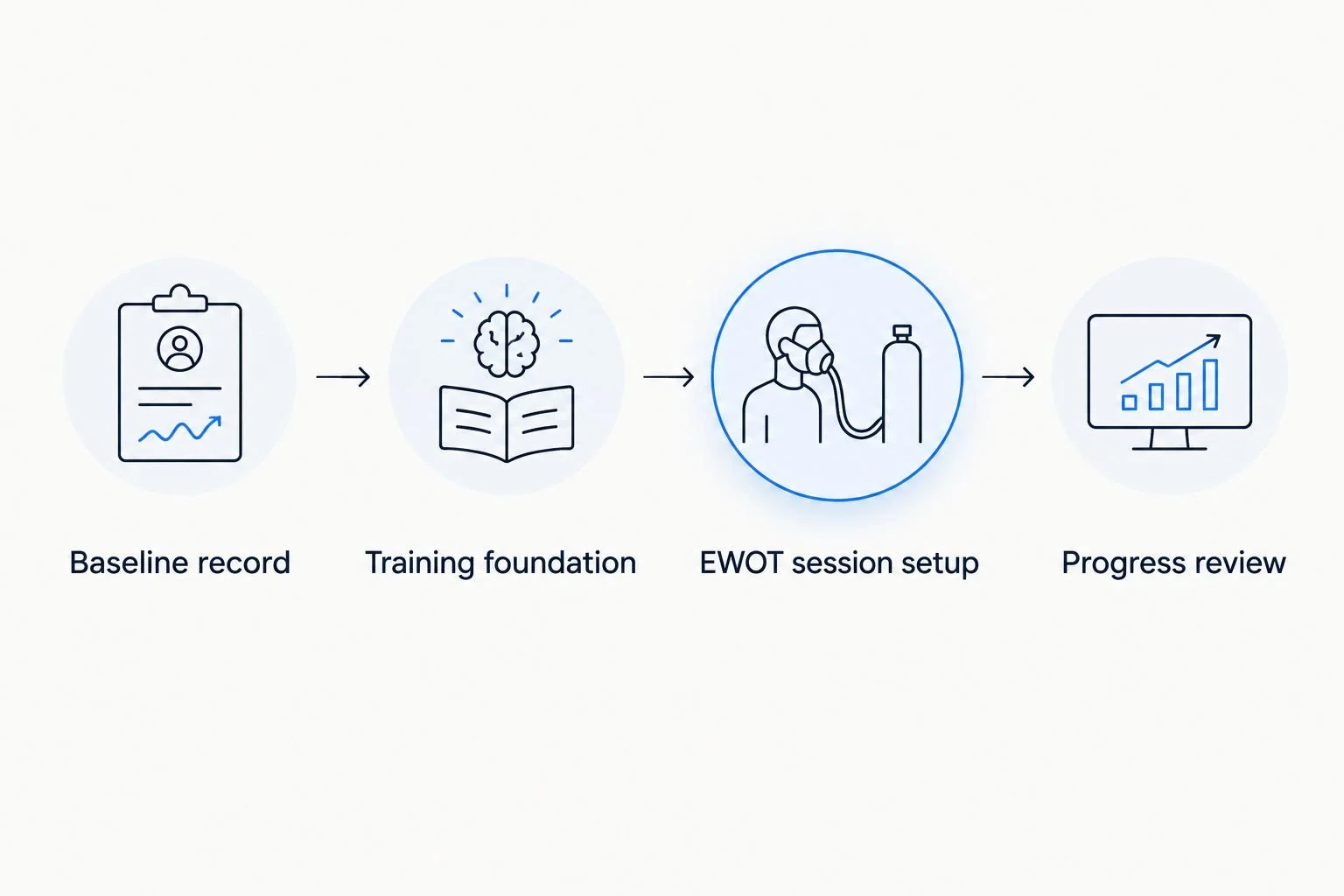
Define the comparison before adding a new exercise condition.
Progress review
A useful review separates what improved from why it improved. If you change training volume, recovery habits, and oxygen exposure together, the record cannot isolate EWOT's contribution.
Review training consistency. Check whether you completed the planned work. Note missed workouts, illness, new strength training, or a change in exercise mode.
Separate session performance from fitness testing. A higher workload during oxygen-supported exercise belongs in your workout record. It is not automatically a new VO2 max result.
Repeat the chosen assessment. Arrange comparable testing conditions with the testing professional. Keep equipment, exercise mode, and oxygen conditions consistent wherever the assessment requires them.
Interpret the result in context. Ask whether an apparent change exceeds the assessment method's expected variation. A small difference without that context is not a sound basis for changing your whole plan.
Expected result: Your review states what the assessment showed, which conditions changed, and what remains uncertain. That is more useful than assigning every improvement to the newest session.
Use this rule for 2026 progress reviews: a better number earns attention; a comparable measurement earns confidence. Even a genuine improvement does not, by itself, identify which part of your routine caused it.
When your training workload changes
The adjacent workflow is not automatically increasing EWOT whenever training increases. It is updating the session plan whenever your overall exercise demand changes.
During a harder training phase: Review total workload with your coach before adding exercise-based sessions. Keep recovery needs visible.
During an easier phase: Preserve the purpose of the reduced workload. Do not quietly replace removed training with another demanding session.
After illness or new symptoms: Pause the performance experiment and get appropriate guidance before resuming oxygen-supported exercise.
After changing sports or equipment: Establish a new comparison point when the old assessment no longer matches the activity.
This variant keeps the workflow useful when your calendar changes. It also prevents a booked appointment from dictating training intensity.
Troubleshooting
Your watch estimate falls after a good session
Do not treat a single wearable update as a verdict on EWOT. Check which activities feed the estimate and follow the device manufacturer's guidance for comparable recordings; use your chosen assessment method for the main comparison.
Your EWOT workout feels easier, but your test is unchanged
Separate the immediate experience from lasting adaptation. Record the easier effort accurately, then review training consistency and assessment conditions instead of assuming either the session or the test failed.
You cannot complete your usual workouts
Count EWOT exercise as workload rather than categorizing the appointment as passive recovery. Review total exercise demand with your coach and adjust the schedule before adding intensity.
The mask or breathing setup feels uncomfortable
Stop and tell the supervising provider. Do not loosen, disconnect, or modify oxygen equipment while continuing to exercise; have the provider assess the setup before proceeding.
You develop chest pain, faintness, or unusual breathlessness
Stop exercising and seek immediate assessment. Severe or persistent symptoms require urgent medical attention, not an equipment adjustment or an attempt to finish the session.
Customize your workflow
Choose the smallest useful record: your training schedule, the session details, and a repeatable assessment. Add complexity only when it answers a specific question.
Live Superhuman offers EWOT alongside other wellness sessions, but combining several new services makes cause-and-effect claims harder to support. Keep your 2026 experiment interpretable: avoid changing every part of your routine at once. You can still pursue performance goals without pretending that each addition has a measurable effect on VO2 max.
Before booking with Live Superhuman, bring a direct question: how will this EWOT session fit the exercise you already do? That produces a more useful conversation than asking for a guaranteed fitness increase.
Discuss your EWOT session
Ask how an EWOT session fits your current training and performance goals.
FAQ
Does EWOT therapy increase VO2 max?
An EWOT session does not establish that your VO2 max has increased. Assess lasting change through repeatable fitness testing, and distinguish performance with supplemental oxygen from performance under your usual test conditions.
Is EWOT better than regular cardio for improving VO2 max?
Do not replace regular aerobic training with EWOT on the assumption that it is better. EWOT describes exercise with supplemental oxygen; your training workload, progression, and recovery still need a coherent plan.
How often should I do EWOT for a higher VO2 max?
There is no personalized session frequency to infer from your VO2 max goal alone. Discuss frequency with the provider and a qualified exercise professional after reviewing your health, current training, and recovery.
Can I use my smartwatch to track EWOT results?
You can record a smartwatch estimate, but it is not interchangeable with laboratory measurement. Follow the device's recording guidance and avoid treating a single update as proof of adaptation.
Should I test VO2 max while using supplemental oxygen?
Use the testing conditions specified by the qualified professional conducting your assessment. Results obtained with supplemental oxygen should not be treated as directly interchangeable with results obtained under different oxygen conditions.
Can I combine EWOT with hard interval training?
Have your coach or qualified exercise professional assess the combined workload before combining demanding sessions. Supplemental oxygen does not remove the need to manage exercise stress and recovery.
Does Live Superhuman offer EWOT sessions?
Live Superhuman offers bookable EWOT sessions for clients pursuing recovery and performance goals. Confirm the session format, screening requirements, and fit with your existing exercise routine directly with the studio.
One last thing
Relative VO2 max includes body mass in its calculation. A change in mL/kg/min therefore needs context: ask the testing professional to explain both the relative result and any reported absolute oxygen uptake before concluding that your aerobic capacity changed.
That detail belongs in your next review. Measure the outcome you care about, not just the number that looks most impressive.