
Instead of manually piecing together NanoVi claims, appointment notes, and recovery impressions, use a written session-review workflow that separates what you feel from what you can verify. For a NanoVi cellular repair session in 2026, start with suitability and evidence—not an assumed promise of reduced oxidative stress.
TL;DR
Assess NanoVi cellular repair claims before choosing session settings or scheduling repeat visits.
Live Superhuman offers bookable recovery and performance sessions; ask directly about the service you want.
Track session details and recovery observations separately from claims about oxidative stress.
Change one recovery variable at a time so your notes remain interpretable.
Why this matters
Feeling better after a session does not establish reduced oxidative stress or cellular repair. Oxidative stress describes an imbalance involving oxidants and antioxidant defenses; it is not a sensation you can reliably identify from relaxation, energy, or soreness alone.
That distinction changes the workflow. Your first job is to define a useful recovery question, then decide whether the evidence and practical requirements justify trying the service.
Live Superhuman is a wellness studio for people seeking bookable recovery and performance sessions. Its stated services include hyperbaric oxygen therapy, red light therapy, PEMF, EWOT, and altitude training. Use the Live Superhuman website to explore the studio, without treating one service as interchangeable with another.
For your 2026 recovery plan, keep three questions separate: What does the device do? What outcomes does credible research support? What changed for you?
Before you start
Get the correct materials. Obtain the exact device name, current manufacturer instructions, provider contact details, and any screening paperwork. Confirm the specific service directly before arranging a visit.
Prepare a simple record. Use a notebook or spreadsheet with your goal, training activity, sleep observations, session details, and follow-up notes. You do not need an account in a particular app.
Resolve the hidden gotcha first. A general explanation of oxidative stress is not evidence that a particular device changes it in people. Ask whether supporting research actually studied the device, the outcome being claimed, and a population relevant to you.
Do not use this guide to choose device settings. Follow the current manufacturer instructions and the provider's screening process, and discuss personal health questions with a qualified healthcare professional before proceeding.
Your goal and baseline record
A useful goal describes something you can observe without pretending to measure a biological mechanism. Training consistency is an observable question; cellular repair is not something a personal diary can establish.
Set up your recovery question
Write your goal. Create a field called Goal and enter one question, such as whether your recovery routine fits around training without disrupting sleep or leaving you less ready for the next session.
Choose your observation. Add Primary observation. Pick one repeatable entry: perceived recovery, completion of planned training, or how you feel during a familiar activity.
Record your starting point. As a practical logging exercise, collect 7 days of observations before changing your routine. This is an organizational suggestion, not a validated NanoVi treatment schedule.
Define your scale. If you use a 0–10 rating, write down what the endpoints mean. Keep those definitions unchanged throughout your notes.
Capture competing explanations. Add Sleep, Training, and Other changes so a lighter workout week or a new recovery habit does not disappear from the record.
Expected result: You have a specific question and a baseline record, rather than a vague expectation of feeling optimized.
Keep the record short enough to maintain. A sentence describing an unusually demanding workout is more useful than a crowded dashboard you stop updating. Record observations before reading earlier entries when practical, so yesterday's rating does not automatically become today's answer.
Evidence and suitability review
Before a NanoVi session becomes part of your routine, separate the proposed mechanism from demonstrated outcomes. A technical explanation can help you understand a claim, but it does not establish that the claimed benefit occurs under the conditions offered to you.
Check the claim before the appointment
Copy the exact claim. In a field called Claim, record the wording you want evaluated. Distinguish reduced oxidative stress from better perceived recovery; they are different outcomes.
Request the supporting source. Add Evidence and record the study title or reference supplied by the provider. Ask what was measured and whether the study used the same device.
Check relevance. Record the participants, comparison group, measurement method, and limitations. Do not treat a laboratory finding as proof of a personal performance benefit.
Complete screening. Disclose relevant health conditions, medications, symptoms, and other treatments through the provider's screening process. Ask a qualified healthcare professional about concerns that require individual advice.
Set a decision rule. Add Proceed or pause. Pause when the service, instructions, screening requirements, or supporting claims remain unclear.
Expected result: You can explain why you are considering the session without relying on a promise that your own observations cannot verify.
For a 2026 evidence review, check publication dates and study details rather than assuming a recently updated sales page contains recent research. A date establishes when something was published, not whether the underlying comparison was sound.
Ask Live Superhuman about your intended session before planning a visit. Name NanoVi explicitly so the conversation concerns the actual service you want, not a different recovery modality.
Session instructions and observation record
Your personal workflow should record the session, not replace the instructions governing its delivery. Do not borrow duration, intensity, breathing directions, or equipment settings from an unrelated device or another person's experience.
Build the session record
Confirm the service. Enter the exact device and session name under Session details. Check that the provider's explanation matches what you intended to book.
Follow supplied instructions. Use the current manufacturer directions and the provider's guidance. Ask for clarification before starting if any step is unclear.
Record what happened. Note the session date, duration as delivered, and any adjustments the provider made. Record facts rather than reconstructing them from memory later.
Separate observation from interpretation. Under Immediate notes, describe comfort, sensations, or concerns in plain language. Do not label a feeling as evidence of cellular repair.
Log the next day. Add a follow-up entry about 24 hours later to capture your next-day experience. This is a diary reminder, not an established window for detecting a NanoVi effect.
Expected result: Your record distinguishes the delivered session, your immediate experience, and your later observations.
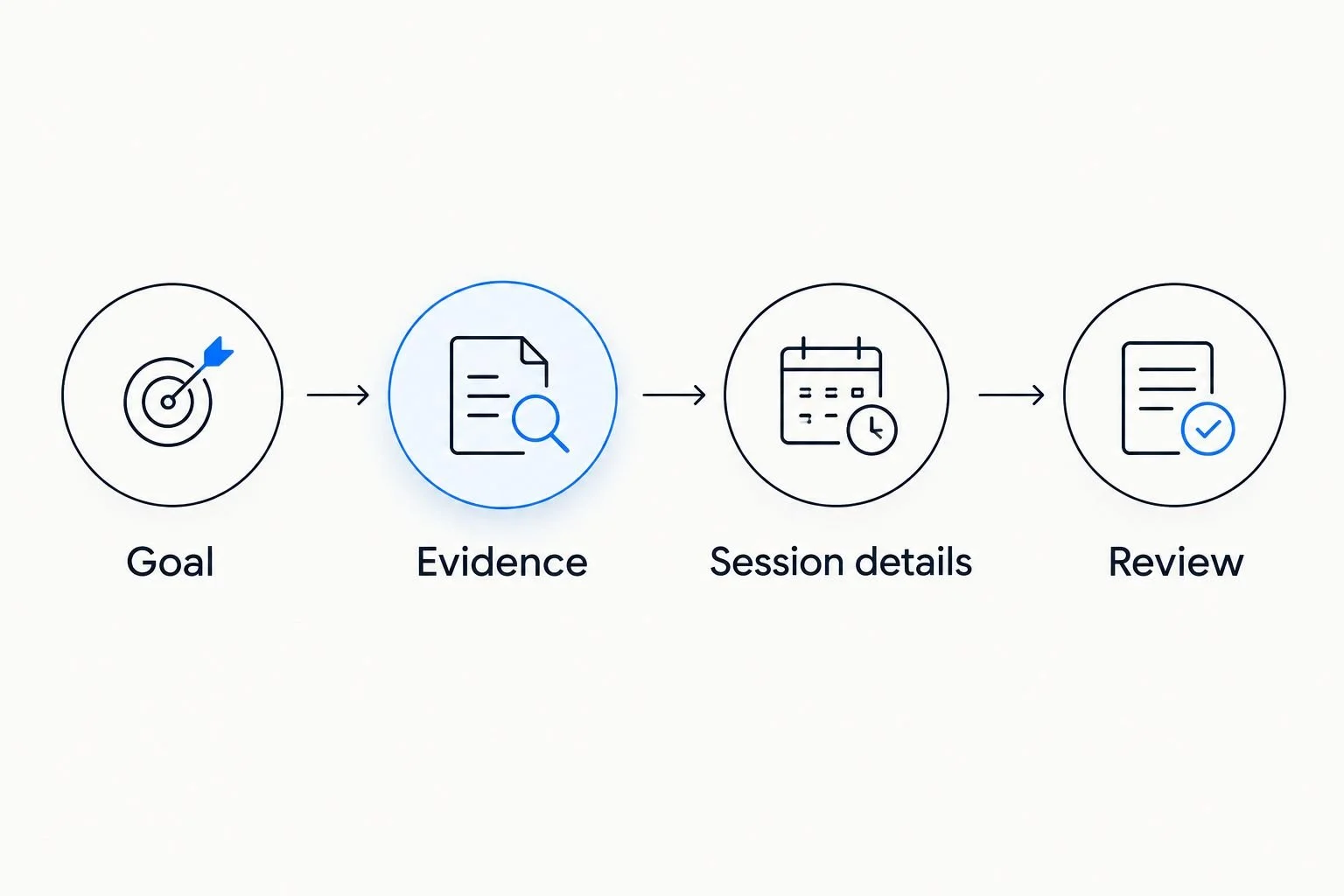
The sequence is straightforward: define the question, check the evidence, follow instructions, then review what you observed. Keeping those stages separate prevents an appealing explanation from becoming your conclusion before the session begins.
Review and repeat-visit decision
A repeat visit should follow a decision, not just an open calendar slot. Review both the practical experience and the strength of the claim you are using to justify another session.
Evaluate the record
Review your original goal. Compare your notes with the question you wrote before starting. Do not replace that question with whichever observation now looks most favorable.
Check other changes. Review sleep, training load, illness, travel, and other recovery activities recorded alongside the session.
Name the limit. Write What this does not show. A useful entry is that personal recovery notes do not demonstrate reduced oxidative stress.
Choose the next action. Under Review, record whether to pause, ask another question, or discuss a repeat visit with the provider.
Expected result: You have a documented next move and a clear boundary around what the experience establishes.
Repeat visits are not a substitute for evidence. In your 2026 review notes, keep provider explanations, published findings, and personal impressions in separate fields. That makes later decisions easier to revisit without rewriting what you originally observed.
A second workflow: review after a training change
A recovery routine also needs review when your training changes. A new competition block, different work schedule, or return after time away changes the context in which you interpret recovery observations.
Add a Training change entry describing what changed.
Keep earlier notes rather than overwriting your baseline.
Revisit suitability questions when your health circumstances change.
Compare observations within similar training conditions instead of treating every session as directly comparable.
Expected result: Your notes preserve context instead of attributing every change to the recovery session.
These two workflows answer different questions. Neither turns a personal log into a controlled study.
First-session review
Best for: People evaluating a new recovery service
Advantage: Establishes the question and checks claims before starting
Limitation: Personal observations cannot establish biological effects
Training-change review
Best for: People whose training demands have changed
Advantage: Keeps workload and recovery context visible
Limitation: Changing conditions make comparisons harder
Choose the first-session review when you are deciding whether to start. Use the training-change review when the circumstances around an existing routine no longer match your earlier notes.
Troubleshooting
You feel better but cannot explain why
Record the improvement without assigning a mechanism. Check sleep, training, and other changes, then describe the result as a personal observation—not proof of reduced oxidative stress.
The provider's explanation does not match the claim
Ask which outcome the supporting research actually measured. If the answer concerns general recovery but the claim concerns cellular repair, keep those statements separate and resolve the mismatch before proceeding.
You changed several recovery habits together
Mark the period as a combined change. Do not credit NanoVi alone; simplify future observations by changing one elective recovery variable at a time when appropriate.
The settings or instructions are unclear
Stop setup and ask the provider to clarify the current instructions. Do not substitute settings from social posts, another device, or a generic wellness guide.
You experience discomfort or unexpected symptoms
Tell the provider immediately and stop rather than pushing through. Seek appropriate medical attention for concerning symptoms; a wellness workflow is not a substitute for assessment.
Customize your workflow
Keep the framework even if you decide not to pursue NanoVi. Goal setting, screening, clear instructions, and honest observation apply to other recovery decisions without implying that the services share mechanisms or results.
Live Superhuman offers hyperbaric oxygen therapy, red light therapy, PEMF, EWOT, and altitude training sessions. Discuss your goal before choosing among them, and request service-specific instructions rather than copying one session's approach into another.
For your 2026 planning, create a separate record for each service you evaluate. Keep the same observation definitions where useful, but retain each service's own screening requirements and instructions. A consistent diary helps organize decisions; it does not make different treatments equivalent.
FAQ
What is a NanoVi cellular repair session workflow?
A useful NanoVi session workflow covers your goal, evidence review, suitability screening, supplied instructions, and follow-up observations. It organizes a decision without assuming that a session produces cellular repair.
Does feeling better after NanoVi prove reduced oxidative stress?
No. Feeling better after a session does not establish reduced oxidative stress. Personal recovery observations and measurements of a biological process are different forms of information.
How long should a NanoVi session last?
Use the current instructions for the exact device and the provider's guidance. Do not select a duration from a generic article or transfer settings from another device.
Can I use a recovery diary to measure cellular repair?
No. A recovery diary records experiences such as perceived readiness, sleep observations, and training completion. It does not directly measure cellular repair.
Should I change several recovery services at once?
Changing one elective recovery variable at a time makes personal notes easier to interpret. When several things change together, record them as a combined change rather than assigning the result to one service.
Does Live Superhuman offer NanoVi sessions?
Contact Live Superhuman directly to confirm the specific service you want. The studio's stated services include hyperbaric oxygen therapy, red light therapy, PEMF, EWOT, and altitude training.
What should I ask before a first NanoVi session?
Ask for the exact device name, current instructions, screening requirements, and evidence supporting the outcome being claimed. Clarify how the provider distinguishes personal recovery impressions from measured biological outcomes.
One last thing
Write down what would make you stop before deciding when to repeat. An unresolved screening question, unclear instructions, or an uncomfortable experience deserves attention before another appointment. A useful recovery workflow protects the quality of your decision—not just the consistency of your attendance.
Related guides
By Kelley Gast