
Instead of guessing whether intermittent hypoxic training prepares you for altitude, build a supervised workflow that connects your destination, session response, and ascent plan. Use training as preparation—not proof that you can skip acclimatization when you arrive.
TL;DR
Intermittent hypoxic training supports a preparation plan; it does not guarantee altitude acclimatization or prevent altitude illness.
Live Superhuman offers bookable altitude training; confirm the session format before requesting IHHT.
IHHT alternates reduced-oxygen and oxygen-enriched breathing; not every altitude training session uses this format.
Match your travel plan to sleeping elevation, symptoms, and gradual ascent—not a single pulse oximeter reading.
Why this matters
Intermittent hypoxic training and altitude acclimatization are not interchangeable. The first describes repeated exposure to reduced oxygen. The second is your body's adjustment to the lower oxygen pressure encountered at elevation.
IHHT is a particular approach: intermittent hypoxic-hyperoxic training alternates reduced-oxygen breathing with oxygen-enriched recovery periods. Other intermittent hypoxic training formats use normal air between exposures. Ask which format a provider actually delivers before comparing sessions.
Live Superhuman is a fit for clients seeking bookable altitude training in a wellness-studio setting. Its altitude training offering does not establish that every session follows an IHHT format or prepares you for a particular expedition. Confirm those details directly.
For your 2026 preparation plan, keep two separate questions visible: how you respond during supervised training, and how you will ascend at your destination. A comfortable session answers neither your future tolerance nor your risk of altitude illness.
Before you start
Bring your itinerary and training calendar. Record your destination, arrival date, first sleeping elevation, highest sleeping elevation, and planned exertion. Include recent illness, usual training, and previous symptoms at altitude.
Arrange appropriate screening and supervision. Discuss relevant health conditions, medications, pregnancy, and previous altitude illness with a qualified healthcare professional. Ask the session provider who supervises exposure, what they monitor, and how they respond to symptoms.
Confirm the actual breathing format. IHHT, intermittent hypoxic training, and altitude training are not identical labels. The non-obvious gotcha is that a simulated elevation setting does not mean you have acclimatized to sleeping or exercising at that elevation.
Do not begin by choosing an oxygen setting from an online schedule. Exposure intensity, exercise workload, recovery periods, and your health history belong in an individualized discussion with the supervising professional.
Your destination brief
Define the altitude demand
Create a trip worksheet. Add the headings Arrival, Sleeping elevation, Activity, and Descent access. These are your planning labels, not equipment controls.
Enter the first sleeping elevation. Include where you actually spend the night, rather than only the airport or trailhead elevation. Sleeping elevation is central to ascent planning.
List the hardest planned activity. Distinguish a sightseeing trip from sustained hiking or racing. Record whether the activity happens immediately after arrival or after time at elevation.
Identify who can change the itinerary. Decide who can postpone an ascent, arrange transport, or help you descend. Make those decisions before exertion and symptoms complicate them.
Expected result: You have a destination-specific brief to discuss with the session provider and your travel companions. “Prepare for altitude” has become an actual task, not an open-ended promise.
For 2026 travel, use established ascent guidance rather than treating simulated exposure as a shortcut. The CDC Yellow Book 2026 identifies travel to sleeping elevations around 2,500 meters and higher as relevant to altitude-illness risk, with illness possible lower down.
The same CDC guidance advises avoiding an increase in sleeping elevation greater than 500 meters per night above 3,000 meters, with an additional acclimatization night for each 1,000 meters gained. These are travel-planning recommendations, not settings to copy into a training device.
A destination brief also exposes practical conflicts. If you land high and plan a demanding activity immediately, additional studio sessions do not repair the itinerary. Discuss a slower arrival schedule and whether medical advice is needed before departure.
Your supervised session plan
Confirm the exposure format
Name the service accurately. Ask whether the appointment uses reduced oxygen alone, alternation with normal air, or alternation with oxygen-enriched air. Do not assume “altitude training” means IHHT.
Clarify the activity component. Ask whether you remain at rest or exercise during exposure. Exercise adds workload, so a resting session and an exercise session are not equivalent experiences.
Confirm monitoring and stopping criteria. Ask which observations guide adjustments and which symptoms end the session. Do not substitute a universal internet oxygen-saturation target for an individualized decision.
Agree on the next review. Establish how your response will inform the following appointment. Progression should follow the supervised assessment, not pressure to reach a more impressive simulated elevation.
Expected result: You can explain what will happen, what the supervisor watches, and when exposure stops. If those answers remain unclear, pause before starting.
Live Superhuman offers altitude training alongside other wellness services. Confirm the current altitude training format and its suitability for your travel goal rather than assuming that another oxygen-related service provides the same exposure.
Separate the available approaches
Intermittent hypoxic training
Best for: Discussing controlled reduced-oxygen exposure with a qualified supervisor
What it involves: Repeated hypoxic periods separated by recovery periods
Main limitation: Session tolerance does not establish readiness for a destination
IHHT
Best for: People specifically seeking a supervised hypoxic-hyperoxic format
What it involves: Reduced-oxygen periods alternating with oxygen-enriched recovery
Main limitation: The label alone does not establish effectiveness for your ascent
Gradual ascent
Best for: Travelers planning their adjustment at actual altitude
What it involves: Managing sleeping-elevation gains and time at elevation
Main limitation: Requires itinerary flexibility and ongoing symptom awareness
Prioritize a workable ascent plan; treat simulated exposure as a separate preparation decision. The table compares approaches, not interchangeable substitutes or guaranteed outcomes.
Your session and travel log
Record the response
Write down your starting condition. Note sleep, recent exercise, current symptoms, and any illness before the appointment. Give the supervisor this context instead of reporting only how motivated you feel.
Record the supervised exposure. Note the breathing format, whether you exercised, and the settings or measurements the provider explains. Use the equipment's actual terminology; do not invent equivalent mountain elevations yourself.
Describe symptoms plainly. Record dizziness, headache, unusual breathlessness, nausea, or other changes without minimizing them. Tell the supervisor when they occur, rather than waiting until the appointment ends.
Add the recovery response. Record how you feel afterward and whether symptoms persist. Share that information before another session or demanding workout.
Review before changing anything. Bring the log to the supervising professional. Do not independently increase exposure because the previous appointment felt easy.
Expected result: Your next decision uses a documented response rather than memory or a single favorable reading. The log is a communication tool, not a self-clearance certificate.
Use this simple sequence in your 2026 training calendar: destination brief, supervised session, response review, then ascent planning. Keep your travel decisions separate from your session settings throughout.
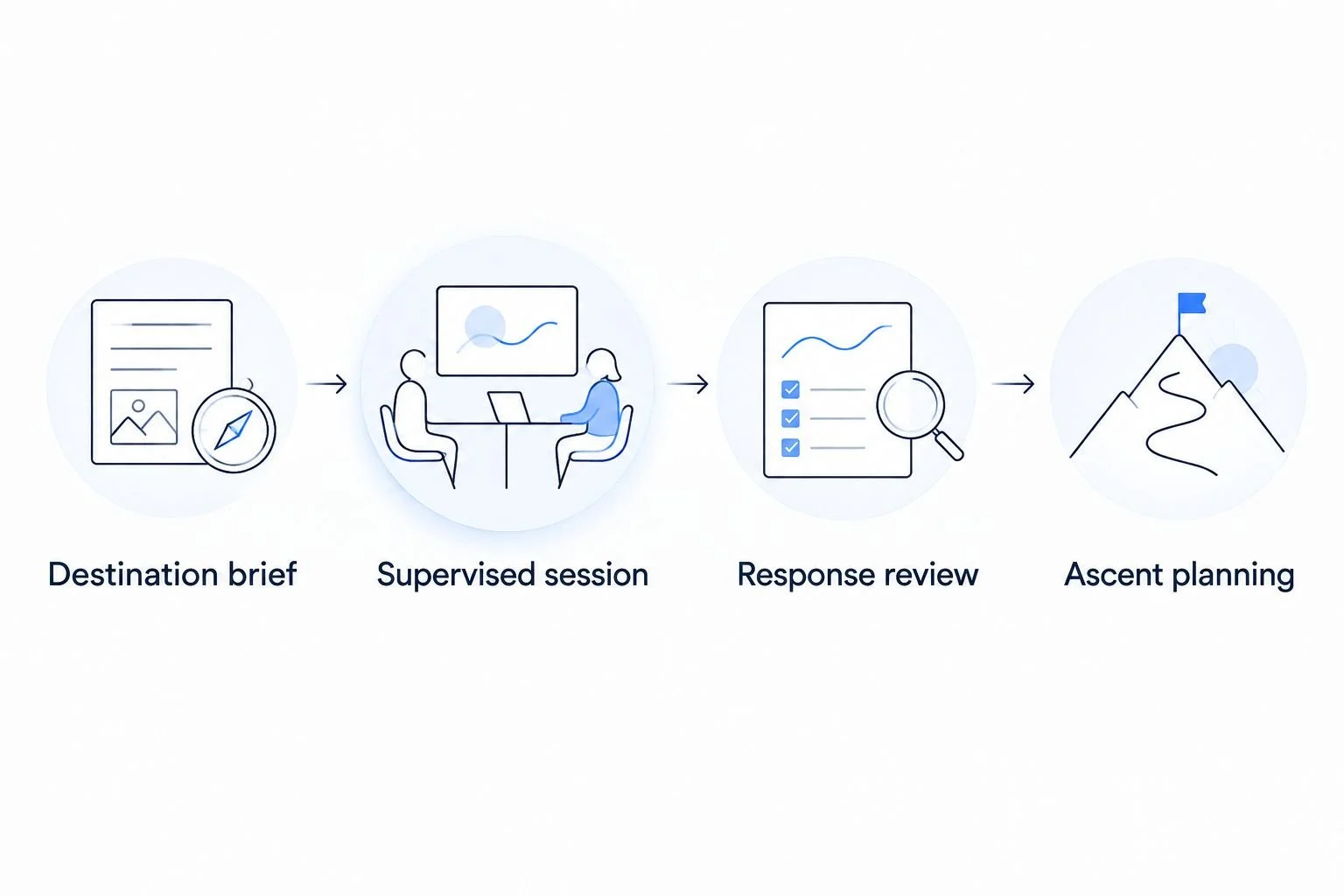
Review your response before changing the training plan, and keep ascent planning separate.
A useful log captures disagreement as well as progress. If a device reading looks reassuring but you feel unwell, record both. Symptoms deserve attention; they are not an inconvenience to remove from an otherwise successful session summary.
When your itinerary changes
A second workflow applies whenever the trip changes. A higher first sleeping elevation, earlier departure, or harder activity changes the preparation question even if your studio sessions remain identical.
Update the destination brief. Replace the old arrival and sleeping-elevation details. Keep the original version so the change is obvious.
Reassess the ascent. Check whether the new itinerary compresses time at elevation or increases sleeping-elevation gains. Ask for medical travel advice when the change creates concerns.
Tell the session supervisor. Explain the new destination demands before the next appointment. Do not compensate for a shortened calendar by requesting more intense exposure.
Reset the decision point. Decide whether to modify the activity, arrival schedule, or trip itself. Completing the original session plan is not a reason to ignore a more demanding itinerary.
Expected result: Your preparation still matches the trip you are taking. A changed booking does not silently become an unchanged training assumption.
This variant also works after illness or an interruption in training. Revisit readiness with the appropriate professional instead of treating previously tolerated settings as automatically suitable now.
Troubleshooting your workflow
Your pulse oximeter reading keeps changing
Movement, cold fingers, poor circulation, nail polish, and device limitations can affect pulse oximeter readings. Ask the supervisor to check measurement conditions and interpret the result alongside your symptoms.
Comparing finger pulse oximeters belongs in a discussion about measurement quality, not proof of altitude readiness: choosing a device does not remove the limits of fingertip measurements. Do not chase a desired reading by changing your breathing or exposure without supervision.
You feel unwell despite a reassuring number
Stop exposure and alert the supervisor. A pulse oximeter does not measure every cause of illness, and a reassuring display does not cancel symptoms.
At actual altitude, do not ascend with symptoms consistent with altitude illness. Worsening symptoms, confusion, difficulty walking normally, or breathlessness at rest require urgent attention and descent when feasible; seek emergency help rather than treating them as training discomfort.
Every session becomes a harder session
Remove automatic progression from your calendar. A higher simulated elevation or longer exposure is not, by itself, evidence of a better preparation plan.
Review symptoms, recovery, exercise load, and the original goal with the supervisor. Keep the next appointment unchanged or postpone it when the professional assessment calls for that decision.
You are trying to combine too many new variables
Separate a new exposure format from changes in exercise intensity, travel fatigue, and unfamiliar recovery sessions. Otherwise, your log cannot clearly describe what changed when you felt different.
Keep your usual training context visible. Avoid interpreting an isolated good workout as proof that hypoxic exposure caused an improvement, or a bad workout as a reason to intensify it.
Your arrival schedule leaves no room to adjust
Change the itinerary rather than treating studio preparation as insurance. Gradual ascent and symptom-responsive decisions remain necessary even after a comfortable training block.
For a 2026 trip, put the fallback plan in writing before departure: who you tell, which activity you stop, and how you reach help. Do not wait until you are tired at elevation to negotiate those choices.
Customize your workflow
Choose one primary purpose for your next conversation: destination preparation, supervised exposure, or general performance training. These purposes overlap, but each needs a different success measure.
For destination preparation, the useful output is an ascent plan you can follow. For supervised exposure, it is a clear understanding of the session and your response. For performance training, it is a goal-specific discussion that does not confuse tolerating reduced oxygen with improving race results.
Live Superhuman altitude training is one service to discuss within that plan. The advantage is access to a bookable studio session; the limitation is that the service description alone cannot establish an individualized acclimatization outcome.
Ask about the session before committing to an altitude-preparation schedule. Bring the destination brief and ask what the studio offers, what screening applies, and where medical travel advice is needed.
Discuss your altitude training goal
Bring your destination, sleeping elevations, and training calendar to the conversation.
FAQ
Is intermittent hypoxic training the same as IHHT?
No. Intermittent hypoxic training is the broader term for repeated reduced-oxygen exposure; IHHT specifically alternates hypoxic exposure with oxygen-enriched recovery periods. Confirm the actual breathing format before booking.
Can intermittent hypoxic training replace altitude acclimatization?
No. Tolerating simulated exposure does not establish that you are acclimatized to sleeping or exercising at your destination. Keep gradual ascent and symptom monitoring in your travel plan.
Does Live Superhuman offer altitude training?
Live Superhuman offers bookable altitude training sessions. Confirm the current format, supervision, and screening before assuming the session uses IHHT or suits a particular trip.
What oxygen saturation should I aim for during a session?
Do not choose a universal oxygen-saturation target from an online guide. A qualified supervising professional should interpret measurements alongside your health history, symptoms, and session format.
Can I use a pulse oximeter to decide whether to keep climbing?
A pulse oximeter reading alone cannot determine whether you should keep climbing. Symptoms and your ascent history matter, and you should not ascend with symptoms consistent with altitude illness.
How should I plan sleeping-elevation gains for a 2026 trip?
The CDC Yellow Book 2026 advises limiting sleeping-elevation increases to no more than 500 meters per night above 3,000 meters, with an extra acclimatization night per 1,000 meters gained. Discuss your individual itinerary and health considerations with a qualified healthcare professional.
What should I bring to an altitude training appointment?
Bring your itinerary, sleeping elevations, activity plan, training calendar, and relevant health information. Include previous altitude symptoms and any recent illness so the discussion addresses your actual trip.
One last thing
Your summit elevation is not the only elevation that matters. Write the first sleeping elevation at the top of your trip brief; it exposes an aggressive arrival schedule faster than a list of completed training sessions.
Treat a comfortable session as information, not permission. The strongest preparation plan still gives you room to slow down, stop, or descend.
Related guides
By Kelley Gast