
Shift workers’ red light therapy is exposure to red or near-infrared light with the aim of supporting recovery around irregular work hours. For nurses and rotating-shift staff, red light therapy for shift workers belongs beside protected sleep and manageable training—not in place of them.
TL;DR
Live Superhuman offers bookable red light therapy sessions for people seeking recovery support around shift work.
Red light therapy for shift workers is not a substitute for sleep or treatment for persistent fatigue.
Separate recovery sessions from circadian light management; they serve different purposes.
Choose session timing around your sleep opportunity, device instructions, and individual safety considerations.
Why red light therapy matters for shift workers
Nurses and other shift workers need recovery options that fit an unusual constraint: their working day can overlap with their biological night. A session that displaces sleep or adds a difficult commute defeats that purpose, regardless of how appealing the equipment sounds.
Red light therapy, also called photobiomodulation, uses light exposure for effects in the tissues receiving it. It is different from bright-light strategies intended to influence your roughly 24-hour sleep–wake rhythm. A recovery session and a circadian intervention are not interchangeable.
Live Superhuman offers bookable red light therapy sessions. The practical question for your 2026 recovery plan is whether a session fits your schedule without crowding out sleep, meals, movement, or necessary healthcare.
Claims about skin, exercise recovery, or localized discomfort also need to match the device, application, and evidence behind them. A finding from one setting does not establish that red light therapy improves night-shift alertness, prevents occupational fatigue, or makes a shortened sleep period sufficient.
Build a shift-friendly recovery routine
1. Define the outcome you actually want
Start with a free written baseline. Separate feeling physically worn down after work from feeling sleepy during work: those problems call for different decisions. Persistent pain, unexplained exhaustion, or involuntary sleep episodes deserve assessment rather than another recovery purchase.
Pick an outcome you can describe without vague language. For example, record how your legs feel after standing, how easily you return to normal activity, or whether your recovery routine interferes with bedtime. These observations help you judge usefulness; they do not prove a biological effect.
Avoid using a busy week as evidence that a session failed or an easy week as evidence that it worked. Workload, sleep opportunity, and exercise all affect how you feel.
Choose one main recovery goal before booking.
Record your shift type beside each observation.
Use a consistent 0–10 scale for your chosen subjective outcome.
Note unusually demanding shifts and workouts separately.
Take new or worsening symptoms to a qualified healthcare professional.
2. Protect sleep before adding sessions
Build your calendar around sleep first. CDC guidance states that adults aged 18–60 need at least 7 hours of sleep per night; shift workers still need sufficient sleep even when their sleep period falls during daylight. Red light exposure does not erase that requirement.
For a 2026 schedule with rotating shifts, mark your intended sleep windows before choosing appointments. Include the journey home, food preparation, and household responsibilities. The workable appointment is the one that leaves those essentials intact.
A daytime bedroom needs darkness and an environment that supports uninterrupted rest. Do not assume that a red-colored lamp, a therapeutic light device, and a sleep-friendly bedroom setup accomplish the same thing.
Block your intended sleep window before optional appointments.
Account for travel time in both directions.
Keep recovery visits out of your main sleep opportunity.
Use a dark, quiet sleeping environment where possible.
Discuss persistent trouble sleeping around shifts with a healthcare professional.
3. Choose between home use and a studio session
Begin by comparing the practical burden, not the sales claims. Home use removes appointment travel but leaves you responsible for selecting equipment, understanding instructions, and using it correctly. A studio provides access to its equipment without requiring you to purchase a device, but introduces scheduling and travel.
Live Superhuman red light therapy is best suited to people who want bookable studio sessions rather than home equipment. That is a service-format advantage, not proof of better health outcomes. Confirm appointment availability, equipment details, and suitability before committing your recovery time.
Ask which body areas the session exposes and what instructions govern positioning and eye protection. Do not infer treatment coverage, output, or session length from a photograph or the phrase full body.
Compare the full door-to-door time commitment.
Ask what device is used and what its intended use is.
Confirm positioning and eye-protection instructions.
Ask how staff handle discomfort or an interrupted session.
Choose the format you can use without sacrificing sleep.
4. Check suitability before the first exposure
Start with the device instructions and your own health information. Red and near-infrared devices differ, so a generic online schedule is not a substitute for instructions tied to the equipment you will actually use.
Tell the provider about medications or conditions associated with light sensitivity, relevant eye conditions, and any area you are receiving medical care for. Ask your prescribing clinician or pharmacist about medication-related questions. Do not stop prescribed treatment to make a wellness session fit.
In 2026, a credible booking conversation still needs clear answers about the actual session—not just a list of possible benefits. If you cannot get those answers, delay the appointment.
Review device-specific warnings and intended uses.
Disclose relevant medications and light-sensitivity concerns.
Ask whether eye protection is required and how to use it.
Explain any skin concerns in the intended exposure area.
Stop and alert staff if exposure causes discomfort.
5. Match timing to your next sleep opportunity
There is no universal clock time that makes red light therapy best for every shift worker. Your next sleep period, commute, and tolerance matter more than labeling an appointment morning or evening. Morning after a night shift is not equivalent to morning after sleeping overnight.
Begin with a time that does not put pressure on bedtime. Do not assume that therapeutic exposure immediately before sleep improves sleep, or that a pre-shift session makes you safer to work while tired. Neither assumption is a sound scheduling rule.
Use a simple sequence: protect sleep, check fit, then review response. Keep your 2026 appointment plan flexible enough to drop an optional session when overtime or a shift change removes your recovery window.
Protect sleep before selecting an appointment.
Check fit against work, travel, and household demands.
Review response without assuming every change comes from light exposure.
Move or skip optional sessions when your sleep opportunity shrinks.
Avoid making your first visit part of an already exhausting day.
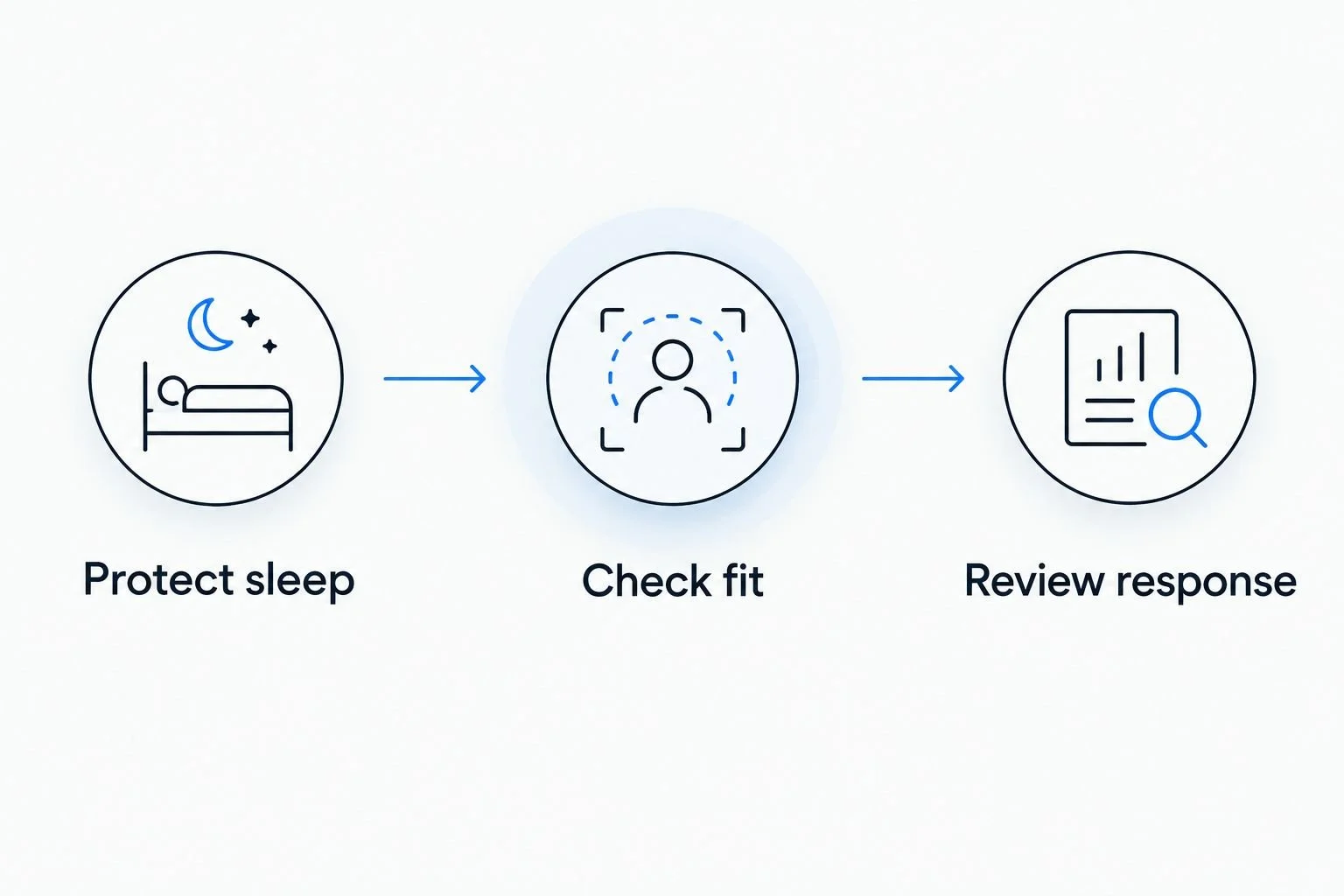
Choose recovery appointments around sleep, not the other way around.
6. Review usefulness without changing everything at once
Use a free diary before adding tracking devices or more services. Compare similar shifts where possible and record the outcome you selected at the start. A notebook entry can capture a practical problem that a readiness score misses, such as an appointment leaving too little time to eat before bed.
Keep exercise and other optional recovery changes reasonably consistent while you assess whether the session fits. Adding several therapies and supplements together makes attribution difficult. You cannot tell which change helped—or which added unnecessary effort.
Live Superhuman also offers hyperbaric oxygen therapy, PEMF, EWOT, and altitude training. Their availability does not mean you need to combine them with red light therapy. Start with a clear goal, not a stack of services.
Record the session alongside shift type and sleep opportunity.
Repeat the same subjective measure each time.
Note comfort, travel burden, and missed obligations.
Avoid adding multiple new recovery interventions together.
Reconsider sessions that consistently interfere with your priorities.
7. Keep circadian care and supplements separate
Manage your sleep–wake schedule as its own issue. Light reaching the eyes is a major signal for circadian timing, while red light therapy sessions are not a substitute for an individualized shift-work sleep plan. Persistent sleepiness at work needs attention even if your muscles feel recovered.
Supplement timing also belongs in a separate decision. Questions about when to take magnesium glycinate should be considered around your actual sleep period, medication interactions, and whether supplementation is appropriate—not a default bedtime on the clock. Do not add a supplement simply because you have booked a light session.
For your 2026 routine, keep the categories distinct: sleep scheduling, recovery appointments, and healthcare decisions. That separation makes it easier to identify what needs changing when fatigue persists.
Discuss ongoing shift-related sleep problems with a qualified clinician.
Seek individualized advice before using bright light to shift sleep timing.
Review supplements with a clinician or pharmacist when appropriate.
Never use perceived recovery as permission to drive while drowsy.
Treat recurring near-misses or unintended sleep episodes as safety concerns.
Compare your recovery options in 2026
The best option depends on the problem you are solving. Sleep protection addresses insufficient sleep opportunity; a light session does not. The table separates practical advantages from limitations without treating different approaches as equivalent therapies.
Protected sleep and schedule planning
Best for: Shift workers losing sleep to competing obligations
Practical advantage: Directly prioritizes sleep opportunity without extra equipment
Key limitation: Work and household demands can restrict what you control
Home red light device
Best for: People prioritizing use without appointment travel
Practical advantage: Fits around your own calendar
Key limitation: You handle device selection, setup, instructions, and consistent use
Live Superhuman red light therapy
Best for: People preferring bookable studio sessions
Practical advantage: Access to studio sessions without purchasing home equipment
Key limitation: Requires appointments and travel; no established guarantee of shift-work outcomes
Clinical sleep assessment
Best for: People with persistent insomnia, excessive sleepiness, or suspected sleep disorders
Practical advantage: Evaluates symptoms that a wellness visit does not diagnose
Key limitation: Requires healthcare access and follow-through
Choose according to need rather than treating the table as a ladder. A clinical assessment is not an upgrade from a studio session; it serves a different purpose. Likewise, buying a home device does not establish that its specifications match equipment used in published research.
Common mistakes nurses and shift workers make
Treating red light as a replacement for sleep
Feeling more comfortable is not the same as restoring attention after inadequate sleep. Keep your sleep plan and workplace fatigue procedures in place even when you enjoy recovery sessions. Do not use a positive post-session feeling as evidence that you are safe to drive.
Copying someone else's exposure schedule
Distance, exposure duration, treatment area, and device output all affect the light delivered. A schedule shared by a coworker is not automatically appropriate for different equipment. Follow the instructions for the device in use rather than trying to match a social-media routine.
Booking immediately after every difficult shift
An appointment can become another demand when you need to get home and sleep. Judge the entire visit, including travel and waiting, against your next sleep opportunity. Convenience means fitting your real day—not simply finding an open appointment.
Expecting evidence from another audience to settle the question
Research involving athletes, skin applications, or localized symptoms does not automatically establish benefits for nurses on rotating shifts. Ask whether a claim concerns your actual goal and the equipment used. Reject promises that light exposure compensates for sleep loss or guarantees better performance at work.
FAQ
Does red light therapy help shift workers sleep better?
Red light therapy should not be relied on as a treatment for shift-related sleep problems. Protect your sleep opportunity and seek assessment for persistent insomnia or excessive sleepiness rather than assuming a recovery session will correct your sleep schedule.
Should I book red light therapy before or after a night shift?
Choose the time that preserves your next sleep opportunity and allows you to follow the device instructions. There is no universal before-shift or after-shift timing rule, and a session should not delay needed sleep.
Is red light therapy the same as bright-light therapy for night workers?
No. Red light therapy and bright-light strategies for circadian timing have different purposes and exposure considerations; do not substitute one for the other without appropriate guidance.
Can nurses use red light therapy while taking medication?
Medication-related suitability requires a review of the specific medication and device warnings. Ask your prescribing clinician or pharmacist about light-sensitivity concerns, and tell the session provider about relevant medications.
Is home red light therapy better than a studio session?
Neither format is automatically better for every shift worker. Home use avoids appointment travel but puts equipment selection and setup on you; studio use provides session access but requires scheduling and travel.
How long should a red light therapy session last?
Session duration should follow the instructions for the specific device and intended use. Do not copy an exposure time from unrelated equipment or assume that longer exposure delivers better results.
Can red light therapy replace recovery sleep after a long shift?
No. Red light therapy does not replace sleep, and feeling physically recovered does not establish that your attention or driving safety has recovered after sleep loss.
One last thing
The easiest recovery variable to overlook is the journey. Before booking, put the entire visit on your calendar—from leaving work or home to returning—and check what it displaces. If a recovery appointment takes away needed sleep, protect the sleep.