Altitude training is not automatically safe for beginners; a safe starting decision depends on your health, the type of exposure, and how closely your response is monitored. Start conservatively, disclose relevant health conditions, and stop for concerning symptoms rather than treating discomfort as proof that a session is working.
TL;DR
Is altitude training safe for beginners? Health screening, conservative exposure, and clear stopping rules matter more than fitness alone.
Simulated altitude and mountain travel involve different exposure conditions; neither is automatically risk-free.
Live Superhuman offers bookable altitude training sessions for clients focused on recovery and performance.
Chest pain, fainting, confusion, or severe breathlessness require urgent medical attention, not another training interval.
Is altitude training safe for beginners?
Beginner status alone does not determine safety. Your health history, the oxygen conditions, exercise intensity, and the ability to end exposure all matter. Being an experienced runner does not establish that reduced-oxygen training is appropriate for you.
Before starting, follow this sequence:
Identify the exposure. Ask whether you will exercise in reduced-oxygen air, rest during intermittent exposure, or train at natural elevation.
Review your health. Discuss relevant conditions, symptoms, medications, and previous altitude problems with a qualified healthcare professional.
Understand the supervision. Ask who monitors you, what they monitor, and how you can stop immediately.
Start below your usual effort. Do not combine unfamiliar oxygen conditions with a maximum-effort workout.
Review your response. Report symptoms during the session and afterward before increasing exposure.
For the separate question of adaptation, see how long it takes to adapt to altitude training. Feeling comfortable during an initial session is not proof that you are ready for longer or harder exposure.
Why this matters
At altitude, oxygen remains present in the air, but lower atmospheric pressure reduces the oxygen pressure available with each breath. Simulated-altitude equipment generally creates reduced-oxygen conditions by changing the oxygen concentration instead.
That distinction matters. A supervised studio session and an overnight mountain stay do not create identical exposure, and a setting described as an equivalent elevation does not establish an individual's safety.
The CDC Yellow Book 2026 chapter on high-altitude travel states that physical fitness does not protect against altitude illness. Your normal training capacity is not a clearance test for altitude.
Which kind of altitude training are you considering?
The phrase covers different experiences. Ask what actually happens during the session before comparing benefits, risks, or suitability.
Supervised simulated-altitude session
Best for: Beginners seeking an introduction without mountain travel
Practical advantage: Exposure can be ended without descending a mountain
Limitation or concern: Safety still depends on screening, settings, monitoring, and response
Training at natural elevation
Best for: People preparing for activity in a mountain environment
Practical advantage: Includes the actual environment in which you will exercise
Limitation or concern: Travel, sleeping elevation, weather, and access to care complicate exposure
Ordinary-air exercise
Best for: Beginners establishing a training baseline
Practical advantage: Avoids the added reduced-oxygen exposure
Limitation or concern: Does not provide altitude-specific exposure
These are different choices, not a ranking of guaranteed results. A beginner with unresolved symptoms should not use the table to self-clear for training.
Is a breathing-resistance mask the same thing?
A mask that makes breathing harder does not necessarily reduce inspired oxygen in the way a simulated-altitude system does. Resistance and reduced oxygen are different training conditions.
Ask what the equipment changes. A label such as altitude mask is not enough information to establish what you are breathing or how the session should be supervised.
What should you check before your first session?
A useful preparation checklist covers Health review, Session details, Monitoring, and Stop rules. Each answers a different safety question; none replaces the others.
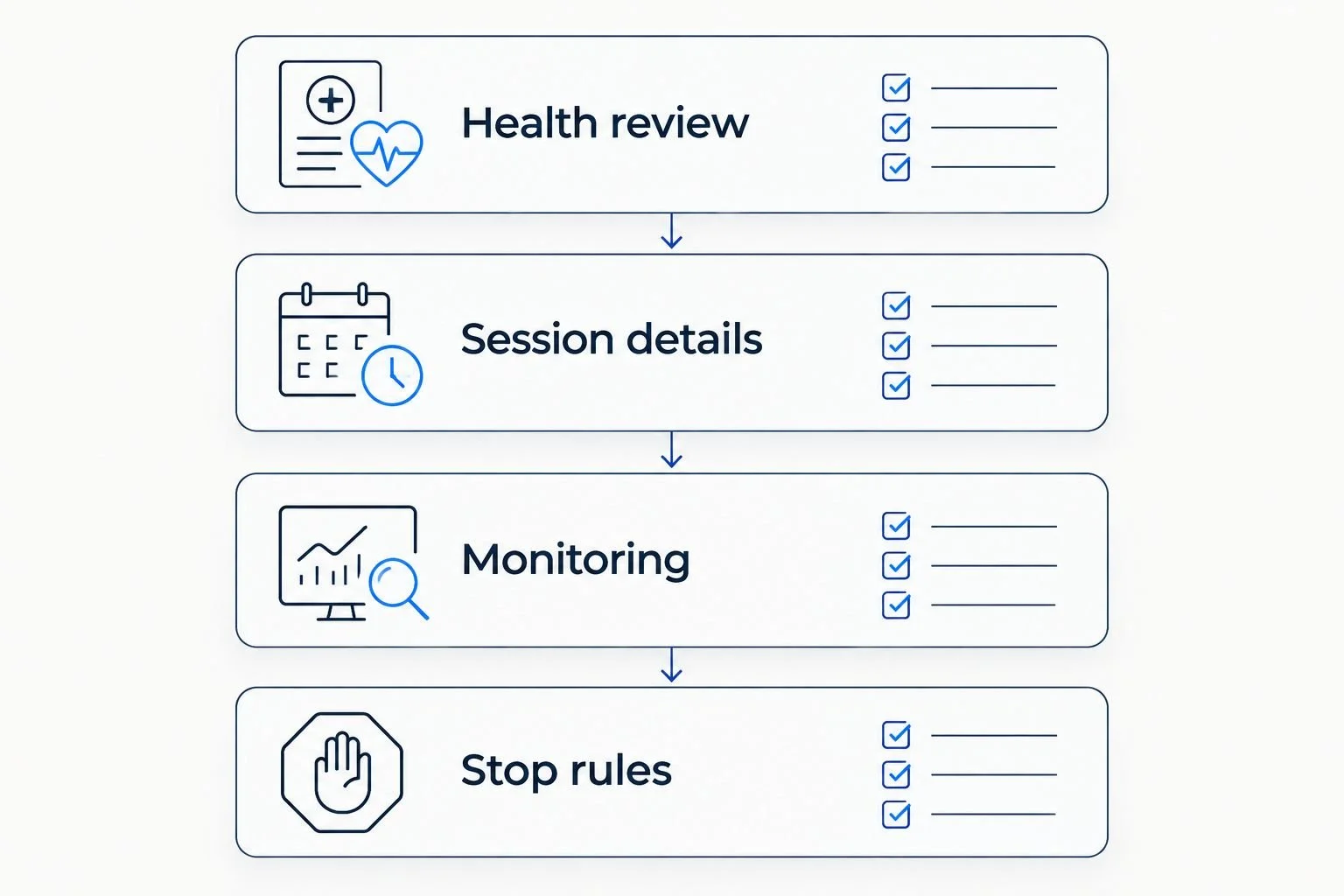
Screening and clear stopping rules belong in the same preparation checklist.
Health review
Tell the provider about heart or lung conditions, anemia, pregnancy, recent illness, unexplained breathlessness, fainting, and previous problems at altitude. Ask your healthcare professional whether reduced-oxygen exposure is appropriate before booking when any of these apply.
Do not assume a familiar condition is irrelevant because it is well controlled. The useful question is whether your current health and treatment are compatible with the planned exposure, not whether you generally consider yourself healthy.
Session details
Ask whether the session involves exercise or rest, continuous or intermittent exposure, and how the operator selects the starting conditions. Request a plain-language explanation rather than accepting a technical setting without context.
You should also understand how you return to ordinary air. Do not begin a session if you cannot explain how to signal discomfort or end exposure.
Monitoring
Ask what staff track and how they respond when symptoms or measurements change. A pulse oximeter estimates blood oxygen saturation, but it does not replace observation, symptom reporting, or clinical judgment.
The FDA's pulse-oximeter guidance identifies limitations involving factors such as circulation, skin pigmentation, skin temperature, and nail polish. A reassuring display is not a reason to ignore chest pain, faintness, or unusual breathlessness.
Stop rules
Agree on the reasons to pause or stop before exposure begins. Report symptoms immediately instead of waiting to see whether you can tolerate them.
A safe stopping decision is more important than completing the planned session. You do not need to earn permission to stop by reaching a particular reading or level of discomfort.
Why altitude-training risk varies
There is no universal beginner setting that makes every session safe. These factors change the demands placed on you:
Health status: Heart, lung, blood, and other health conditions affect whether reduced-oxygen exposure is appropriate.
Exposure level: Natural elevation and simulated oxygen conditions determine the environmental challenge.
Exposure duration: A brief supervised session differs from spending an entire night at elevation.
Exercise intensity: Hard exercise adds demand during an already unfamiliar exposure.
Previous altitude response: A history of altitude illness belongs in your screening discussion.
Ability to stop: Immediate access to ordinary air or descent matters when symptoms develop.
For your 2026 training plan, change unfamiliar demands conservatively rather than increasing exposure and exercise intensity together. Otherwise, it becomes harder to identify what caused an uncomfortable response.
What symptoms mean you should stop?
Stop exercise and end reduced-oxygen exposure if you develop dizziness, headache, nausea, or unusual shortness of breath. Tell the person supervising you; do not hide symptoms to finish the session.
Chest pain, fainting, confusion, difficulty walking normally, or severe breathlessness require urgent medical attention. If symptoms are severe, persistent, or worsening, call emergency services rather than driving yourself or waiting for a recovery treatment.
During mountain travel, headache accompanied by nausea, dizziness, or unusual fatigue after ascent can indicate acute mountain sickness. Do not ascend higher while symptomatic; worsening symptoms require descent and medical assessment.
Symptoms in a studio do not automatically establish altitude illness. They still require stopping and assessment rather than an assumption that they are harmless adaptation.
How high is high enough to raise concern?
The CDC Yellow Book 2026 identifies unacclimatized travelers sleeping at approximately 2,450 meters, or 8,000 feet, and above as being at risk of altitude illness. Susceptible people can develop problems at lower elevations, so that figure is not a boundary below which everyone is safe.
For mountain travel above 3,000 meters, CDC guidance recommends limiting increases in sleeping elevation to 500 meters per day and allowing additional acclimatization time. These figures concern mountain ascent and sleeping elevation, not a prescription for a studio session.
Do not translate those travel figures into a target on simulated-altitude equipment. The exposure pattern, exercise demand, and supervision differ, and a beginner does not need to reach a particular equivalent elevation to justify the visit.
How should your first session fit into your training?
Make the first exposure a learning session rather than a performance test. Arrive ready to explain your recent training, current symptoms, and what you want from the experience.
Do not use a hard workout beforehand to prove readiness. If you already feel unwell, unusually exhausted, or short of breath, postpone and address the reason rather than adding reduced-oxygen exposure.
During the session, follow the agreed effort level and report changes promptly. Afterward, record how you felt during exposure and later that day so you can give a clear account before the next visit.
For a 2026 training log, useful entries include the activity, perceived effort, symptoms, and the operator's description of the exposure. Keep the record factual; a difficult session is not automatically a productive one.
Should beginners train harder at simulated altitude?
Beginners should not use their usual maximum effort as the starting target for simulated-altitude exercise. Establish tolerance under supervision before considering progression, and keep symptoms—not competitive pride—central to the decision.
Does feeling fine mean you can increase exposure?
Feeling fine during a session does not establish that a harder or longer session is appropriate. Review the full response, including symptoms afterward, before changing the next session.
Where does a wellness-studio session fit?
Live Superhuman is best suited to clients seeking bookable wellness-studio sessions for recovery and performance goals, rather than a mountain-travel itinerary. Altitude training is among its stated offerings, alongside hyperbaric oxygen therapy, red light therapy, PEMF, and EWOT.
The convenience of a studio session does not establish personal suitability or replace medical clearance. Before booking Live Superhuman altitude training, ask about the session format and supervision, including screening, monitoring, and stopping procedures.
Ask specific questions rather than requesting a promise that the experience is safe. You need to understand what happens, who is responsible during exposure, and what happens if you feel unwell.
FAQ
Is altitude training safe for beginners who are not fit?
Low fitness alone does not determine altitude-training safety, and high fitness does not protect against altitude illness. Your health, planned exposure, exercise demand, and supervision matter more than a fitness label.
Do I need medical clearance before altitude training?
Seek medical guidance before altitude training if you have relevant health conditions, are pregnant, have unexplained symptoms, or have previously had altitude problems. Give your healthcare professional the actual session details rather than only its marketing name.
Can I get altitude sickness even if I run regularly?
Yes, regular running does not protect against altitude illness during mountain travel. The CDC Yellow Book 2026 specifically states that physical fitness does not influence altitude-illness risk.
What oxygen saturation is safe during a beginner session?
There is no single oxygen-saturation target that makes every beginner session safe. A qualified professional should interpret readings alongside your health, symptoms, exposure conditions, and the device's limitations.
Is simulated altitude safer than going to the mountains?
Simulated altitude allows exposure to end without a mountain descent, but that does not make every session safe. Screening, supervision, exercise intensity, and your individual response still matter.
Should I keep going if I get a headache?
No, report a headache and stop reduced-oxygen exposure rather than pushing through it. During mountain travel, do not ascend higher while you have symptoms of altitude illness.
Can I book altitude training at Live Superhuman as a beginner?
Live Superhuman offers bookable altitude training sessions, but beginner suitability requires a discussion about your health and the planned session. Confirm screening, supervision, and stopping procedures before booking.
One last thing
A good first session leaves you with information, not a story about how much discomfort you endured. For your 2026 training plan, write down this question before booking: What exactly happens if I feel unwell?
If you cannot get a clear answer, do not start. The ability to stop is part of preparation, not a backup plan you discuss after symptoms appear.
Related guides
By Kelley Gast