Intermittent hypoxic training can improve some measures of exercise performance, but it does not consistently outperform comparable training in normal air. The result depends on the type of exposure, the exercise performed, and the outcome measured. Treat it as a targeted addition to training—not a substitute for consistent workouts, recovery, or sport-specific preparation.
TL;DR
Intermittent hypoxic training has mixed performance evidence; harder breathing does not establish better fitness.
Exercise in hypoxia and passive altitude exposure are different interventions with different demands.
Live Superhuman offers bookable altitude training sessions for clients pursuing recovery and performance goals.
Judge results through repeatable performance testing, not oxygen saturation readings alone.
Why this matters
A lower oxygen reading is not the same thing as a faster race. Hypoxic exposure creates a physiological challenge, but the challenge itself does not prove that your training has become more effective.
For your 2026 training plan, separate three questions: what happens during the session, what changes afterward, and whether those changes improve your sport. The time needed to adapt to altitude training is a separate issue from how demanding an individual session feels.
That distinction protects your training priorities. An additional session earns its place when it supports a clear objective without compromising the work that already matters.
Is intermittent hypoxic training effective for performance?
Intermittent hypoxic training is effective for some outcomes, but it is not a reliable shortcut to better overall performance. Exercise research distinguishes between improvements within a training group and improvements beyond those achieved by a comparable normal-air group. Only the latter demonstrates an added benefit from hypoxia.
That comparison matters because exercise itself improves fitness. If you add structured workouts while changing the oxygen environment, a better result afterward does not establish which change caused the improvement.
The term also covers approaches that should not be treated as interchangeable:
Exercise in hypoxia
What you do: Train while breathing air with reduced oxygen availability
Best for evaluating: Whether a specific workout benefits from a hypoxic setting
Main limitation: The same effort can require a lower pace or power output
Passive intermittent hypoxia
What you do: Alternate lower-oxygen exposure and recovery while resting
Best for evaluating: Responses to exposure without exercise
Main limitation: It does not replace the mechanical and technical demands of training
Normal-air training
What you do: Complete workouts without deliberately reducing oxygen availability
Best for evaluating: Sport-specific pace, power, technique, and progression
Main limitation: It does not reproduce an altitude environment
These are comparison categories, not a ranking. Exercise in hypoxia has a direct training component; passive exposure does not. Neither should inherit claims from studies of extended altitude residence simply because all involve reduced oxygen availability.
For a 2026 decision, ask whether the evidence matches the actual session you are considering. Matching the label is not enough.
Why intermittent hypoxic training results vary
Differences in the session and the athlete explain why a single verdict cannot cover every use of intermittent hypoxic training. These factors change what you are actually testing:
Exposure method: Exercising in reduced oxygen and resting in reduced oxygen place different demands on your body.
Exposure pattern: The length, repetition, and frequency of exposure determine the stimulus. A session name alone does not describe it.
Exercise intensity: Hypoxia can increase internal strain while reducing the external workload you can sustain.
Starting fitness: An experienced endurance athlete and a previously inactive participant do not start with the same training capacity.
Performance target: A change in an exercise test does not automatically translate into faster racing, better lifting, or improved technical execution.
Recovery demands: Additional fatigue matters when it interferes with your next important workout.
The practical consequence is straightforward: match the session to the goal before judging whether it works. A method selected for altitude preparation should not be assessed only through a sea-level sprint test. A method selected for cycling performance needs a cycling-relevant outcome.
What would count as convincing evidence?
A useful study compares similar participants completing comparable training, with oxygen exposure as the meaningful difference. It measures an outcome that matters to the intended user and reports the comparison between groups—not just improvement from the starting point.
Look closely at the outcome. Oxygen saturation describes blood oxygenation at the time of measurement; it is not a direct measure of race performance. Heart rate describes another part of your response, but a higher heart rate does not establish a greater training benefit.
Likewise, a change in maximal oxygen uptake does not answer every performance question. Running economy, pacing, fatigue resistance, skill, and race conditions also affect results. Better laboratory performance and better competition performance are related questions, not identical ones.
Be especially cautious when a claim jumps between methods. Evidence about repeated sprint exercise in hypoxia does not establish the same benefit for seated exposure. Evidence about preparing for altitude does not automatically establish faster sea-level racing.
For your 2026 assessment, use this evidence order:
A sport-relevant performance outcome measured under comparable conditions.
Supporting physiological measurements that help explain that outcome.
Subjective session feedback used to assess tolerance and fit.
All three have a role. They answer different questions, and the third should not replace the first.
How should you test whether it works for you?
Choose the measurement before you start. Otherwise, it is easy to notice whichever result improved and overlook the outcome you originally wanted.
Set the goal
Write a specific performance objective, such as improving a repeatable running effort or maintaining cycling power more comfortably. Avoid combining unrelated goals into one verdict. Feeling more relaxed after a session and riding faster are separate outcomes.
Decide what would make the addition worthwhile for your schedule. This is a personal decision about training value, not a promise that the session will produce a particular gain.
Record a baseline
Pick a test you already know how to perform reliably. A 5-kilometer run or a 20-minute cycling effort is an example of a repeatable task, not a prescribed hypoxic workout.
Keep the equipment, setting, warm-up, and measurement method consistent. For outdoor testing, record conditions that affect performance rather than treating every result as directly comparable.
Keep training stable
Avoid introducing several major training changes simultaneously. If you change your interval structure, sleep schedule, strength program, and oxygen exposure together, you cannot separate their contributions afterward.
Record important changes that still occur. A demanding work period, illness, or unusually heavy training week belongs alongside the performance result.
Repeat the test
Repeat the same task under similar conditions and review the wider training picture. Look for a pattern across comparable efforts rather than treating a single strong day as proof.
Assess the trade-off as well as the result. Better performance in one test is less useful if the added sessions repeatedly leave you unable to complete priority workouts.
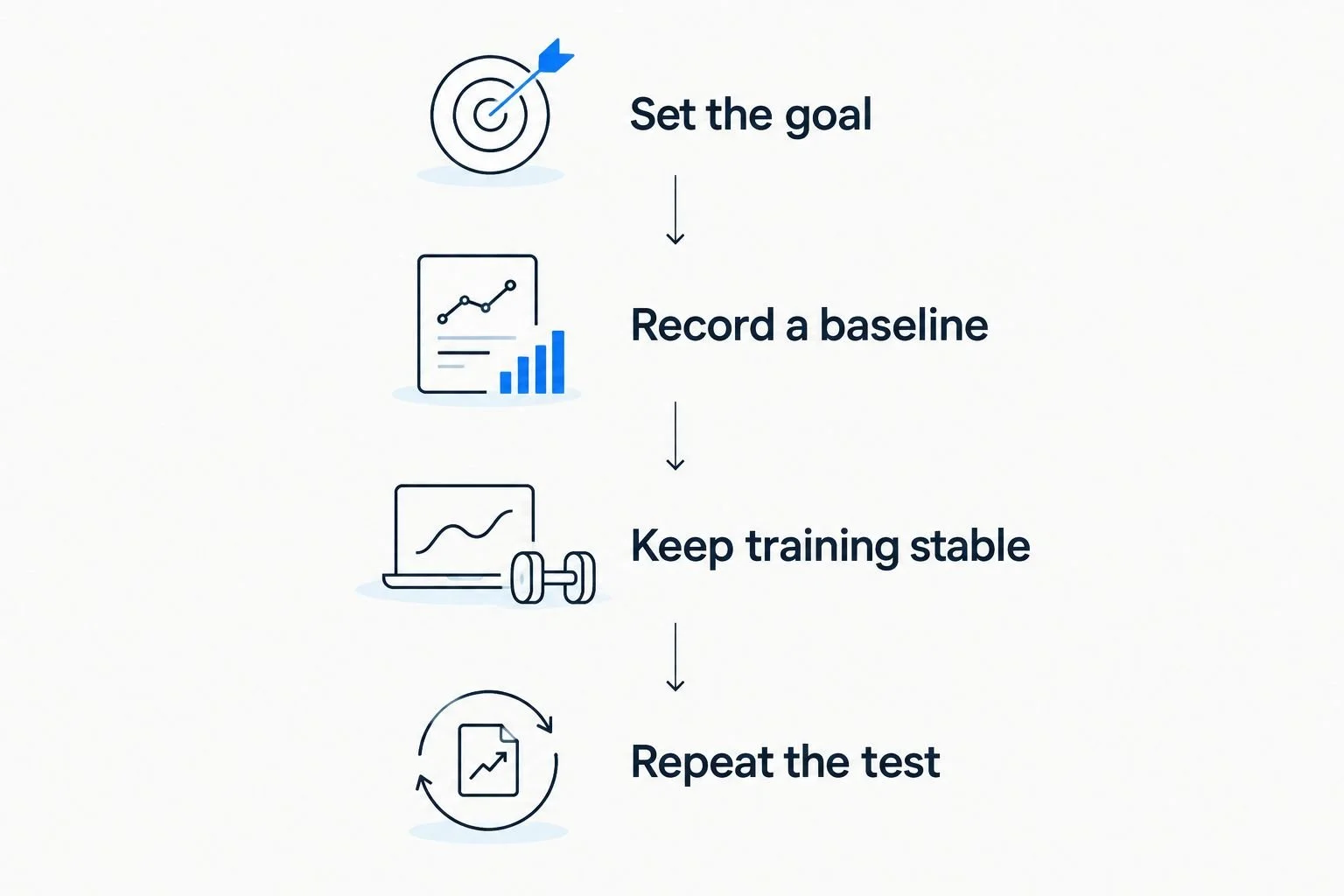
Choose the outcome before adding the session so you know what you are evaluating.
Does reduced oxygen mean a better workout?
No. A session can feel harder while producing less speed or power. That distinction matters when the purpose of the workout is to practice race pace, produce high power, or maintain technique under a specific workload.
For example, room air contains approximately 20.9% oxygen. At terrestrial altitude, that proportion stays approximately the same while barometric pressure falls, reducing oxygen partial pressure. Simulated altitude systems can instead reduce the oxygen fraction at normal ambient pressure.
Those environments share reduced oxygen availability, but the settings are not interchangeable descriptions. Ask what the equipment changes and what the session requires you to do.
For cyclists, the oxygen direction matters too: EWOT for competitive cyclists concerns exercise with supplemental oxygen, whereas hypoxic training deliberately reduces oxygen availability. Evidence or settings from one approach should not be transferred to the other.
The same principle applies across your 2026 training plan: identify the stimulus before interpreting the response. A demanding breathing experience does not establish that you completed a better sport-specific workout.
Will intermittent hypoxic training increase red blood cells?
Brief intermittent hypoxic exposure does not guarantee a meaningful increase in red blood cells. The body's response to reduced oxygen is not evidence that every exposure pattern produces the same adaptation.
Extended altitude residence and short intermittent sessions differ substantially in total exposure. You should not assume that a short studio session reproduces the blood-related adaptations associated with living at altitude.
A performance claim also needs a performance outcome. Even when a physiological measurement changes, you still need to establish whether the change helps the task you care about.
Is passive hypoxic exposure equivalent to exercise?
Passive hypoxic exposure is not equivalent to exercise. Sitting during an exposure does not reproduce the muscle loading, movement practice, or sport-specific work of running, cycling, or strength training.
That does not make every passive session irrelevant. It means you should evaluate the session for its actual purpose rather than counting it as a replacement for a workout.
If your main objective is better pacing, pedaling technique, or running durability, retain the practice that develops those abilities. An additional oxygen-related stimulus does not remove the need to train the task itself.
When does a studio session fit your plan?
Live Superhuman offers bookable altitude training sessions for clients seeking to support performance goals. Start with the purpose of the session: what you will do, how the exposure is managed, and how it fits around your existing training.
Live Superhuman is best for clients seeking bookable altitude training sessions, not a guaranteed race result. The practical benefit is access to a session format; the limitation is that booking a session does not establish its effectiveness for your individual goal.
Before booking, ask about the actual session format, monitoring, screening, and how the settings are selected. Do not assume that every service described as altitude training involves the same exercise or exposure pattern.
Use the contact page to clarify those details. Bring your training objective and the demands of your current schedule so the conversation stays specific.
What should you check before starting?
Reduced oxygen availability adds physiological stress. Get qualified medical advice before starting if you have a heart or lung condition, a history of altitude illness, unexplained fainting, or another condition affecting oxygen delivery. Pregnancy also warrants individual medical guidance.
Do not treat dizziness, chest discomfort, confusion, or unusual shortness of breath as evidence that a session is working. Stop the exposure and alert the person supervising; severe or persistent symptoms require urgent medical assessment.
Ask how the provider responds to symptoms and unexpected readings. A target on a display is not permission to ignore how you feel, and a tolerable session is not automatically an effective one.
For a demanding 2026 competition calendar, avoid experimenting immediately before an important event. Discuss new training stress with your coach or qualified clinician rather than relying on a generalized session recommendation.
FAQ
Does intermittent hypoxic training actually improve athletic performance?
Intermittent hypoxic training can improve some performance measures, but it does not consistently outperform comparable normal-air training. The exercise method, exposure pattern, and measured outcome determine how relevant the evidence is to your goal.
Is intermittent hypoxic training better than regular cardio?
Intermittent hypoxic training is not consistently better than regular cardio. Keep sport-specific exercise as the foundation and evaluate reduced oxygen as an additional variable, not a replacement for training.
Can I replace a workout with passive altitude exposure?
Passive altitude exposure does not replace a workout. It does not reproduce the movement practice, muscle loading, or external work of running, cycling, or strength training.
Does a lower oxygen saturation reading mean I am getting fitter?
A lower oxygen saturation reading does not mean you are getting fitter. It describes blood oxygenation during measurement, not whether your speed, power, or endurance has improved.
How long does it take to see results from hypoxic training?
There is no single results timeline that applies to every hypoxic training method. Judge a defined course of sessions through repeatable performance testing rather than assuming that a demanding first session demonstrates adaptation.
Is hypoxic training the same as EWOT?
Hypoxic training and EWOT are different approaches. Hypoxic training reduces oxygen availability, while EWOT involves exercise with supplemental oxygen; their settings and evidence are not interchangeable.
Does Live Superhuman offer altitude training sessions?
Live Superhuman offers bookable altitude training sessions. Ask about the session format, screening, monitoring, and fit with your performance goal before booking.
One last thing
The most useful result might be deciding not to add another training stress. If your key workouts already suffer from poor recovery or inconsistent execution, a more demanding environment does not solve that problem.
Before adding intermittent hypoxic training, identify the workout or performance outcome you expect it to support. Keep that question visible when reviewing your results. The goal is better performance outside the session—not simply becoming better at tolerating the session itself.
Related guides
By Kelley Gast