A peptide consultation is worth it when a licensed healthcare professional evaluates your goals, explains the evidence for a specific treatment, and helps you decide whether treatment is appropriate—including deciding against it. It is not worth it when the appointment is mainly a sales pitch for a predetermined package. In 2026, judge the consultation by the quality of the decision it supports, not by whether you leave with a prescription.
TL;DR
Is a peptide consultation worth it? Yes, when individualized evaluation—not a guaranteed prescription—is the outcome.
FDA approval applies to specific drugs and uses, not to peptide therapy as a category.
Ask about evidence, risks, medication sourcing, follow-up, and reasons not to proceed.
Live Superhuman offers wellness recovery sessions; peptide prescribing requires a licensed healthcare professional.
Is a peptide consultation worth it?
A useful peptide consultation buys informed judgment, not automatic access to treatment. The provider should explain what supports a recommendation, what remains uncertain, and how your health history changes the decision.
Use the following comparison to distinguish an evaluation from a transaction. These are appointment-selection criteria, not claims about any particular provider.
Individualized medical evaluation
Best for: Someone considering a specific treatment
Main benefit: Connects evidence and personal suitability
Main limitation: Does not guarantee treatment
Verdict: Consider
General educational appointment
Best for: Someone learning about options
Main benefit: Helps organize questions before deciding
Main limitation: Does not replace an individual medical assessment
Verdict: Consider for education
Predetermined package presentation
Best for: Someone seeking basic package information
Main benefit: Explains what a seller includes
Main limitation: Package details do not establish medical suitability
Verdict: Skip as a substitute for evaluation
Before booking, ask whether the appointment includes an assessment by a licensed clinician authorized to practice where you receive care. Also ask whether you can decline treatment without committing to an ongoing package.
For recovery services rather than prescribing decisions, Live Superhuman offers bookable wellness sessions. Keep those services separate from a medical evaluation of a proposed peptide drug.
Why this matters
Peptide is a broad molecular description, not a verdict on safety or effectiveness. An approved prescription medicine and a substance marketed for research do not become equivalent because both are described as peptides.
That distinction matters when your goal is better recovery, body composition, or performance. A desirable outcome does not establish that a particular substance will produce it—or that its risks are acceptable for you.
In 2026, start with the exact proposed drug and intended use. Without those details, claims about “peptide therapy” are too broad to support an informed decision.
What a worthwhile consultation should cover
A good appointment should leave you able to explain the recommendation in your own words. You should understand both the proposed benefit and the strongest reason not to proceed.
Your goal
Describe the change you actually want rather than asking for a substance by name. “I want to understand why recovery feels harder” gives a clinician a different starting point from requesting a product you saw online.
Bring relevant symptoms into the conversation rather than assuming they are a performance issue. Persistent fatigue, unexplained changes in weight, or ongoing pain deserve medical assessment, not just a discussion of wellness products.
Your history
Expect discussion of your health conditions, medications, supplements, allergies, and previous reactions to treatment. Give complete answers even when an item seems unrelated to your goal.
The clinician should explain whether an examination, existing records, or further testing is needed. A long list of tests is not automatically evidence of a better appointment; ask how each proposed test would affect the decision.
The evidence
Ask what research supports the exact substance for your intended use. Evidence about a biological mechanism is not the same as evidence that treatment improves a meaningful outcome in people.
The relevant questions include who was studied, what outcome changed, and whether the findings apply to your situation. A confident explanation should include limitations, not hide them behind technical terminology.
The follow-up
Before starting treatment, understand who handles questions, how progress will be assessed, and what would trigger a change or a stop. Ask what to do if an unexpected reaction occurs.
Do not treat access to a prescription as proof that the follow-up plan is adequate. The appointment should establish responsibility after the initial decision, not leave you to work it out later.
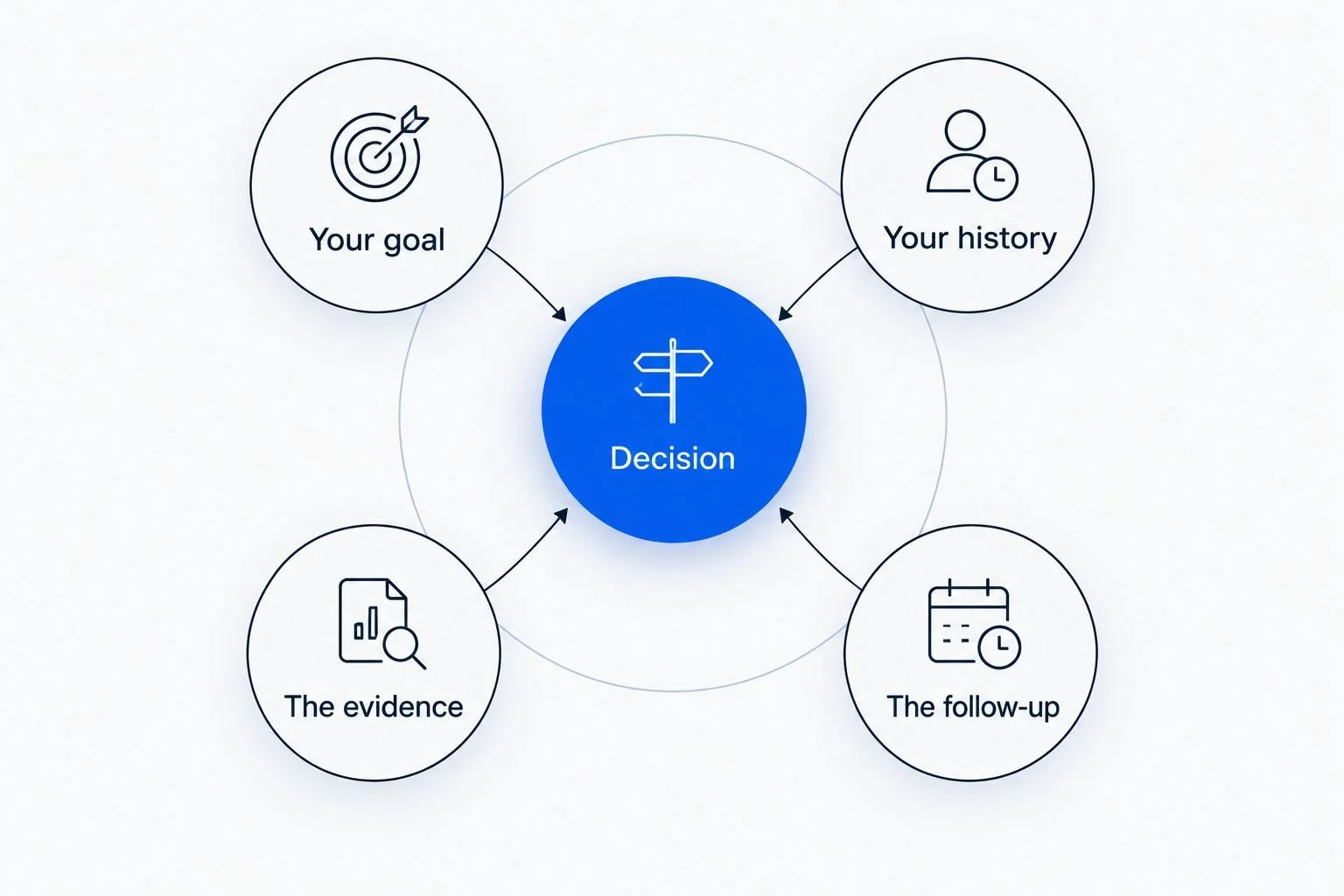
A treatment decision needs more than an explanation of the proposed substance.
Why the value of a peptide consultation varies
The appointment label tells you little about its usefulness. These factors determine whether the discussion supports a decision you can defend:
Clinical fit: Choose a clinician whose scope and experience match the concern you want assessed. Verify licensure through the relevant licensing authority.
Specificity: The discussion should identify the exact substance and intended use. Broad promises about recovery or longevity are not enough.
Evidence quality: Ask whether claims come from human clinical research, laboratory findings, or another source. Those sources answer different questions.
Independence: Ask whether the clinician can recommend no treatment and whether purchasing a package is optional.
Continuity: Find out who remains responsible for monitoring and questions after the appointment. An initial recommendation is only part of the decision.
You do not need the provider to promise success. You need a clear explanation of what is known, what is uncertain, and why the recommendation fits—or does not fit—you.
Separate approval, prescribing, and compounding
For a 2026 decision, verify regulatory status for the exact proposed drug rather than relying on a category-level statement. The U.S. Food and Drug Administration evaluates specific drug products and their approved uses; it does not approve “peptide therapy” as a single category.
FDA-approved does not mean approved for every goal
A medicine's approval for one use does not establish approval for recovery, performance, or another proposed goal. Ask the clinician whether your intended use appears in the FDA-approved labeling.
Clinicians can prescribe approved drugs off-label in appropriate circumstances. That does not make the off-label use FDA-approved, and the distinction should be part of your consent discussion.
Compounded does not mean FDA-approved
The FDA states that compounded drugs are not FDA-approved. The agency does not verify their safety, effectiveness, or quality before they are marketed in the way it does for approved drugs.
If compounding is proposed, ask why it is appropriate, which pharmacy would supply the medicine, and what alternatives exist. Do not infer that a pharmacy's involvement makes the finished preparation equivalent to an FDA-approved product.
Research labeling is a warning boundary
A substance labeled for research use is not a substitute for a prescribed medicine intended for human use. Do not self-administer a product on the assumption that a familiar peptide name establishes its identity, purity, or suitability.
Ask the clinician to explain legitimate sourcing. A seller's certificate or technical-looking report does not replace medical assessment or resolve the regulatory status of the proposed treatment.
Prepare before you book
You can make an appointment more useful without arriving with a preferred drug or a self-designed treatment plan. Prepare information that helps the clinician assess your situation.
Write your goal. Describe the change you want and how it affects everyday life or training. Separate a measurable concern from a general desire to feel optimized.
List your history. Bring current medicines, supplements, relevant conditions, allergies, and previous treatment reactions. Include information about other clinicians involved in your care.
Gather existing records. Ask the office which records are relevant before ordering anything new. Do not assume a consultation requires a particular testing package.
Request appointment details. Confirm who conducts the assessment, what it includes, and whether treatment purchases are separate. Ask how you receive the clinician's recommendations.
Keep decision space. Give yourself permission to review the information afterward. A useful consultation does not require an immediate commitment.
In 2026, use online material to prepare questions, not to select your own injectable treatment. The point of professional assessment is to evaluate details that a general article cannot resolve.
Questions that reveal the quality of the recommendation
Ask the provider to explain the case for treatment and the case against it. That comparison is more useful than asking whether a substance is “good.”
Start with these questions:
What exact outcome are we trying to improve?
What evidence supports this substance for that outcome?
Is the proposed use FDA-approved, off-label, or based on a compounded preparation?
What risks and uncertainties matter most given my history?
What alternatives should I consider, including no treatment?
What finding would make you advise against starting or continuing?
Listen for direct answers that connect to your circumstances. If the explanation repeatedly returns to general benefits without addressing your questions, pause the decision.
A provider's willingness to recommend no treatment is a useful selection criterion. It shows that the appointment can serve a purpose other than moving you toward a purchase, although it is not by itself proof of clinical quality.
What should you clarify about the ongoing commitment?
Request a written explanation of what the initial appointment includes and what is separate. Distinguish the evaluation from any medication, laboratory work, supplies, repeat visits, or continuing service arrangement.
Then ask what happens if you do not start treatment. You should understand whether you receive an assessment, written recommendations, or a referral, and whether further appointments are optional.
The same clarity matters if you start and later stop. Ask who reviews concerns, whether reassessment is needed, and how to obtain your records for another clinician.
Do not judge value solely by the amount of time booked. A longer appointment is not automatically more useful; the relevant question is whether it addresses suitability, evidence, alternatives, and follow-up thoroughly enough for an informed decision.
Is a consultation worth it if I decide against treatment?
Yes—a decision against treatment can be a useful consultation outcome. Learning that the evidence does not match your goal, that a risk deserves attention, or that another evaluation should come first gives you an actionable answer.
Ask the clinician to explain the next step rather than leaving with a vague rejection. That might mean discussing another approach with your usual healthcare professional or resolving an unanswered health question before reconsidering treatment.
Should I choose recovery sessions instead?
Recovery sessions and peptide prescribing answer different questions. A wellness service is not a substitute for medical assessment, and a prescription is not a substitute for reviewing sleep, nutrition, training load, and recovery habits.
Live Superhuman is a wellness-session option for people seeking recovery and performance support, not a substitute for peptide prescribing advice. Its stated services include hyperbaric oxygen therapy, red light therapy, PEMF, EWOT, and altitude training.
That provides a relevant service choice for someone exploring wellness sessions, but it does not establish that a particular session will address a medical concern. Discuss suitability with an appropriate healthcare professional rather than treating the service list as a treatment recommendation.
FAQ
Is a peptide consultation worth it for recovery?
A peptide consultation is worth considering when you want a licensed clinician to assess a specific recovery concern and discuss treatment suitability. It is not evidence that a peptide will improve recovery, and a prescription should not be the predetermined outcome.
Will a peptide consultation guarantee a prescription?
No—a consultation should not guarantee a prescription. An individualized assessment can reasonably end with advice against treatment, a request for further evaluation, or discussion of another approach.
Are all peptide treatments FDA-approved?
No—FDA approval applies to specific drug products and approved uses, not to peptide treatments as a category. Ask for the exact drug name and whether the proposed use is included in its approved labeling.
Do I need blood tests before a peptide consultation?
Testing depends on your health history, the concern being assessed, and the proposed treatment. Ask the clinician which tests are necessary and how each result would change the recommendation before arranging testing.
Can I buy research peptides instead of booking a consultation?
Research-use products are not a substitute for prescribed medicines intended for human use. Do not self-administer them based on online claims; discuss any proposed drug with a licensed healthcare professional.
How do I judge a peptide consultation in 2026?
Judge a peptide consultation in 2026 by its individualized assessment, explanation of evidence, discussion of risks, and follow-up arrangements. Be prepared to leave without treatment if the recommendation does not fit your circumstances.
Does Live Superhuman offer the same thing as a peptide consultation?
Live Superhuman's stated services are wellness sessions in hyperbaric oxygen therapy, red light therapy, PEMF, EWOT, and altitude training. Those sessions are distinct from a licensed clinician's assessment of a proposed peptide medicine.
One last thing
Before agreeing to treatment, ask: What would make you recommend that I do not start? Then ask what would make the clinician stop treatment after it begins.
Those questions move the conversation from promised benefits to decision boundaries. You should leave knowing not only why treatment is being considered, but also what evidence or personal circumstance would change that recommendation.
Related guides
By Kelley Gast